
The data center outlook looks bright for the Land of the Rising Sun.
When the world’s largest alternative asset manager Blackstone announced its plan to invest US$ 30 billion in Japan’s AI data centers over the next three to five years, it was record-breaking on many levels. First, it was the single biggest investment in the country for data centers, doubling the record US$ 15.2 billion pledged by AWS earlier. It also exceeded the US$ 27 billion in total investment by all western hyperscalers since 2024.
Just days earlier within the same month of June, Korean conglomerate SK Group had announced plans to build an AI factory in Japan and possibly a semiconductor business, adding to the buzz that charts increasing number of foreign investors beating a path to the country.
In recent years, Big Tech, which have long been a feature of the Japanese data center market, have expanded aggressively in Japan driven by surging demand for cloud expansion, AI workloads, 5G rollout, Internet of Things (IoT), and increasingly data sovereignty requirements.
Before Blackstone took over the crown, Amazon Web Services (AWS) was the biggest spender followed by Microsoft which has allocated about US$ 12.9 billion to fund AI infrastructure between 2026 – 2029. Also in the game is Australia-based AirTrunk which plans to spend US$ 8 billion to expand its capacity to 530MW in the next few years. Meanwhile, Oracle and Google have each committed US$ 8 billion and US$ 1 billion respectively to meet growing cloud and AI demand.
Western firms are not the only ones who saw the potential in Japan – at least six Singaporean firms have flocked to Japan enticed by the high returns in the thriving market. One of them is CapitaLand Ascendas REIT, which has purchased a 40.5-MW data center in Osaka for ¥156 billion (US$1 billion), said to be Japan’s largest single-asset data center transaction as of June 2026.
But one of the biggest changes to the data center landscape in Japan is the wave of Chinese hyperscalers descending onto Tokyo and Osaka since 2025. While their previous presence has been merely peripheral, as of 2025, an influx of Chinese companies has witnessed over 100MW of planned contracted capacity across just a few deals. This represented a huge jump from the typical contract sizes of between 1 and 3MW, according to DC Byte in its latest report.
The reasons are simple – America’s export controls on high-end chips and semiconductors targetted at China has forced Chinese firms to seek a third country to access them. Japan offers the perfect alternative having a stable economy and government complemented with high standards of labour, equipment, and data and physical security. The country also boasts unparalleled subsea cable connectivity.
Domestic players are just as upbeat, if not more so, about Japan’s potential. Heavyweights such as NTT Global Data Centers, KDDI Corporation and SoftBank Corp continue to invest heavily focusing on hyperscale, colocation, and enterprise facilities. For example, in April 2026, NTT Data Group announced it will construct one of Japan’s largest data centers. SoftBank Group has also announced it will launch in October 2026 an AI Data Center GPU Cloud, allowing its customers to leverage advanced GPU-accelerated AI computing infrastructure. As the biggest funder of OpenAI’s US$ 500 billion Stargate AI project, SoftBank is said to be bringing elements of Stargate to Japan, with a vision to transforming regions like Sakai City and Toyama into potential hubs for massive AI data centers and superclusters.
Other leading local players include Fujitsu Limited, NEC Corporation, Hitachi Systems, SCSK Corporation, and Itochu Techno-Solutions.
The top five operators in the country, comprising both locals and foreigners, dominate about 60-65 per cent of installed megawatts.The five – Equinix, NTT Data, KDDI Telehouse, Colt, and Digital Realty – leverage the latest practices that are not easy to replicate, for example, NTT utilises micro-modular builds inside its telecom exchanges to speed up service while Equinix uses district-heating loops and has inked a long-term virtual power purchase agreement (vPPA) for solar power.
Another recent announcement is by new entrant Tokyo Exchange-listed Datasection, which had recently pivoted from data analytics into AI describing itself now as a neocloud operator. It claims to be the only Japanese company developing large-scale AI clusters whilst simultaneously securing huge GPU capacity (20,000 – 30,000 GPUs), power resources and customers on a global scale.
As the examples above show, Japan is firmly on investors’ radar, both foreign and domestic. Not only is the nation the second largest data center market in the developed world after the US, demand for compute is accelerating like never before.
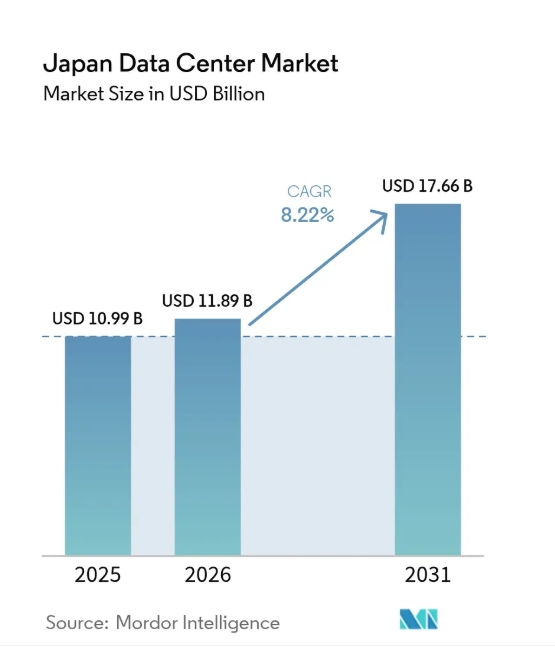
The Japan data center market size as of early 2026 is valued at about US$ 14 billion and is projected to grow at a compound annual growth rate (CAGR) of about 14.5 per cent reaching about US$ 41.2 billion by 2034, according to Fortune Business Insights. JLL meanwhile estimates that about USD $3 trillion in investment will be needed by 2030 to support the digital transformation in Japan.
Tokyo – Osaka Dominance
Tokyo and Osaka corner 90 per cent of the data center footprint in Japan. Tokyo metropolitan area alone commands 40.7 per cent of the market size. Various reasons contribute to its draw – central location, reliable power supply, direct links to trans-Pacific subsea cables, proximity to corporate headquarters, fintech trading nodes, and a dense population.
Hence, despite hefty rentals and land prices, scarcity of land as well as eye-popping power connection queues of up to 10 years, Japan’s capital city continues to be much sought-after.
There are solutions however, with the most significant being a decisive shift out of Tokyo into Osaka for expansions and new builds. The Kansai capital, which is about 500 kilometers from Tokyo, offers lower seismic risk, faster grid connection approvals, municipal incentives, and is connected by a vast network of routes. It offers geographical diversity without giving up on latency to Tokyo.
Tokyo’s power grid connection queue of between 8-10 years makes Osaka’s 3-5 years’ wait akin to the speed difference between an ordinary train and a bullet train. But even more staggering are land prices for large plots of land in Tokyo – these have shot up by 770 per cent above national averages, by some accounts. In contrast, Osaka offers abundant land at a fraction of the cost.
Not surprisingly, between 2024-2026, hyperscalers’ take-up rate in Osaka had doubled, led by Oracle, Microsoft and AirTrunk. Backed by Blackstone, AirTrunk plans to build a 100MW hyperscale data center in West Osaka, adding to its existing 20MW there.
Local operator, Mitsubishi Estate’s multi-billion-yen commitment to Kansai data centers is another example of growing confidence in this corridor. Osaka data center market is projected to grow at 13.28 per cent CAGR to 2031.
Beyond that, operators are leasing former industrial properties in suburban regions like Inzai and Akishima, which are about 30 kilometers from central Tokyo.
Accelerating Demand
Data centers are clearly proliferating at an accelerated pace in Japan. The country has the advantage of a large domestic economy, low power outage rates, world class energy infrastructure, supportive digital demographics, and extensive fibre network. A number of subsea cables are being built, the latest being the 8,100-km subsea cable connecting Japan, Malaysia and Singapore. Significantly, Google’s USD 1 billion Proa and Taihei subsea cables help improve trans-Pacific connectivity.
The Japanese government has proven to be very supportive as well. In June, PM Sanae Takaichi ‘s government unveiled a US$ 2.3 trillion planned investment for the economy which includes a massive allocation for AI and semiconductors, among others.
The government’s target of migrating all central government’s workloads to the cloud by 2025, followed by similar moves in municipals and state-owned corporations, add to the upward trajectory. Data sovereignty requirements have also accelerated joint ventures between global hyperscalers and domestic players due to the latter’s advantage in public tenders. This has resulted in a steady pipeline of government workloads over the next few years.
Another growth factor is the decommissioning of enterprise self-built server rooms which average 15 years of age, and lack seismic and energy-efficiency features. This has pushed enterprises towards Tier 3 colocation facilities creating another source of strong demand.
Demand is so high that it surpasses the available digital infrastructure to the point that hyperscalers are either self-building high capacity campuses or pre-leasing entire blocks years in advance. This has created vast opportunities for foreign investors to tap into the booming market.
Overcoming Challenges
However, rapid expansion comes with a price. Issues like electricity and water consumption, and grid strain that plague data centers elsewhere in the world are starting to bite in Japan.
But the main constraint in the country is the high cost as reflected in its high capital investment. Hyperscale data center construction costs 40–50 per cent higher than conventional facilities. Also, large scale expansions are limited in some regions due to power supply constraints and/or lack of suitable land. If suburban land is utilized, the wait time for grid connection takes up to three years, while substation upgrades would also be needed.
As a result, edge computing is gaining traction especially near manufacturing centers which require low latency. Energy-efficient data centers are becoming the standard as Tier 3 data centers become the norm. With the high heat emission from AI data centers, operators are adopting liquid cooling and integrating renewable energy to reduce power usage. This can bring down power by 20-25 per cent. Operators are also starting to adopt modular construction to reduce deployment timelines by up to 30 per cent, hence increasing investment returns.
High seismic engineering premiums are also forcing developers to optimize space in their facilities and diversify away from Tokyo/Osaka regions. But seismic risk increases construction complexity – and with a shortage of skilled personnel, it is an operational challenge facing every data center in Japan.
A shortage of specialized labour has resulted in a serious construction bottleneck unique in Japan’s DC industry. According to DC Byte, only the ‘Big Five’ general contractors are capable of building large scale data centers. Imported labour is not a good option due to cultural and language obstacles. All these factors have naturally driven up development costs. “It’s still possible now to build but one has to expect extended timelines and exercise a lot of patience,” DC Byte cautions.

Optimistic Outlook
Within APAC, Japan’s data center market leads in scale, stability and sophistication. Key trends include a wave of Chinese hyperscalers entering the market since 2025, expansion of hyperscale campuses, shifting to regions beyond Tokyo and Osaka such as Kyushu, integrating renewable energy, adopting advanced technologies such as liquid cooling, and increasing deployment of AI-ready infrastructure and edge data centers.
Rapid growth is driven by huge hyperscale spend from both western and Chinese Big Tech, government cloud mandates and massive investment, data residency requirements, and increased AI workloads.
As a result, there is strong investment potential – high returns from a stable environment that prioritizes quality on the back of long-term digital demand. There are attractive opportunities in AI infrastructure, renewables, edge facilities, green DCs, and subsea cables.
Kyushu, considered an up-and-coming third hub after Tokyo and Osaka, presents a vast opportunity for hyperscalers wanting to avoid the power and land bottlenecks in Tokyo. The island offers abundant and affordable renewable power, available land for large scale projects and proximity to East Asian hubs. A pipeline of self-builds suggests it will be increasingly used by hyperscalers as a good alternative.
Verdict: Japan is very likely at the beginning of an AI boom especially with the recent US$ 30 billion Blackstone investment and massive government allocation. High ROI is expected due to the many positive factors. There are vast opportunities for hyperscalers especially further away from Tokyo and Osaka regions.
*This article has previously appeared in Issue 13 cloud & datacenters magazine.