
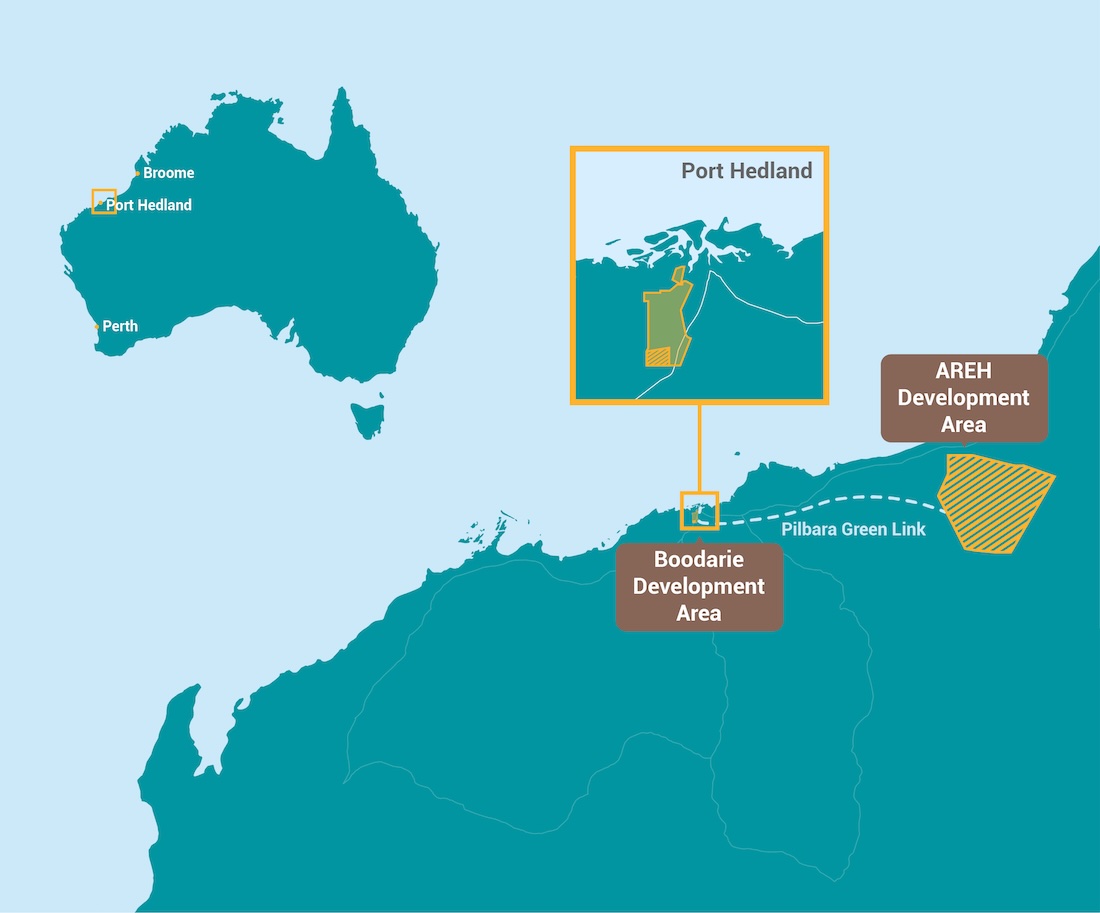
InterContinental Energy (ICE) is targeting up to 300MW of IT capacity at its Australian Renewable Energy Hub (AREH) in the East Pilbara region of Western Australia, about 2.5 hours’ drive from Port Hedland, by the end of 2029, as the company explores opportunities to combine large-scale AI compute with renewable power generation and green hydrogen production.
The company is targeting a final investment decision (FID) and construction start in the first half of 2027 for both the renewable generation and the associated data centre infrastructure, with initial AI compute potentially coming online in 2028. That said, the development timeline and capacity remain dependent on customer demand, and ICE has not disclosed whether its discussions with prospective AI compute partners have resulted in formal commercial commitments.
The proposed development would form part of AREH, a large-scale renewable energy project. ICE says its longer-term ambition remains to develop up to 26GW of wind and solar generation. Existing environmental approval covers up to 15GW, and the company says its next phase involves seeking further approvals to expand to 26GW.
Alex Tancock, CEO of ICE, told W.Media the company was seeing growing interest from AI developers, frontier labs, neoclouds and hyperscalers seeking access to large-scale renewable-powered compute.
ICE is leading development of the data centre proposition and said it is in advanced discussions with several potential AI compute partners, although it declined to disclose the status or terms of those discussions.
Instead of developing and operating the data centres itself, ICE intends to provide powered land for customers or partners to build and operate the compute infrastructure.
Combining AI compute with hydrogen production
ICE’s proposed P2(H₂)Node model is designed to integrate renewable generation, AI compute and hydrogen production within a shared energy system.
The company estimates that 300MW of IT capacity would require approximately 1GW of upstream wind and solar generation. It says the broader initial development could require more than 2GW of renewable generation to support AI compute alongside hydrogen production and other industrial customers.
Under the proposed configuration, the company expects around 2GW of upstream renewable generation to supply approximately 1GW of downstream load, of which AI compute could account for 10-50%, with the remainder used for green hydrogen production for its green iron customer. The precise split would depend on customer demand.
ICE’s figures describe different configurations, although the company did not explain to W.Media how they relate. The estimate that 300MW of IT capacity would require around 1GW of upstream generation implies roughly 3.3GW of generation per GW of IT capacity, while the node figure of around 2GW of generation supplying around 1GW of load implies a ratio closer to 2:1.
The caveat here is that the two measures are not directly comparable, as one refers to IT capacity and the other to total downstream load, and the node also shares infrastructure and hydrogen storage between its uses. ICE did not detail the overbuild and storage assumptions behind either figure.
Tancock says the load profiles of data centres and hydrogen production are mutually supportive, which it argues reduces energy costs for both customers. The company says its design work indicates that the integration of renewable generation, hydrogen production and storage could support a highly reliable power supply for AI infrastructure. Its stated design target is 100% renewable power and 99.995% uptime, although these are targets.
Initially, batteries would provide power firming, with hydrogen storage expected to play a larger role over time. Tancock also anticipates a grid connection from 2031, although its intention is for the data centres to operate behind the meter, supplied by on-site wind and solar generation. He says the Pilbara Green Link (PGL) may be able to play a role in firming, although it will principally be used to export power from AREH to customers in the Pilbara.
The numbers look good but as the company did not provide detailed storage capacity or operating data, the proposed configuration’s ability to deliver its stated reliability target can’t be independently assessed.
Power, connectivity and scale
The Pilbara’s renewable energy resources are central to ICE’s proposition. Tancock says nine years of on-site data inform its modelling of the site’s wind and solar generation profile, which it estimates could deliver a capacity factor of approximately 74% from its base renewable configuration.
He argues that the combination of strong daytime solar generation and wind generation at night could help it achieve its reliability target with less renewable overbuild than the industry has generally assumed would be necessary – the 74% figure is also modelled.
Connectivity is another consideration for a development of this scale. Tancock says existing fibre routes pass near AREH and could be upgraded, while the project has approval for four subsea cables into Asia although it wasn’t specified if these were energy or data, or potentially both.
It is important to note, the company is not developing long-haul fibre itself. Tancock says upgrades to existing fibre capacity and potential subsea connections are being discussed with carrier and customer partners, with investment dependent on confirmed demand. As a result, he clarifies, the four permitted subsea cables provide a basis for future development and not a commitment to build all four.
Tancock sees proximity to Asian markets as a potential advantage, arguing that the location could support AI compute serving customers in Australia and Asia. The commercial attractiveness of the site will depend on the eventual cost and reliability of power, connectivity investment and the requirements of prospective customers.
A phased development
AREH has been planned as a phased development, with subsequent renewable generation capacity intended to progress in line with market demand.
Tancock says the current discussions envisage AI compute scaling beyond 1GW of IT capacity after 2030, although it has not established a fixed allocation of the project’s approved or proposed renewable generation for data centres.
The longer-term development is intended to support a combination of renewable power, green hydrogen production, green iron and other industrial demand. ICE says ammonia production is no longer contemplated at AREH itself, with any future ammonia production instead envisaged at the Boodarie strategic industrial area.
The company’s plans reflect the growing interest in securing large amounts of power for AI infrastructure, but the scale and timing of the proposed compute development still have the important caveats of customer demand, investment decisions and the delivery of supporting energy and connectivity infrastructure.