
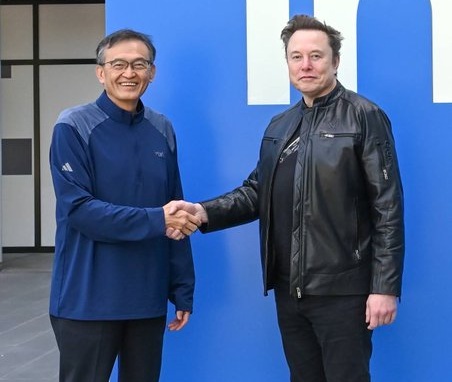
Intel, an American multinational technology company, will join Elon Musk’s Terafab AI chip complex project with SpaceX and Tesla to manufacture processors for robotics and AI data centers. As a result of this new partnership, Intel’s shares rose by 2.9 percent after the announcement and were trading at US$ 52.28 by mid-afternoon ET on Tuesday.
Readers would recall that in March this year, Elon Musk, founder and CEO of Tesla, outlined plans for Terafab, a large-scale semiconductor project that would bring chip design, fabrication, memory, and packaging into a single facility in Austin, Texas, as his companies face rising demand for AI hardware. The announcement about Intel joining forces with Terafab was first reported by Reuters, and this partnership gives Musk’s companies an experienced manufacturing partner for a project that would otherwise be difficult to execute.

Building a semiconductor fabrication plant is one of the most expensive and complex industrial projects, often costing more than US$ 20 billion and taking years to complete. Such facilities require vast clean rooms and thousands of highly specialized machines to produce advanced chips.
In a post on X, Intel said, “Intel is proud to join the Terafab project with Our ability to design, fabricate, and package ultra-high-performance chips at scale will help accelerate Terafab’s aim to produce 1 TW/year of compute to power future advances in AI and robotics.”
In a separate post on X, Lip-Bu Tan, CEO, Intel, said, “Elon has a proven track record of re-imagining entire industries. This is exactly what is needed in semiconductor manufacturing today. Terafab represents a step change in how silicon logic, memory and packaging will get built in the future.”
Tesla, SpaceX and xAI planned to build two chip factories at a site in Austin, Texas. One would make chips for Tesla vehicles and humanoid robots, while the other would support AI data centers in space.
Intel, which has been seeking major customers for its contract manufacturing business, now appears set to fill that role. The agreement gives Intel two large anchor customers as it tries to expand Intel Foundry, its chipmaking business for outside companies.
The arrangement also suggests Terafab may rely more on Intel’s existing manufacturing expertise than on a new approach developed by Musk’s companies.

Intel was once the dominant U.S. chipmaker, but appears to have lost ground in recent years to rivals NVIDIA and AMD, which design chips but outsource manufacturing. Intel has been trying to revive its position through its foundry business, even though that unit posted a US$ 10.32 billion operating loss in 2025.