
“We’re not selling GPUs. We’re selling watts turned into tokens,” said Dapeng Liu, CEO of FREYR AI. Two days at NEXTDC’s facility in Kuala Lumpur showed exactly what that takes.
The data centre industry has a habit of announcing things. Products, partnerships, “AI-ready” facilities, all unveiled with the enthusiasm of a ribbon-cutting ceremony.
But announcements don’t train models. They don’t cool over 200kW racks. And they don’t turn stranded power into tokens.
The NVIDIA Vera Rubin Workshop, convened by FREYR AI, NVIDIA, and NEXTDC, wasn’t about announcements. It was about engineering the unglamorous details that determine whether an AI factory actually ships. This was also the moment FREYR AI, as an NVIDIA Cloud Partner (NCP), stepped to the table as a regional driver. It placed chip vendor, data centre operators, and its own service strategy in the same decision-making frame.
Here are five insights from those two days. They define the next decade of AI infrastructure and shed light on the direction FREYR AI is taking.
Insight 1: The Rack Has Become a Building
Let’s start with the numbers that should make any facility manager pause.
The fully integrated rack introduces significant static and rolling-load considerations. Structural engineers must validate slab capacity, load distribution, delivery routes, and clearances before installation.
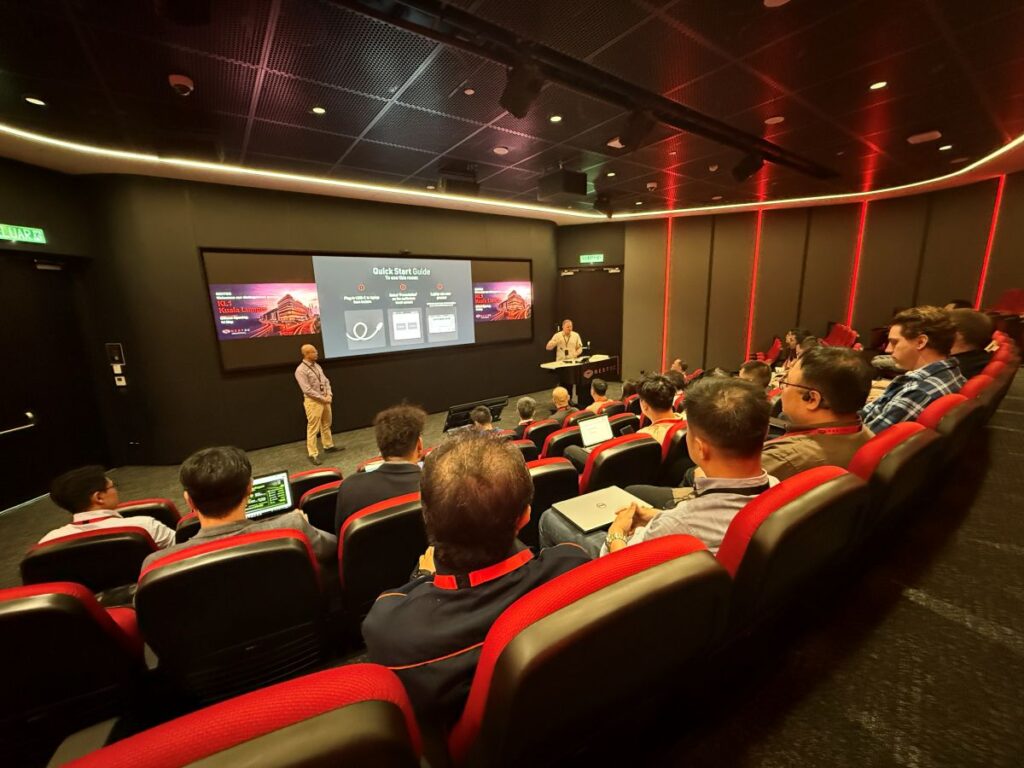
“We’re no longer deploying servers. We’re deploying buildings,” said Luke Mackinnon, Senior Vice President and Managing Director, Asia, NEXTDC.
FREYR AI’s Deployment & Operations lead, Bruce S., made it clear during Day 2’s “Bring-up, Commissioning & Day-2 Operations” session: these construction-grade workflows can’t live on paper. They must be baked into FREYR’s NCP service delivery baseline as standard operating procedure for every customer deployment. From visual inspection and UV leak checks on arrival, to every step of the liquid-cooling flush, FREYR AI is translating “building-scale” operations into a repeatable service discipline.
The insight: The boundary between “IT deployment” and “construction project” has collapsed. If your data centre team and your general contractor aren’t in the same daily stand-up, you’re not ready for NVIDIA Vera Rubin. FREYR AI has already made that stand-up a service delivery standard.
Insight 2: Static Power Allocation Is the New Stranded Capacity
Here’s a number that should keep every AI infrastructure operator awake: ~60% utilisation is the industry norm for static power allocation. The other 40%? Stranded. Paid for, cooled for, but sitting dark because workloads haven’t migrated to that rack yet.
NVIDIA’s MaxLPS (Maximum Liquid Power System) changes this equation. Instead of statically allocating power per rack, MaxLPS uses policy-driven, on-demand allocation. Idle power from one workload is instantly redistributed to an active one. Total consumption stays within budget. Throughput doesn’t.
Then there’s DSX Flex, which takes this one step further: it allows the AI factory to interact with the electrical grid itself. Scale power up when renewables are abundant. Scale down during grid stress. Avoid penalties. Get paid for flexibility.
The token economy is real. Electricity goes in. Tokens come out. Every watt of loss, whether to facility overhead, idle capacity, or static provisioning, is direct revenue left on the table.
This is the economic foundation of FREYR AI’s TokenaaS (Token-as-a-Service) proposition. During the Day 2’s session, FREYR AI CEO Dapeng Liu laid out the vision: Customers can do more than pay for GPU-hours. They can also pay for tokens delivered. That means FREYR’s own power scheduling efficiency directly determines both margin and pricing competitiveness. Earlier, on Day 1, FREYR AI CFO Ian Wong had framed the core business logic: FREYR’s model isn’t to sell hardware, but to maximise the “watts-to-tokens” conversion efficiency through operational excellence. This makes customers and FREYR both win.
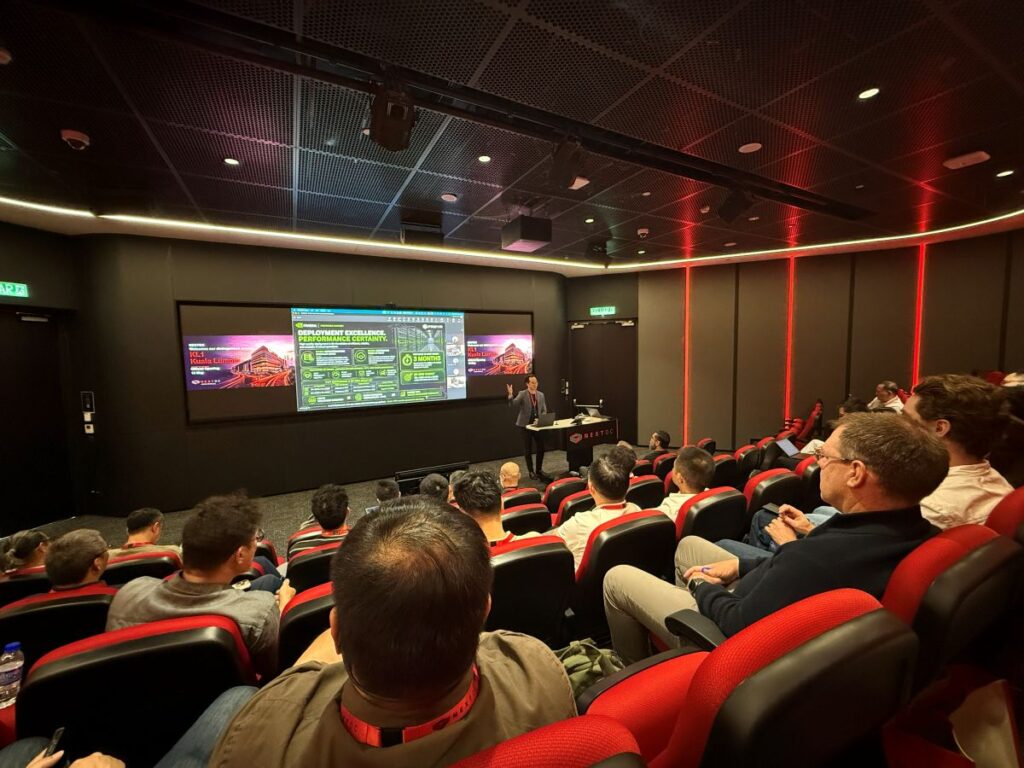
The insight: The most valuable software in your AI factory may not be your training framework. It’s your power scheduler. FREYR AI is turning it into a billable business.
Insight 3: The Network Is the Cluster
We used to think of networking as “plumbing between servers.” That model is now obsolete.
With Vera Rubin, each rack contains 72 NVIDIA Rubin GPUs with ConnectX-9 SuperNICs, doubling connectivity speeds and supporting clusters of up to 128K GPUs in a two-layer, single-rail topology. Spectrum-X isn’t just “faster Ethernet.” It’s a highly-resilient multi-rail, multi-plane architecture purpose-built to minimise east-west latency and communication bottlenecks for GPU-to-GPU communication at AI Factory scale.
And the cabling? Over 100 fibres per rack. The team had to reinforce cable trays, choose direct MPO port-to-port connections over termination panels (to eliminate intermediate failure points), and pre-lay fiber during the renovation phase. Doing it after the fact isn’t viable.
Storage got the same treatment. Context Memory eXtension (CMX) places NVMe storage racks adjacent to GPU racks to serve KV-cache for inference. In the token economy, every microsecond of read latency is a measurable hit to tokens-per-second.
FREYR AI contributed a one-page English pre-read covering its service and operational requirements. It explicitly stated expectations for Spectrum-X topology, CMX storage interfaces, and site management integration. This wasn’t passive acceptance of a reference design. It was FREYR AI, as an NCP, actively defining which architectural decisions directly impact SLA. It made sure those decisions land in the design phase, not as retrofits.
The insight: Your network topology isn’t infrastructure. It is the computer. And FREYR AI is making sure that computer is born service-grade from day one.
Insight 4: Multi-Tenancy Without Multi-Headaches
One of the most technically sophisticated and commercially important discussions of the workshop centred on BlueField DPUs and the DOCA Platform Framework (DPF).
For cloud providers and NCPs serving multiple customers from a shared Vera Rubin cluster, multi-tenancy has always meant a painful trade-off: isolation vs. performance. BlueField changes that. Hardware-enforced zero-trust policies, orchestrated via Kubernetes, mean tenants get bare-metal performance with cloud-grade isolation. Network policies, encryption, and firewalling happen on the DPU, not on the CPU, not on the GPU.
“You don’t choose between security and speed anymore. The DPU gives you both,” said the NVIDIA Networking Team.
This isn’t just a technical win. It’s the enabler for Sovereign AI: the ability for enterprises to deploy their own AI clusters with IP protection, compliance, and performance guarantees, without surrendering data to a public cloud.
This is the architectural cornerstone of FREYR AI’s third service pillar: Sovereign AI. Dapeng Liu made the case that enterprise customers across Southeast Asia have fundamentally different data sovereignty requirements than hyperscale cloud users. They don’t need to send data to Silicon Valley. They need local AI capability with public-cloud performance and private-cloud control. BlueField DPU makes it possible for FREYR AI to deliver that: “public-cloud experience, private-cloud control.” This is where GPUaaS and Sovereign AI converge commercially. FREYR AI is the integrator making it real.
The insight: Sovereign AI isn’t a political slogan. It’s a DPU configuration. FREYR AI is turning it into a real enterprise choice across Southeast Asia.
Insight 5: Why “We Got an Alert” Is the Most Dangerous Phrase in AI Ops: Inside FREYR AI’s Signal-to-Action Engineering
Here’s a quiet revolution underway. It might be the most important operational insight of the entire workshop.
DCGM (Data Center GPU Manager) generates a massive stream of telemetry. The problem isn’t too little data. It’s that critical signals are drowning in noise. Reduce alerts too aggressively and you miss real failures. Keep them all and you train your team to ignore them.
Enter the Signal Contract: a logical framework (not a commercial SLA) that links system logs, failures, and actions into a documented evidence chain with clear owners. AI agents assist: they collect signals, analyse cases, and suggest next steps. But they operate read-only in production. Final decisions stay human.
“Agents don’t flip switches. Engineers do. The agent’s job is to make sure the engineer has the right answer in three minutes instead of thirty,” said the FREYR AI Operations Team.
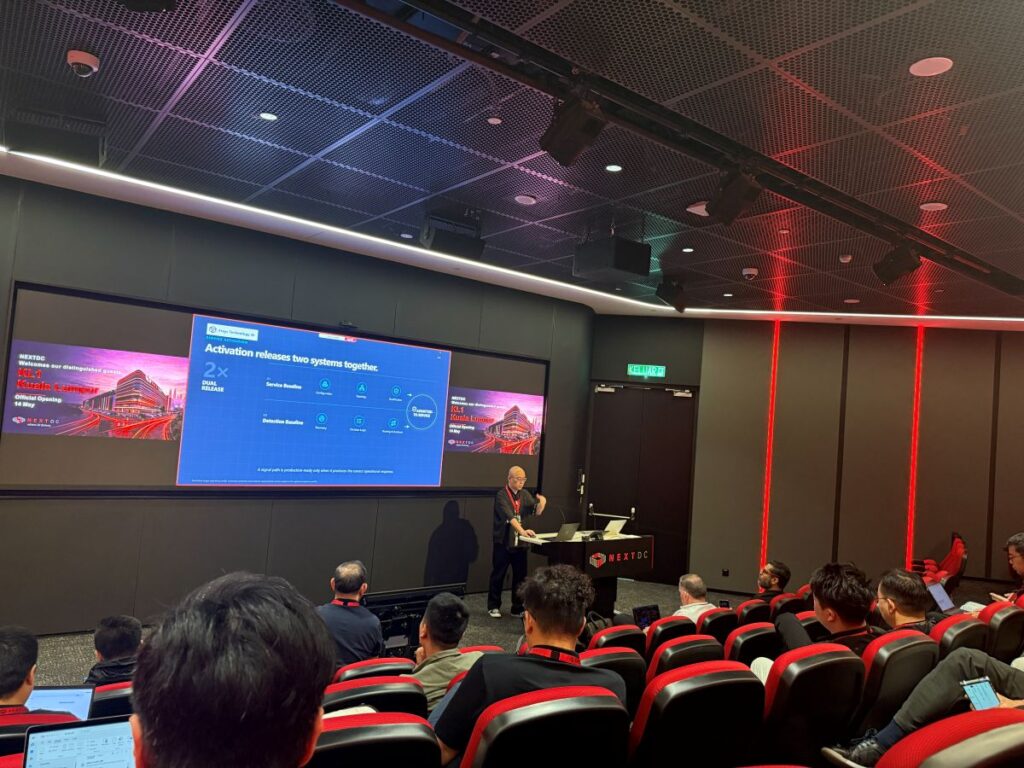
Two baselines gate service release: Service Baseline (capacity readiness, configuration) and Detection Baseline (problem identification and handling). Nothing ships until both pass.
This framework is the operational backbone of how FREYR AI turns “AI factory operations” from a concept into a deliverable service. Bruce S. defined FREYR’s service-acceptance point, go-live gates, monitoring ownership, incident and change processes, customer-support boundary, and Day-2 operating model. The Signal Contract and dual baselines are the underlying discipline. For FREYR AI’s customers, this means: when you buy GPUaaS or TokenaaS from FREYR, you’re not buying powered-on GPUs. You’re buying a validated, accountable operating system.
The insight: In AI factory operations, the most dangerous phrase isn’t “the cluster is down.” It’s “we got an alert but we weren’t sure what it meant.” FREYR AI’s Signal Contract ensures that sentence never appears in a customer incident report.
The Bigger Picture: 80% of the World Is Still Waiting
The most perspective-shifting moment of the workshop didn’t involve a rack, a cable, or a line of code. It came from Dapeng Liu, CEO of FREYR AI, during his presentation.
“Less than 20% of global GDP is digitised today. AI combined with robotics can skip the digitisation phase entirely and go straight to physical-world enablement. That remaining 80%? It’s the next doubling of data centre demand. It makes today’s IT industry look small.”
Think about that. We’re optimising over 200 kW racks and dynamic power allocation for a market that represents one-fifth of what’s possible. The other four-fifths, manufacturing, agriculture, logistics, energy, don’t need SaaS. They need tokens. They need inference at the edge. They need Sovereign AI clusters sized for an enterprise, not a hyperscaler.
This is the macro thesis driving everything FREYR AI presented across the two days. It runs from Ian Wong’s Day 1 business strategy through Bruce S.’s Day 2 operations framework to Dapeng Liu’s closing service vision. GPUaaS, TokenaaS, and Sovereign AI aren’t product line items on a pricing sheet. They are FREYR AI’s structural response to a market 4–5 times larger than the one the industry is currently serving.
The insight: We’re not building for the market that exists. We’re building for the market that’s about to arrive. FREYR AI has already raised the flag.
What Comes Next
The Vera Rubin Workshop ended the way it began: with decisions, not declarations. A confirmed execution roadmap. Risk owners assigned. Evidence requirements documented. The next governance gate scheduled.
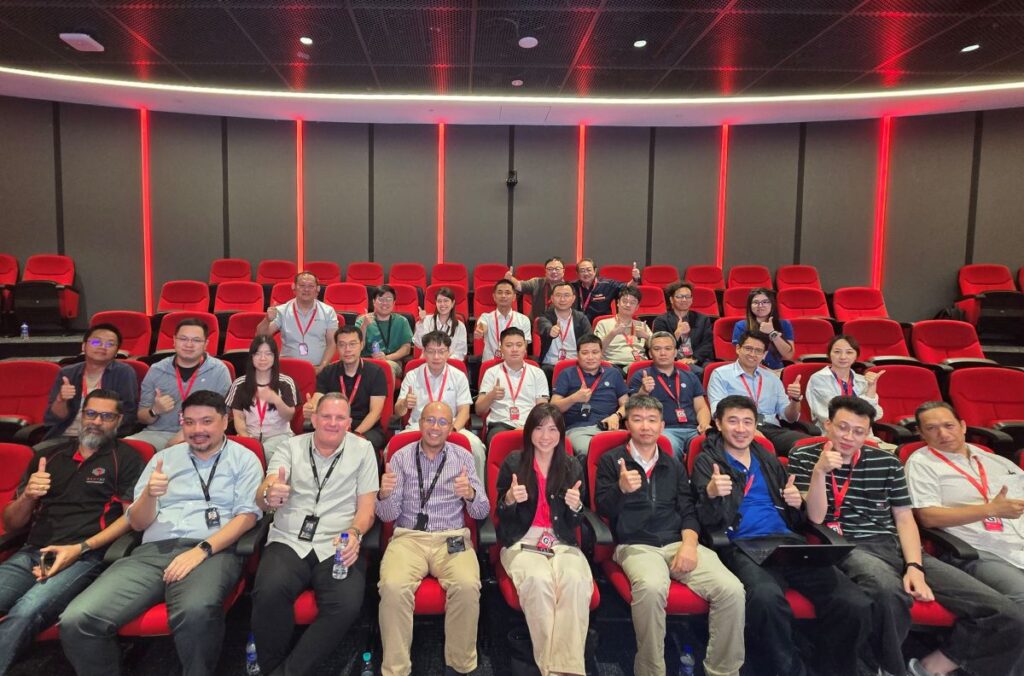
But the real outcome isn’t on any slide. It’s this:
The AI factory era has moved from architectural theory to engineering reality. The teams in that room in Kuala Lumpur, chaired by James Soh, Head of Data Centre Business Unit at FREYR AI, proved it across 8 sessions, 3 companies, and 2 days of relentless technical alignment.
The industry is still measuring data centres in megawatts. FREYR AI spent two days measuring in tonnes, kilowatts, and tokens per second. That is what the customer will be billed on.
“Let’s move.” The FREYR AI team is ready.