
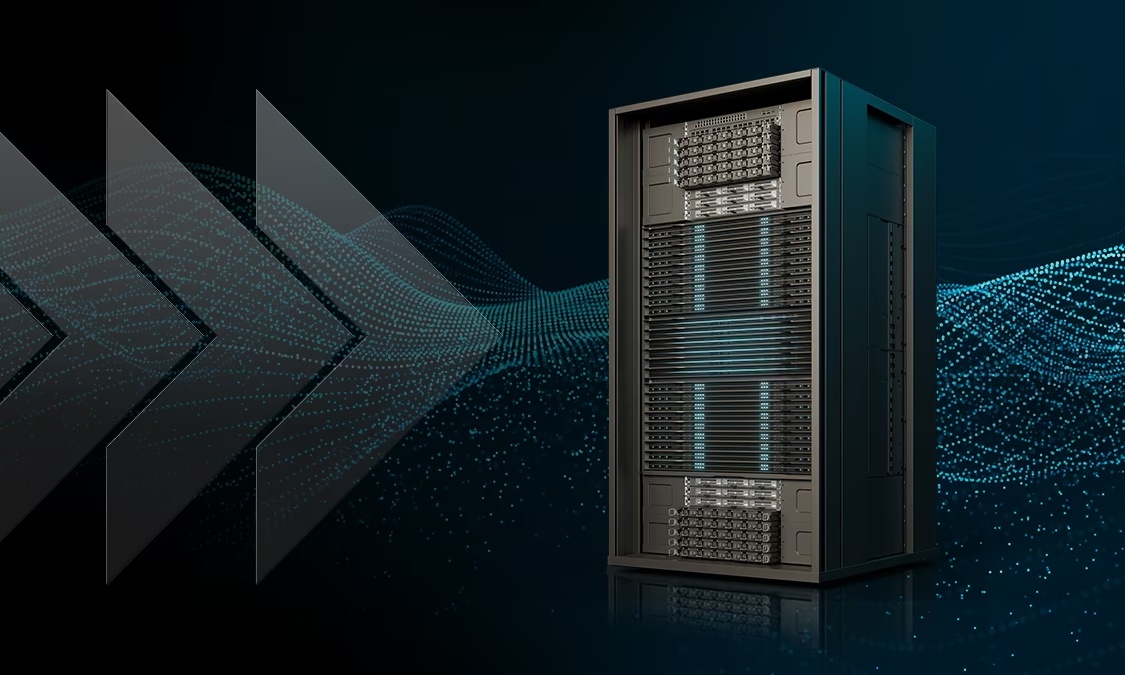
HPE will become one of the first original equipment manufacturers to adopt AMD’s Helios rack-scale AI architecture, with worldwide availability planned for 2026 as the companies position themselves to challenge Nvidia’s dominance in AI infrastructure. The collaboration, announced at HPE Discover, centres on AMD’s Helios platform, which combines the company’s EPYC CPUs, Instinct GPUs, Pensando advanced networking and ROCm open software stack into an integrated rack-scale system. The platform is built on the Open Compute Project’s Open Rack Wide design specification.
AMD claims the architecture will deliver up to 2.9 exaFLOPS of FP4 performance per rack using Instinct MI455X GPUs, next-generation EPYC Venice CPUs and Pensando Vulcano network interface cards for scale-out networking.
A key element of the partnership involves networking infrastructure. HPE will integrate a purpose-built HPE Juniper Networking scale-up switch developed in collaboration with Broadcom. The switch is designed to deliver high-bandwidth, low-latency connectivity using the Ultra Accelerator Link over Ethernet standard, supporting AMD’s emphasis on open, standards-based technologies rather than proprietary interconnects.
“With Helios, we’re taking that collaboration further, bringing together the full stack of AMD compute technologies and HPE’s system innovation to deliver an open, rack-scale AI platform that drives new levels of efficiency, scalability, and breakthrough performance for our customers in the AI era,” said Dr Lisa Su, chair and chief executive of AMD.
Antonio Neri, president and chief executive at HPE, said the introduction of Helios and HPE’s purpose-built scale-up networking solution would provide cloud service provider customers with faster deployments, greater flexibility and reduced risk in scaling AI computing.
Separately, AMD and HPE announced they will power Herder, a new supercomputer for the High-Performance Computing Centre Stuttgart in Germany. Built on the HPE Cray Supercomputing GX5000 platform, the system will use AMD Instinct MI430X GPUs and next-generation EPYC Venice CPUs.
Delivery of Herder is scheduled for the second half of 2027, with the system expected to enter service by the end of that year. The supercomputer will replace HLRS’s current flagship system, Hunter.
Professor Dr Michael Resch, director of HLRS, said the pairing of AMD Instinct MI430X GPUs and EPYC processors within HPE’s GX5000 platform would support both traditional high-performance computing applications and growing demand for machine learning and artificial intelligence workloads.