
The data center sector currently sits at the beginning of one of the largest infrastructure investment supercycles seen in the modern era, according to JLL at the beginning of 2026. How do companies in the industry prepare for the elevated rate of activities in the coming days and months in the midst of this historic digital infrastructure boom?
For one, sustainability, a buzzword for years, is now a given – regulators globally are catching on and are tightening up rules and making minimum sustainability standards mandatory for data centers. This, coupled with community and political pressures, have had the effect of raising the bar for a greener data center landscape globally.
Asia Pacific is no exception – data center capacity is projected to almost double to about 57 GW by 2030 from the current 32 GW driven by the relentless growth of digital transformation, artificial intelligence and cloud adoption. With aggressive growth comes unprecedented demand for power and water, the two resources most needed to run data centers. As power and water supply constraints spiral out of control in some jurisdictions, there are those who watch and adapt even before any crisis hits them.
The current industry blueprint must change in order to keep up with the lightning-speed changes. News of racks approaching 600 kW for next-generation AI applications is proof that silicon speed waits for no one. And while the industry currently debates on stranded infrastructure assets being a possible outcome of such speed, for Bridge Data Centres (BDC), it has already embedded the future into its design from the ground up.
Its design philosophy takes into account all possible outcomes, hence it has prioritised sustainability, intelligent engineering and deep collaboration – all while controlling the entire stack as ecosystem architect.
With Environmental, Social, and Governance (ESG) now dictating investment and customer decisions, BDC wields sustainability as a business strategy rather than a compliance exercise. Its recently unveiled ‘BRIDGE’ ESG framework gives a very transparent look at where it stands in terms of every metric that investors might look at including its decision to join the RE100 initiative for 100 per cent renewable energy by 2040, and its commitment to science-based emissions reductions.
“Resiliency today means more than just physical durability—it means creating adaptable, sustainable, and future-proof systems,” says Eric Fan, CEO of Bridge Data Centres. This future forward view, often spanning a 20-year operational horizon, justifies upfront investments in green technology as well as funding innovative solutions for potential problems.
Adapting on multiple fronts
In tandem with higher rack density, the rest of the data center architecture and components may also need an overhaul to keep up. Cooling, in particular, has moved from a supporting function to being a critical component, with liquid cooling becoming a mandatory feature in new hyperscale data centers. BDC’s response is a hybrid cooling architecture designed for flexibility – its facilities cater for every need – from traditional air-cooled racks using efficient perimeter fan-walls to high-density AI racks employing direct-to-chip liquid cooling. This system is engineered for subtropical climates, using warmer cooling tower water where possible and integrating smaller “trim chillers” only for premium GPU workloads.
When it comes to construction, BDC leverages advanced prefabrication and modular building models, slashing build times and enabling it to deliver a campus in Malaysia in a record eight months. This speed-to-market, all part of its 2024-launched AI-Ready Data Centre Total Solution 2.0, is crucial in a region racing to add capacity.
BDC is also ahead of the curve when it comes to power and water; its approach is multi-pronged and partnership-driven.
On the power front, the company is actively securing its renewable future, having locked in nearly 1GW of renewable energy reserves through multiple Memorandums of Understanding (MOUs). It’s also an early participant in Malaysia’s Corporate Renewable Energy Supply Scheme (CRESS), enabling direct access to green electricity via the national grid—a model that enhances reliability while decarbonising, in addition to its 400MW Renewables Electricity Supply Agreement with TNB, Malaysia’s national electricity provider.
BDC is translating ESG commitments into measurable operational outcomes: at its Thailand facility, on-site distributed PV generated 511.00 MWh in 2024, meeting nearly 50% of annual electricity demand—demonstrating near-term decarbonisation progress while strengthening long-term energy resilience and supporting a scalable renewable strategy across the platform.
The region’s digital future can’t be built on yesterday’s assumptions—that water and power will always be abundant, and that scale is simply a matter of adding capacity. BDC’s vision is to lead APAC into a new model of data centre growth: beyond scarcity, beyond compromise, beyond linear consumption.
From pioneering a Johor Water Reclamation Plant using Membrane Bioreactor MBR and Reverse Osmosis (RO) to produce high-grade cooling water from treated municipal effluent, to extending closed-loop refresh cycles from two months to over six months, BDC is engineering circular, resilient systems that protect performance while reducing resource intensity. In a resource-constrained decade, the winning platforms won’t just be bigger—they’ll be smarter.
Ecosystem leadership
As ecosystem architect, BDC has forged several collaborations ranging from a joint venture with BCA International to promote global green data centre standards, to a 10-year sustainable water supply agreement in Thailand, and its pivotal public-private partnership with Johor authorities for water reclamation. Not only do these enable the firm to secure essential resources, they also embed the company within the community and regulatory fabric.
Underpinning the technical achievements is a commitment to social resiliency and human capital. BDC’s focus on local talent development—with 85.5 per cent local hires—and its leadership in gender diversity, with women holding 33.3 per cent of executive management roles, builds a stable, skilled workforce. This ensures long-term operational resiliency.
Beyond the 2026 debate on chasing lightning-fast silicon evolution versus stranded infrastructure assets, what is still commanding sustainability headlines in Asia Pacific is the convergence of explosive AI-driven demand and acute resource constraints. BDC is responding with an integrated blueprint that connects modular, climate-adapted engineering with circular resource management and strategic ecosystem partnerships.
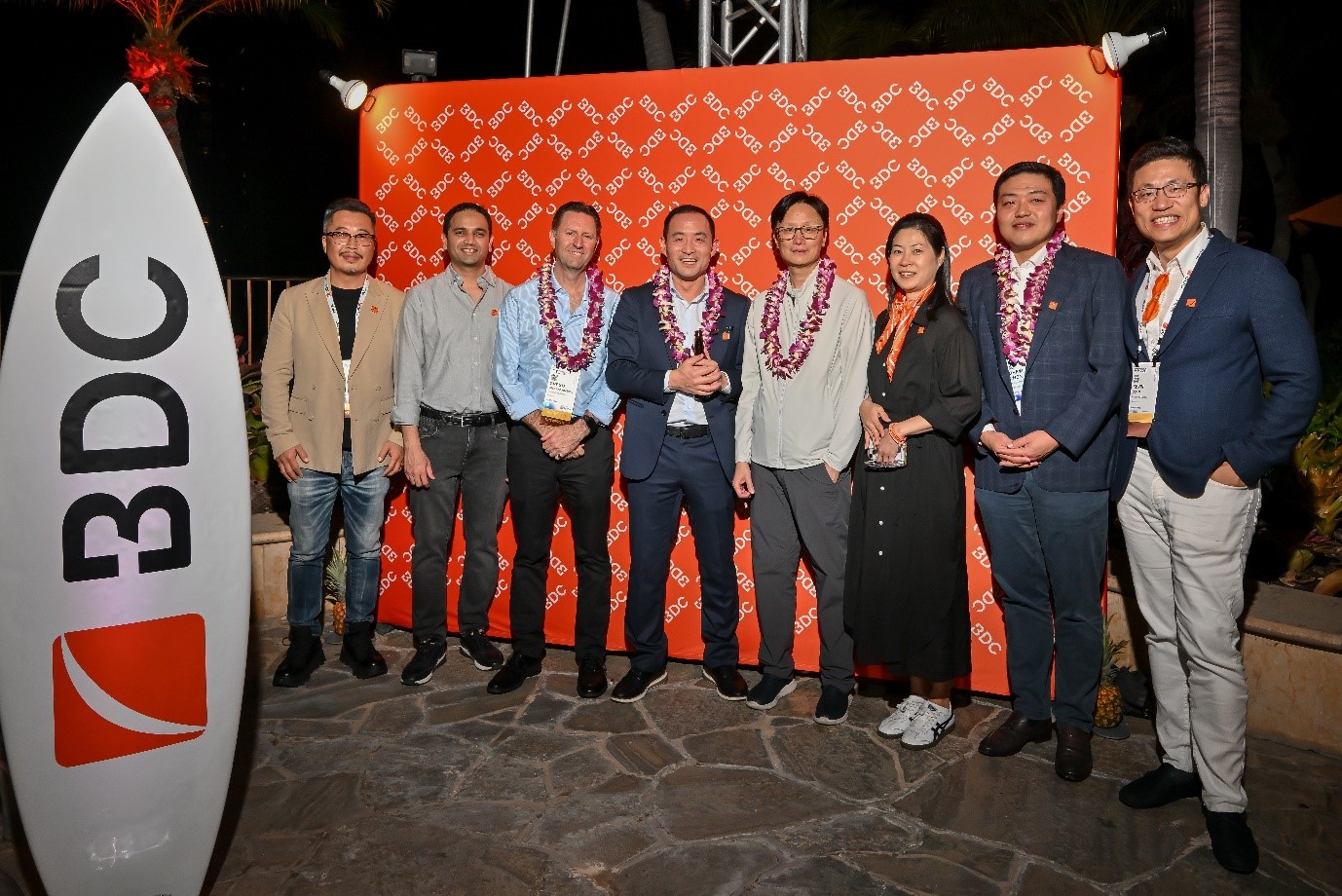
The company’s recent accolades, including the IDC Future Enterprise Award for ESG, Singapore’s Green Mark Platinum certification, as well as w.media’s Hyperscale Infrastructure Leader and Strategic Network Infrastructure Leader awards, presented to Sandy Xiao and Eric Fan, President and CEO respectively, validate this approach.
BDC is preparing for the future by being scalable, resilient and innovative – ensuring it remains a leader and innovator in a field where competition and technological obsolescence are constant threats.
To this end, the company is starting 2026 with a new brand identity to reflect its leading position as a fast-adapting hyperscale and AI-infrastructure builder with a growing network of mega-campus developments in Asia. Its existing hyperscale campuses in Malaysia and Thailand are approaching 700 megawatts of operating capacity in 2026, with concrete plans to expand into other regions. This aligns with BDC’s operating model as a glocal platform combining regional scale with deep local execution underpinned by strong cash flows.
“Our new identity reflects who BDC is today; a platform built on disciplined execution, certainty of delivery, and the ability to scale with our customers,” said CEO Fan, elaborating on the brand refresh.