
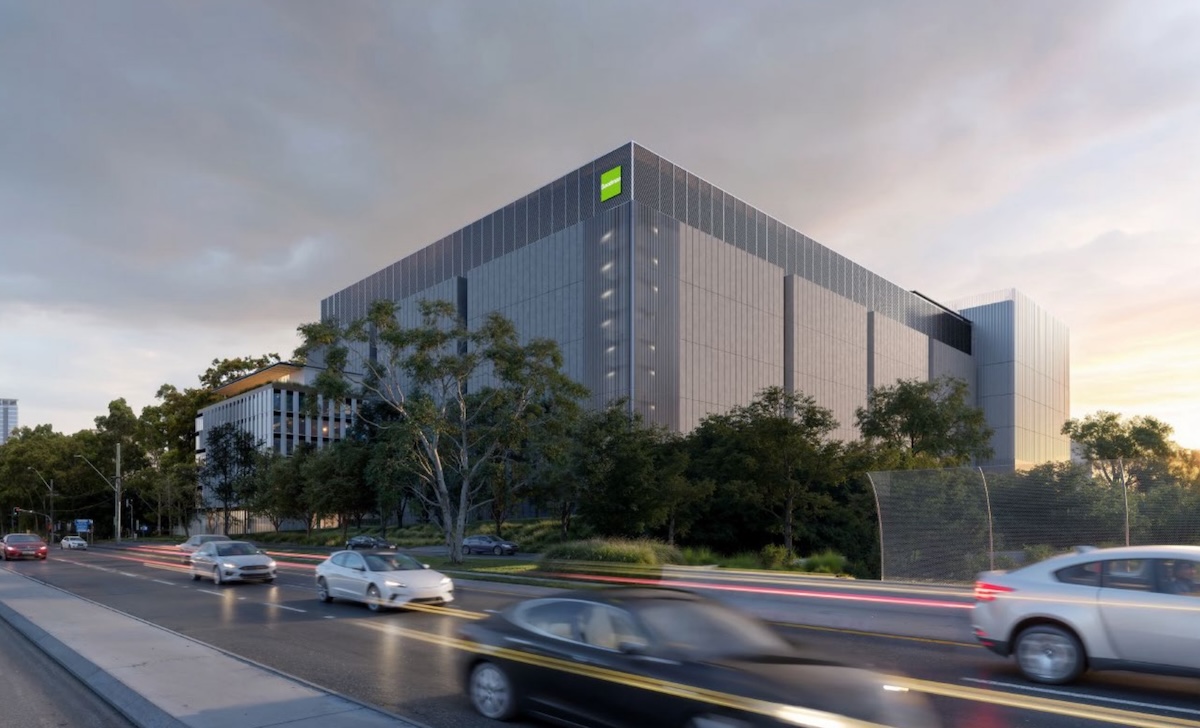
Goodman Property Services has secured approval to build and operate a 135MW data centre at Macquarie Park in Sydney, with the AUD 1.365 billion project set to incorporate large-scale evaporative cooling, diesel backup generation and lithium-ion battery systems. The Project Apollo data centre will be built at 4-10 Talavera Road on a 23,190-square-metre site, with eight data halls spread across four levels. The facility will operate around the clock and have a maximum building height of 45 metres.
The NSW Department of Planning, Housing and Infrastructure approved the State Significant Development application on 2 September, following an assessment that considered the project’s environmental, infrastructure and amenity impacts. The development is expected to generate up to 400 construction jobs and 60 operational jobs, according to the Department’s assessment.
Water-intensive cooling
One of the more significant infrastructure requirements is the project’s cooling system. The proposed facility will use open-circuit evaporative cooling towers, with the assessment allowing for up to 1.5 million kilo-litres of water consumption a year under its maximum assessed operating scenario.
The Department said that the figure represents a worst-case scenario based on the proposed evaporative cooling system and operating assumptions. Actual water use could be lower depending on the eventual tenant mix and cooling configuration. The water requirement comes as NSW begins a separate examination of how data centres should be charged for water services.
NSW’s Independent Pricing and Regulatory Tribunal (IPART) released draft terms of reference this week for a review of water pricing and regulation for data centres, including how operators should contribute to the cost of connecting to water networks, network upgrades and additional supply capacity. Submissions on the draft terms of reference are open until Friday 2 October 2026
The Apollo assessment indicates that Sydney Water is already examining infrastructure requirements in the local water-supply zone, including potential non-potable water options for data centres.
The consent requires Goodman to obtain a Sydney Water Section 73 compliance certificate before the facility can operate, while also requiring measures to reduce potable water consumption and ongoing monitoring and reporting of water use.
135MW of capacity
The data centre’s eight halls will provide space for future tenants to install server racks and networking equipment, with the internal configuration designed to accommodate different tenancy requirements over time.
The Department describes the project as having an operational capacity of up to 135MW, with the revised design retaining the same fundamental scale and intensity despite changes made during the planning process.
Power will be supplied through a multi-feeder grid connection designed to provide redundancy if a feeder is lost. The facility will also have diesel generators and an uninterruptible power supply using lithium-ion batteries to maintain the critical load during grid interruptions.
The assessment was based on approximately 1,100 tonnes of diesel storage capacity and around 210 tonnes of lithium-ion batteries. The final consent permits diesel storage of up to 2,000 tonnes and limits non-emergency operation of the backup generators to 187 hours a year, with no more than one generator tested at a time.
The consent also prevents the backup generators from being used for load curtailment or to generate electricity for export to the National Electricity Market.
Renewable energy requirement
The approval contains a significant requirement around the project’s operational electricity supply.
Before operation, Goodman must demonstrate that its electricity demand, including both IT and non-IT loads, is matched by a portfolio of additional, firmed renewable energy supply at all times.
It must also enter into NSW-based power purchase and firming agreements within the National Electricity Market (NEM) and establish a framework for managing periods when renewable supply is unavailable, including through demand flexibility and firming.
The consent requires Goodman to begin the process of securing those agreements within six months of construction commencing.
Council maintained objection
The approval follows a lengthy assessment in which the City of Ryde maintained its objection to the development. Council raised concerns about the building’s bulk and scale, landscaping and tree removal, public-domain interface, at-grade parking, security fencing and the cumulative environmental and risk impacts associated with the concentration of data centres in Macquarie Park.
The Department nevertheless concluded that the revised design provided acceptable urban-design outcomes and that the project’s impacts could be managed through conditions of consent.
The assessment notes that the site is at a prominent entry point to the Macquarie Park precinct and that nearby residential receivers are located approximately 100 metres away, beyond the M2 Motorway.
Noise was consequently one of the Department’s two principal assessment issues, alongside urban design. The consent requires continuous operational noise monitoring, while the Department said monitoring would help establish whether emissions remain consistent with predicted levels and identify tonal or low-frequency noise, particularly because the ultimate tenants and some rooftop plant arrangements are not yet known.
The project’s backup generators also presented an air-quality issue. The EPA raised concerns about cumulative emissions during emergency operation and testing, prompting Goodman to revise its generator testing regime and prepare a site-specific air-quality management plan.
The Department ultimately concluded that the environmental impacts of the development could be appropriately managed through the conditions of consent. The project will now move into delivery, subject to the conditions attached to the approval.