
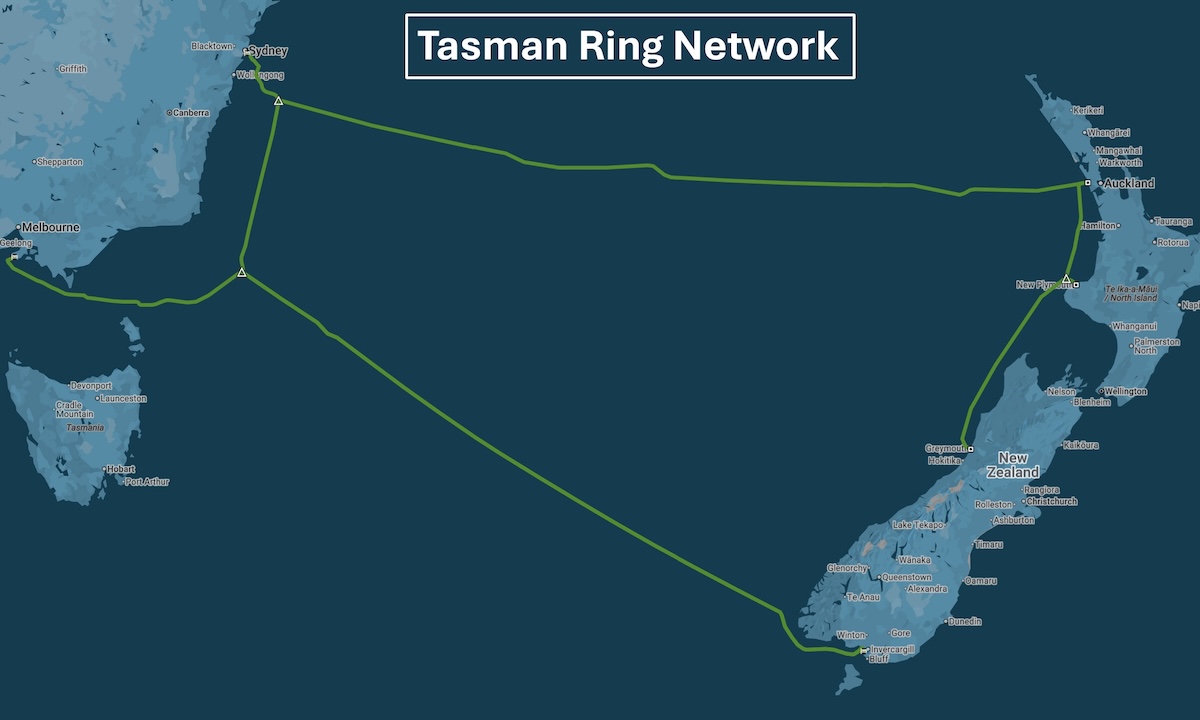
A proposed subsea cable network designed to create a ring around the Tasman Sea will include a connection to Tasmania and a new landing in Melbourne, reflecting the Australian city’s rapid emergence as a hyperscale data centre hub, according to the project’s developer.
Rémi Galasso, founder and CEO of Datagrid New Zealand and the entrepreneur behind the proposed Tasman Ring network, revealed at W.Media’s New Zealand Cloud Data Center Convention in Auckland that his team is conducting a desktop study for a Tasmanian connection, while positioning Melbourne as a critical node in what he terms the “Great Southern Route” for global connectivity.
The announcements signal a fundamental shift in how the Australia-New Zealand region is now being positioned in global connectivity strategies. Rather than being termination points at the edge of the global internet, the two countries sit in the middle of a new trans-global spine that bypasses the South China Sea.
Galasso stated that approximately 75% of new Australian data centre investments are currently flowing to Melbourne, a dramatic shift from Sydney’s historical dominance that is reshaping connectivity requirements across the Tasman.
“Melbourne is going to be a super large hub in the coming years, and it’s very important for New Zealand to connect directly to Melbourne as well,” Galasso told the Auckland conference.
The Tasman Ring network design reflects this reality, with planned landings in both Sydney and Melbourne on the Australian side. While Sydney remains essential as the region’s largest connectivity hub and a requirement from hyperscalers, direct connectivity to both Sydney and Melbourne, rather than backhauling via existing NZ–Australia cables, is essential for hyperscalers designing multi-AZ, multi-regional architectures across the Tasman.
Tasmania enters the chat
Perhaps more surprising is Galasso’s revelation that Tasmania is under consideration for a Tasman Ring landing. “I’m pleased to announce today that we are also exploring a connection of Tasmania. So we are currently doing the desktop study,” Galasso said, adding that Tasmania has “huge potential for data centres” and requires access to more connectivity and fibre pairs.
The island state has renewable energy, cool climate and land availability – traits similar to New Zealand’s South Island. But its greatest constraint has always been connectivity. A Tasmanian landing would provide geographic diversity for the Australian end of trans-Tasman cables and offer a southern alternative that could serve both the island state’s data centre ambitions and provide routing diversity for the broader network.
Reimagining the Tasman Ring
Galasso said the Tasman Ring represents a fundamental rethinking of trans-Tasman connectivity. Rather than simple point-to-point links between major cities, the ring topology creates multiple diverse paths and enables more landing points to participate in international connectivity.
On the New Zealand side, the network would include four landings: Auckland and New Plymouth in the North Island, and Greymouth and Invercargill in the South Island. The ring architecture requires connecting through Australia rather than directly between Greymouth and Invercargill due to seabed conditions. “The reason why we cannot loop from Greymouth to Invercargill is really the seabed is not good at all between Greymouth and Invercargill, too many canyons, so we cannot really lay a cable between the two,” Galasso explained.
The Greymouth-Invercargill segment would instead utilise existing domestic fibre pairs. The Greymouth landing is positioned as optimal for direct connection to Christchurch, New Zealand’s second-largest city. Galasso projects the Tasman Ring would improve South Island latency by 35-40%, describing it as “a game changer for the South Island” and specifically for cities like Christchurch and Dunedin.
The system would span approximately 6,000km of cable, smaller than the 15,000km Hawaiki cable that Galasso’s team built a decade ago. The project is currently in supplier selection, with a tender launched and a decision expected “in the coming weeks or months.”
The Great Southern Route
Galasso’s most significant strategic observation concerned the fundamental repositioning of Australia and New Zealand in global connectivity architecture. Reflecting on the Hawaiki cable built ten years ago, Galasso noted that at the time, “we did consider that Australia, New Zealand, was a kind of dead end, right? There was the traffic. There was no reason to go further down.”
The cable was built with limited fibre pairs to serve the combined 30 million population.
“But actually the world is changing,” Galasso stated. He described what he calls “the Great Southern Route” as an emerging, highly secure path connecting the United States to Australia, New Zealand, and onward to Singapore, India, and the Middle East.
Critically, this route avoids crossing the South China Sea, an area of increasing geopolitical tension and a chokepoint that concerns operators and governments seeking network resilience. Google has announced several projects utilising this routing. “What it means for us in New Zealand and Australia is that we’re not the dead end anymore. We are now located in the middle of this US to Middle East route,” Galasso explained. This repositioning means “the potential will be massive again in the two countries, and we have to be very active right now to make sure we can address future requirement of those hyperscalers.”
The Tasman Ring fits directly into this strategic framework. By connecting to international cables utilising the Great Southern Route, traffic would automatically gain access to six landing points: three in Australia and four in New Zealand, dramatically improving both diversity and reach.
This evolution from regional backwater to strategic waypoint has capacity implications. Rather than cables being sized purely for local traffic, future systems may need to accommodate significant through traffic between the Americas and Asia-Pacific, Middle East, and African destinations.
Hyperscaler demand
Throughout his presentation, Galasso emphasised that these connectivity initiatives are responses to concrete hyperscaler demand rather than speculative development.
“The Americans are coming, and they are coming big,” Galasso stated, characterising it as “a great opportunity.” These operators are seeking massive locations with substantial power capacity, and both Australia and New Zealand need to address these requirements.
Galasso expressed confidence in projections for “6-7-10 large scale data centre locations, not just in Australia, because there’s potentially not enough, but also in New Zealand” in coming years.
The Tasman Ring isn’t being developed in isolation, either. Galasso’s Datagrid company is simultaneously building a major data centre campus in Invercargill on New Zealand’s South Island, which provides both the commercial rationale and anchor tenant for the Invercargill cable landing.
The project involves 49 hectares of land in Makarewa, near Invercargill, with plans for 300MW of total capacity. Galasso said that stage one power of 100MW has been secured. The site’s average temperatures of 9.8°C provide “enormous advantage” for natural cooling, representing “millions of dollars of cost saving” compared to Sydney or Melbourne.
Critically for connectivity, the Invercargill campus plans include an on-site cable landing station with direct connection to Australia. This integration of hyperscale data centre capacity with international connectivity infrastructure in a single development reflects the convergence of these infrastructure layers. Sitting beneath multiple 220kV transmission lines originally developed for the Tiwai Point aluminium smelter, the site benefits from access to some of New Zealand’s highest-capacity grid connections.
Strategic window
The Great Southern Route concept appears already has commercial traction beyond Galasso’s vision. Google’s investments in southern routing, including the Honomoana cable connecting the US, French Polynesia, and Australia and the recently announced cables in there Indian Ocean, validate the strategic logic. Combined with increasing recognition of the geopolitical value of diverse routing that avoids contested waters, Galasso believes the business case for trans-Tasman infrastructure investment is strengthening.
The inclusion of Tasmania and the targeting of Melbourne alongside traditional hubs like Sydney and Auckland signals that this opportunity is being understood in more sophisticated, forward-looking terms than simply connecting existing population centres. If the Great Southern Route continues to develop as expected, future systems from the US to India and the Middle East will automatically utilise Tasman Ring connectivity, giving New Zealand six direct landings and transforming the country from a cul-de-sac into a transit point.
As Galasso emphasised, the region must act decisively to capitalise on current momentum created by hyperscaler demand, the emergence of the Great Southern Route, and the unique attributes of Australia and New Zealand.