
Datagrid New Zealand has received full resource consent to develop what it describes as the country’s first “AI factory,” a 280 MW hyperscale computing campus planned for Southland on New Zealand’s South Island. The approvals were granted by Southland District Council, Environment Southland, and Invercargill City Council, clearing the way for construction to begin on the project in Makarewa near Invercargill.
The project will see the construction of a 78,000 sqm AI-focused data centre campus designed to support high-density GPU clusters for artificial intelligence training, inference, and high-performance computing workloads. Once operational, the facility is expected to consume 280 MW of power, making it the second-largest electricity user in New Zealand after the Tiwai Point aluminium smelter.
The campus will be connected to the national grid via a dedicated Grid Exit Point substation linked to Transpower’s 220kV transmission network, enabling large-scale compute deployments aimed at global AI and cloud providers. Datagrid said the development will generate more than 1,200 construction jobs during the build phase while establishing Southland as a new digital infrastructure hub.
“We extend our sincere gratitude – ngā mihi nui – to the iwi, landowners, local councils, and the Southland community for their unwavering support throughout this process,” said Rémi Galasso, founder and CEO of Datagrid New Zealand.
“This approval is the result of years of dedication and collaboration, and we are excited about the transformative impact this project will have on Southland and New Zealand as a whole.”
Subsea cable landing approved
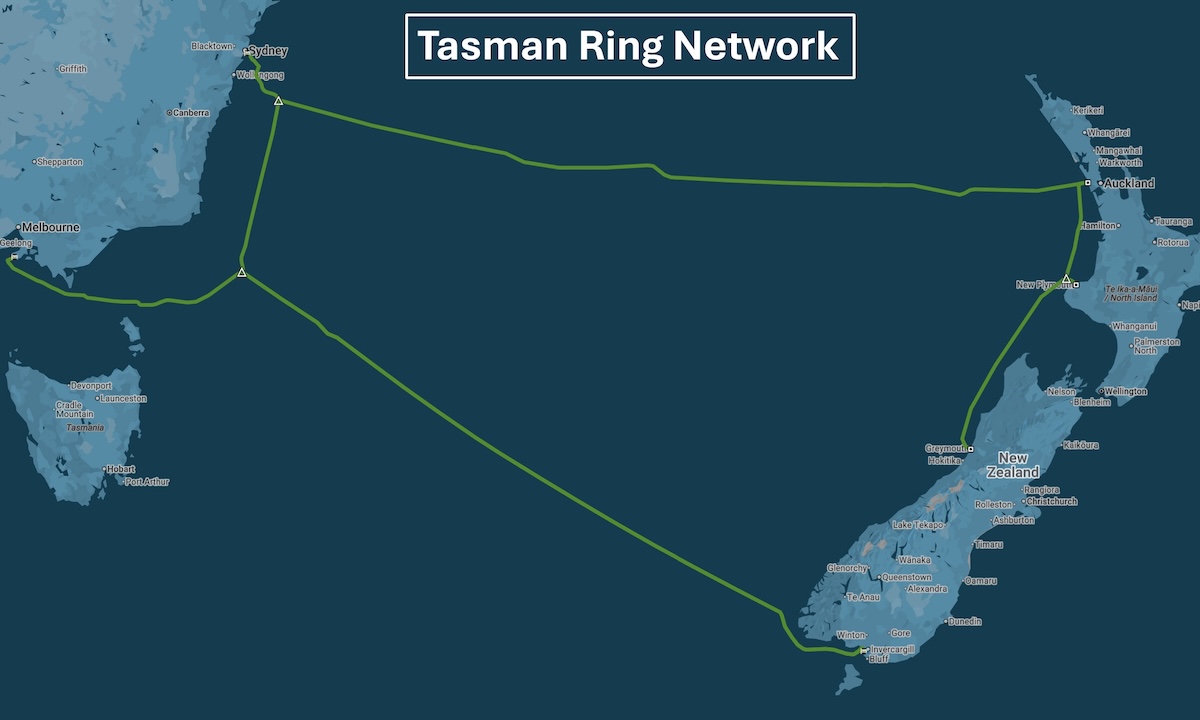
Alongside the data centre approval, Datagrid confirmed that the Tasman Ring Network landing at Oreti Beach has also received full approval. The subsea cable project is designed to deliver the first international cable landing on New Zealand’s South Island, providing direct global connectivity to support large-scale compute infrastructure.
The cable is part of a broader network architecture intended to improve international connectivity across the Tasman region while supporting the growth of hyperscale infrastructure in both New Zealand and Australia. Datagrid said the integrated development of both a hyperscale AI campus and international cable landing will help position Southland as a strategic location for digital infrastructure investment.
Southland’s natural advantages
Datagrid argues that New Zealand’s political stability, abundant renewable energy, and cool climate provide strong advantages for hyperscale AI infrastructure. The company has previously highlighted Southland’s average annual temperature of around 9.8°C, which allows extensive use of natural cooling and can significantly reduce energy costs compared with warmer data centre hubs in Australia or Asia.
The site sits close to major high-capacity transmission lines originally developed to support the nearby Tiwai Point smelter, providing access to substantial power capacity that could support large-scale AI deployments.
Hyperscaler demand driving investment
The project reflects growing demand for large-scale AI infrastructure in the Asia-Pacific region, particularly from US hyperscalers seeking locations with abundant renewable power and stable political environments.
Speaking at W.Media’s New Zealand Cloud Data Center Convention in Auckland in 2025, Galasso said the company was responding to significant demand from global cloud and AI companies. “The Americans are coming, and they are coming big,” he said at the conference, describing hyperscalers’ search for locations capable of supporting massive compute deployments.
Datagrid’s strategy pairs the Invercargill campus with the Tasman Ring subsea cable network, which will connect multiple landing points across New Zealand and Australia. The ring design is intended to create resilient international connectivity while linking the region to what Galasso calls the emerging “Great Southern Route” – a global network path connecting the United States, Australia, New Zealand, and onward to Asia and the Middle East.
From edge market to global transit point
According to Galasso, this shift in global connectivity architecture is repositioning Australia and New Zealand from peripheral markets to strategic transit points in global data flows. Rather than serving only local traffic, future subsea cables running through the region could carry significant transit data between the Americas, Asia-Pacific, and the Middle East.
For Datagrid, combining hyperscale compute capacity with new subsea connectivity is central to that strategy. The company said further announcements related to the AI factory project and the Tasman Ring Network are expected in the coming weeks as development progresses.