
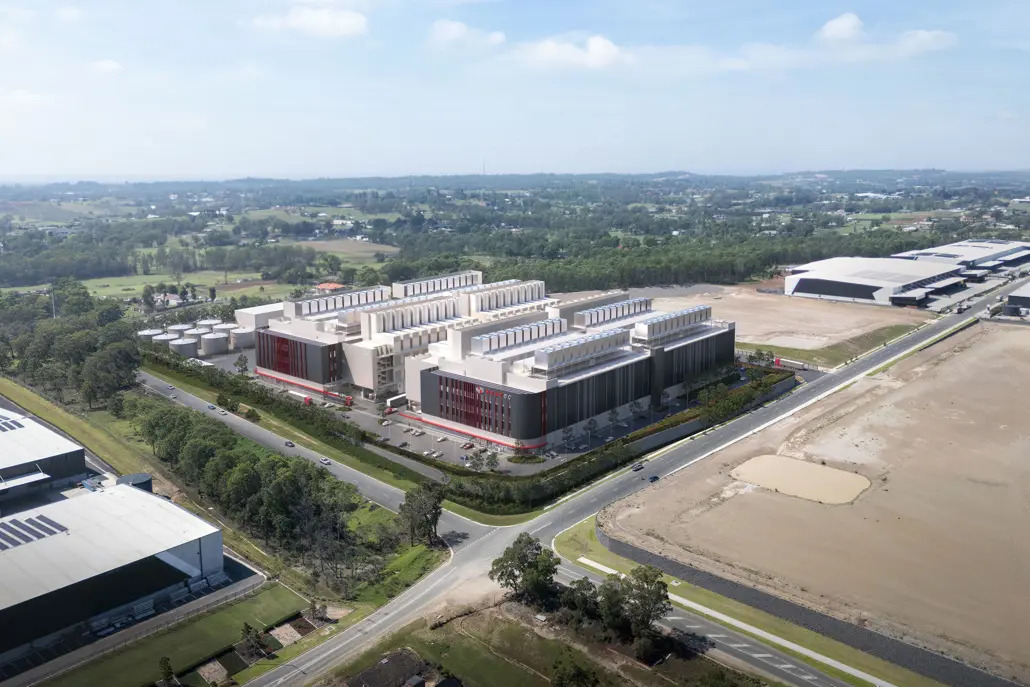
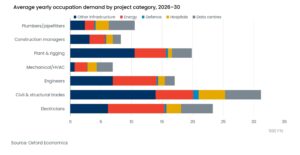
Australia’s data centre construction pipeline could require an average of 5,200 full-time equivalent electricians, 4,200 plumbers and pipe fitters, and 2,600 mechanical and HVAC technicians each year between 2026 and 2030, adding to competition for skilled workers across an already stretched infrastructure sector.
The report warns that competition for specialised labour could push up wages and contractor costs, while increasing the risk of delays across data centre, energy, defence, hospital and other infrastructure projects.
The figures come from a new Oxford Economics briefing, Data centres boost demand for trades, which forecasts direct employment in Australia’s data centre industry will peak at approximately 38,400 workers in 2030. Around 36,000 of those jobs will be in construction and project delivery, compared with just 2,400 in the operation of completed facilities.
The report, authored by Oxford Economics economist Oscar Guth, estimates that data centre projects will account for around 22 percent of electrician demand across major projects nationally over the five-year period. They will represent approximately 40 percent of demand for plumbers and pipe fitters, and 38 percent for mechanical and HVAC technicians.
Oxford Economics expects non-IT work, which includes site infrastructure, shell construction, electrical and mechanical systems, fit-out and refurbishment, to rise eightfold from AU$4bn in 2024 to AU$32.4bn in 2030. At its peak, this will be equivalent to around 13 percent of all non-residential building and engineering construction undertaken in Australia.
The construction pipeline is expected to grow alongside other major infrastructure investment. Oxford Economics forecasts spending on major infrastructure projects, including data centres, will rise from approximately AU$106 billion in 2026 to AU$144bn in 2030. Within that, major energy-project construction spending is expected to increase from around AU$28bn to AU$45bn, reflecting both the transition to renewable energy and the demand for reliable power from data centres.
The additional demand comes as the infrastructure workforce is already experiencing significant shortages. Citing Infrastructure Australia estimates, Oxford Economics said the sector had a workforce of around 204,000 people in 2025 but faced a shortfall of approximately 141,000 workers. Job-advertising data shows pressure continuing to mount: since September 2025, ad postings have risen by 16 percent for electrical and telecommunications tradespeople, 10 percent for engineers and 5 percent for ICT technicians.
Construction jobs spread beyond Sydney and Melbourne
The report also forecasts a significant geographic shift in data centre construction employment as development moves beyond Australia’s traditional Sydney and Melbourne markets.
Those two cities account for 87 percent of the sector’s construction workforce in 2026, but their share is expected to fall to 54 percent by 2030. Regional construction employment is forecast to increase from around 300 workers in 2026 to more than 10,000 in 2030, lifting the regional share from approximately 3 percent to 29 percent.
Oxford Economics said AI-focused data centres have different requirements from conventional facilities designed for data storage and retrieval. Their higher energy requirements and different specifications, alongside lower latency requirements, could make regional locations with abundant land and fewer approval constraints more attractive.
The investment is also expected to generate substantial indirect employment through domestic suppliers and additional household spending. Assuming the activity does not displace workers and resources from elsewhere in the economy, Oxford Economics estimates the industry could support a further 84,000 jobs indirectly through supply chains and 96,000 induced jobs through household spending in 2030.
However, the report cautions that existing supply constraints will limit the extent to which these potential employment gains can be realised, as competition for labour and other resources displaces activity elsewhere.
The outlook for ongoing operational employment is more modest. Much of the work involved in running data centre computing infrastructure is carried out off-site by hyperscale customers using existing software and global engineering teams. Australian neocloud providers could create additional local roles in cluster engineering, platform operations and customer support.
Data centre boom compared with mining investment
A separate Oxford Economics briefing, Data centres and mining – a tale of two trade stories, examines whether Australia’s data centre investment boom can deliver the same economic benefits as the mining investment surge of the 2000s and early 2010s.
The report, authored by economist Harry McAuley, argues that although mining investment was larger in scale, a much larger proportion of data centre spending will flow overseas through imported equipment. At its peak, mining investment reached almost AU$130bn a year and accounted for roughly 9 percent of GDP.
Oxford Economics estimates that investment in data centre facilities and the high-specification equipment installed within them could exceed AU$240bn over the five years to 2030. It forecasts the value of data centre investment, including IT equipment, will grow from around AU$20bn in 2026 to more than AU$60bn in 2030.
However, up to three-quarters of the total investment value is expected to be allocated to imported goods, compared with an estimated peak of 45 percent during the mining investment boom.
IT equipment, including GPUs, CPUs, networking infrastructure and storage systems, is expected to account for around half of data centre investment through to 2030 and is almost entirely imported. In some AI-focused hyperscale projects, IT equipment could represent more than two-thirds of total investment. Australia currently has no advanced processor manufacturing capacity and is entirely reliant on imports for the most valuable segment of the data centre value chain.
Oxford Economics forecasts data centre-related imports will peak at just under AU$45bn in 2030, with more than two-thirds allocated to IT equipment. The report notes that servers, routers, storage and processing units accounted for almost half of data centre-related imports by value in the March 2026 quarter, with data processing units, memories and circuits representing 69 percent of those IT imports.
By comparison, during the mining boom, specialised equipment accounted for around 20 percent of industry capital expenditure, while Australian manufacturers and workers supplied much of the labour and materials for buildings and infrastructure.
The difference has implications for the domestic economic benefits of the current investment cycle. While mining exports subsequently repaid the import bill several times over and provided sustained support for Australia’s terms of trade and currency, the long-term export contribution of data centres remains less certain.
McAuley cites NextDC estimates that application, education and compute exports could generate AU$11bn over the five years to 2030. However, Oxford Economics argues this is a relatively small contribution compared with the value of imported components required to develop the infrastructure. Data processing unit imports alone totalled AU$5.2bn in the March 2026 quarter.
Instead, data centre operators and the federal government are banking on productivity gains and the adoption of AI across industries beyond the technology sector to make the broader economic case. The NextDC report estimates these gains could total AU$112bn over the same period, lifting GDP by 4 percent and average wages by 7 percent.
The Oxford Economics briefing also highlights the shorter replacement cycle for data centre equipment compared with mining infrastructure. GPUs and accelerators used for advanced computing are estimated to have a lifespan of four to six years, and in some cases may become obsolete sooner. By contrast, major mining assets such as processing plants and power infrastructure can last up to 30 years, while bulk transportation infrastructure can last up to 40 years.
This means data centre investment could generate repeated waves of equipment imports as operators upgrade their IT infrastructure, rather than a single initial investment cycle.