
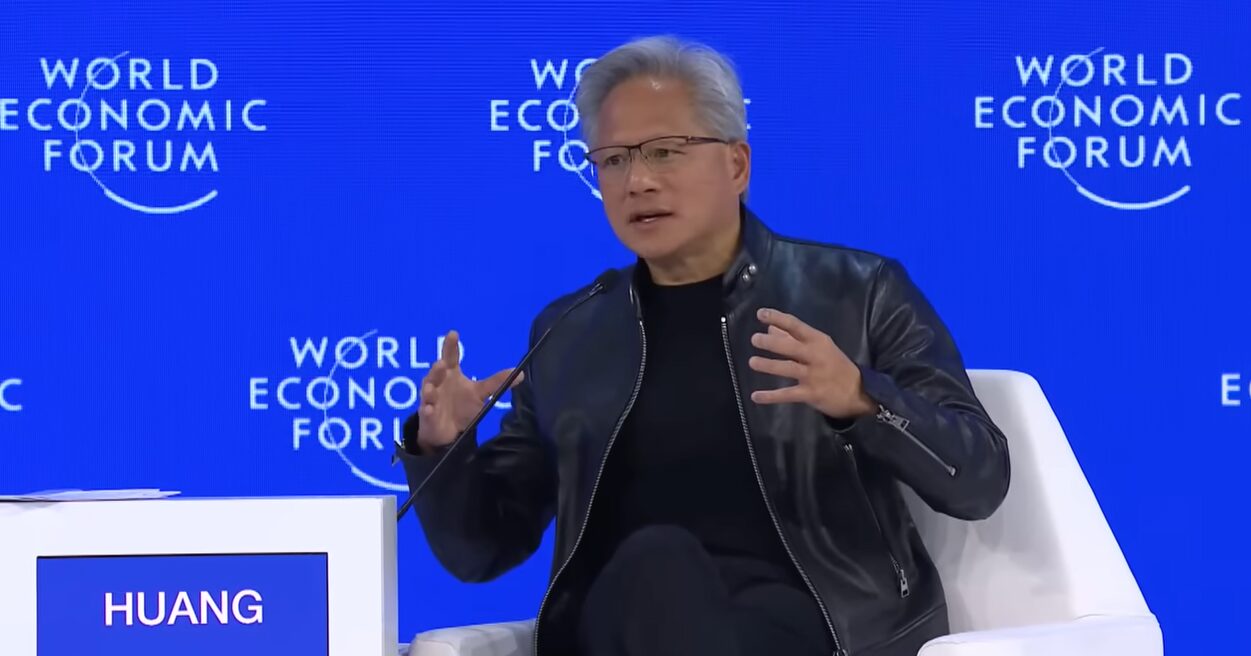
NVIDIA CEO Jensen Huang made his Davos debut this year, appearing at the World Economic Forum (WEF) for a chat with BlackRock CEO, Laurence D. Fink, who is also the Forum’s interim co-chair. During the discussion on the future of Artificial Intelligence, Huang compared AI to a ‘five layered cake’, and said that it had triggered the largest infrastructure buildout in human history.
“AI is essentially a five-layer cake,” said Huang. Huang said that energy was the first layer of the AI cake, followed by chips, cloud, the AI model itself, and finally application. “This layer on top,” he said while referring to the application layer, “is where economic benefit would happen.” He went on to say, “Because this computing platform requires all the layers underneath it, it has started the largest infrastructure buildout in human history.” He said that there’s still trillions of dollars of infrastructure that needs to be built out.

On the subject of concerns surrounding AI taking away jobs from humans, Huang said that the infrastructure buildout itself would create a lot of jobs. He gave the example of the United States where he claimed salaries of plumbers, electricians, steel workers, buildout and fitting technicians had gone up. He says there will be a shortage of such types of workers. “We are talking about six figure salaries for people who are building chip factories or computer factories or AI factories, and we have a great shortage in that,” he said. He also gave the example of radiologists and nurses, two professions where the demand for people increased after embracing AI.
On the subject of ensuring countries across the world, especially developing economies also derive benefit from AI, Huang pointed out that the sheer ease of using AI, it can level the playing field when it comes to technological advancement. Huang advised emerging and developing countries, “Build your infrastructure, get engaged in AI, and recognize that AI is likely to close the technology divide.”
