
“Be at war with your vices, at peace with your neighbors,” advised Benjamin Franklin, one of the Founding Fathers of the United States of America. Now, two hundred years later, as data centers pop up across the country, can the common man be at peace with a neighbour that keeps demanding more and more of everything – land, electricity and water?
The US is the world’s largest data center market, with its size estimated at US$ 122.08 billion in 2026 by Mordor Intelligence[1]. It is projected to grow to US$ 168.34 billion by 2031, at a CAGR of 6.64 percent over 2026-2031. With growing investments into AI factories and mega projects, Goldman Sachs[2] estimates the power demand to surge from 31 GW in 2025 to 66 GW in 2027, doubling over a mere two-year period!
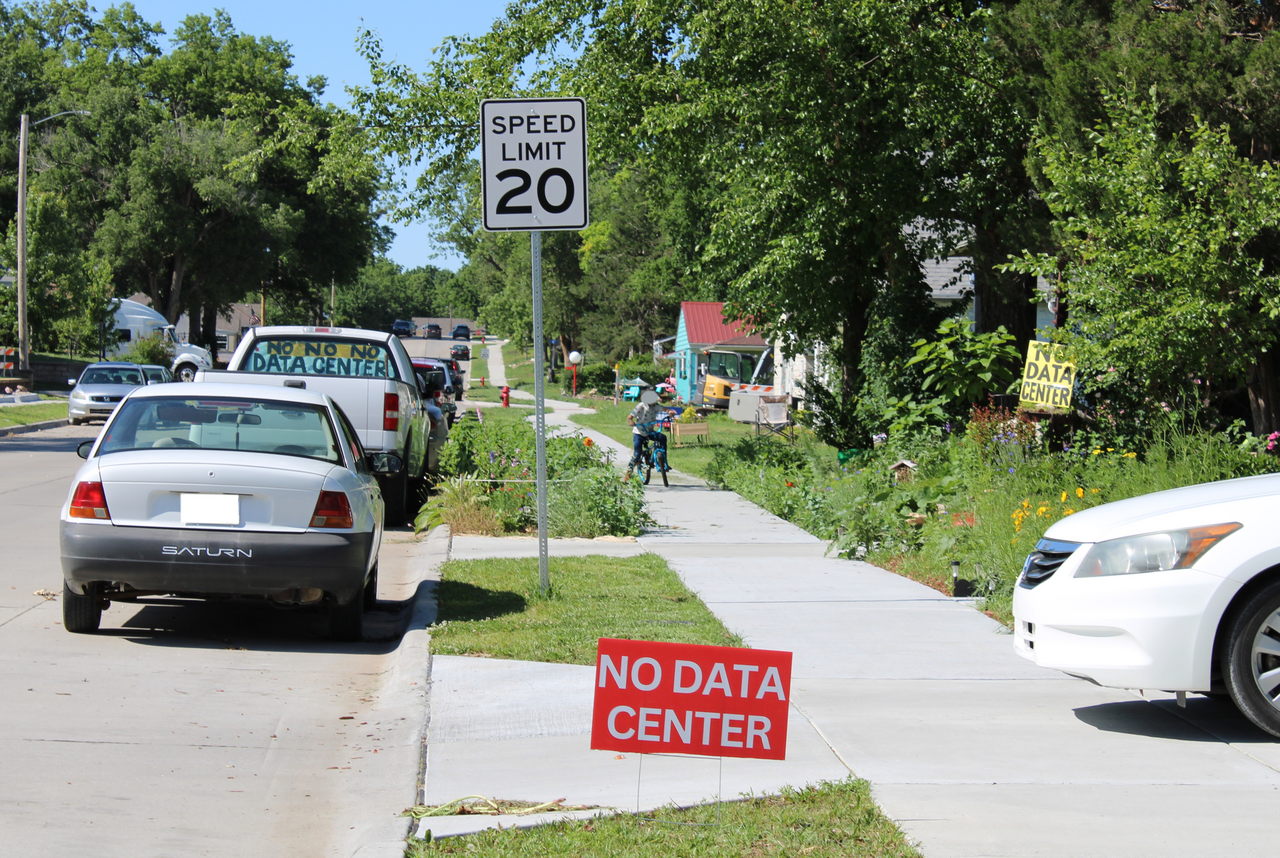
The pressure this is putting on resources, has led to protests, and legislation pausing or restricting data center development in some states. We have been covering these legislations on w.media, and at the time of writing this piece as many as 200 local governments, including New York, Seattle, and Baltimore, and nearly a dozen states, have passed a variety of laws and issued moratoriums to check the indiscriminate development of hyperscale and AI data centers.

Who is pressing pause?
For example, New York State Senator Liz Krueger and Assemblymember Anna Kelles introduced legislation in February this year to impose a temporary, three-year moratorium on new data center construction across the state. The move came in response to growing public pressure since December 2025, when over 50 groups called for a moratorium, citing unsustainable resource use and rising utility costs.
Liz Kruege, New York State Senator, said, “Massive data centers are gunning for New York, and right now we are completely unprepared. When one of these energy-guzzling facilities comes to town they drive up utility prices and have significant negative impacts on the environment and the community – and they have little to no positive impact on the local economy.”
Anna Kelles, Assemblymember, said, “This legislation creates a responsible pause so the state can complete a comprehensive assessment and put clear, data-driven standards in place, ensuring that any future development is aligned with our climate goals and the long-term health and economic stability of New Yorkers.”
But, perhaps the most talked about among these moratoriums is the Artificial Intelligence (AI) Data Center Moratorium Act[3] which was jointly proposed by Sen. Bernie Sanders (I-Vt.) and Rep. Alexandria Ocasio-Cortez (D-N.Y.) in March this year. The legislation aims to create a temporary prohibition on the construction of new data centers and the expansion of existing data centers until Congress passes comprehensive legislation to address the economic, environmental, and safety impacts of artificial intelligence.
“AI and robotics are creating the most sweeping technological revolution in the history of humanity. The scale, scope and speed of that change is unprecedented. Congress is way behind where it should be in understanding the nature of this revolution and its impacts,” said Sanders. “We need serious public debate and democratic oversight over this enormously consequential issue. The time for action is now. We need a federal moratorium on AI data centers.”
There are also growing concerns surrounding the unethical use of AI in surveillance and creating content harmful to women and children.
“We have seen ICE partner with AI companies to surveil Americans, social media users employ AI bots to create sexually explicit deepfakes of women and children, and data center construction inflate electric bills in communities across the country. And all of this harm has occurred because of the absence of federal legislation to regulate AI,” said Ocasio-Cortez. “Congress has a moral obligation to stand with the American people and stop the expansion of these data centers until we have a framework to adequately address the existential harm AI poses to our society. We must choose humanity over profit.”
In fact, Ocasio-Cortez recently introduced it in the House with Sanders leading it in the Senate. The legislation is cosponsored[4] by Representatives André Carson (IN-07), Steve Cohen (TN-09), Jesús “Chuy” García (IL-04), Dan Goldman (NY-10), Adelita Grijalva (AZ-07), Jim McGovern (MA-02), Terri Sewell (AL-07), Rashida Tlaib (MI-12), and Bonnie Watson Coleman (NJ-12).
Ocasio-Cortez had also raised concerns over impact of data centers on water resources, famously holding up glass jars of red-brown water as she appealed to the Environmental Protection Agency (EPA) to investigate environmental complaints tied to the Stanton Springs industrial area in Georgia in May this year.
Activists and environmental groups are demanding greater transparency in site selection and a stronger commitment to sustainability and responsible resource usage. Writing about the need for greater transparency on her blog, American paralegal, consumer advocate, and environmental activist Erin Brockovich asked, “If AI data centers are such a tremendous benefit to communities, why are so many of them being built without meaningful community input?”
She invited ordinary people to share their experiences and after receiving more than 3,000 responses launched a crowd-sourced map of data center related complaints on her website. Brockovich discovered, “The single most common concern—more than noise, more than water usage, more than rising utility bills—is the one word that keeps appearing in submission after submission: transparency. Residents are using words like silenced, ignored, secretive, and not seen and not heard.”
Brockovich also highlighted issues pertaining to an increase in utility bills and long-term impact on health and property value.
Who is taking remedial measures?
One of the things the industry agrees upon unanimously is that data centers do indeed consume a large amount of electricity. This has led to two types of measures being taken.
As a first step, data centers developers, owners and operators, are now increasingly sourcing power from renewable energy sources. For this they are either entering into power purchase agreements (PPAs) with solar and wind energy companies, or investing in developing their own solar and wind farms. For example, in February this year, Google signed two long-term PPAS with TotalEnergies to power its data centers in Texas with 1 GW of solar capacity over 15 years. The power will come from two solar projects under development in Texas: the 805 MWp Wichita site, and the 195 MWp Mustang Creek site.
Also in Texas, Meta, and Spanish renewable energy company, Zelestra, are expanding their clean energy collaboration with a new PPA for the 176 MWdc (136 MWac) Skull Creek Solar Plant in Anderson, Texas. The project is currently under development and is expected to reach operational status in May 2027, after which it will deliver power into the Electric Reliability Council of Texas (ERCOT) grid.
Then in March this year, US President Donald Trump announced the Ratepayer Protection Pledge[5], a voluntary agreement signed by major technology companies including Amazon, Google, Meta, Microsoft, OpenAI, Oracle and xAI to prevent electricity costs tied to data center expansion from being passed to households. The companies agreed to “build, bring, or buy” new generation resources for data centers and cover costs of required transmission and distribution upgrades, even if they do not use all the electricity requested.
“As that infrastructure grows and the related electricity demand increases, the American people should not be footing the bill for the benefit of private companies. Instead, the data center boom should be leveraged to address affordability and benefit all American households and businesses,” says the pledge. However, this pledge lacks teeth, as it lacks binding legal enforceability. Moreover, it only covers electricity use, and ignores concerns surrounding water use.
According to the Environmental and Energy Study Institute (EESI)[6], large data centers can consume up to 5 million gallons per day, equivalent to the water use of a town populated by 10,000 to 50,000 people. As per a study by the University of California, Riverside[7], a data center’s water consumption is calculated by taking into account not only the on site water use, but also water use by power plant facilities that supply power to data centers, and water consumption during the manufacturing process of processor chips. This is a more comprehensive scope of analysis and evaluation.
While switching to recycled or grey water seems like a better idea than tapping into groundwater or water from municipal sources, the most efficient way to reduce the water consumption of a data center is to switch to liquid cooling. Techniques like immersion cooling or direct to chip cooling using dielectric fluids, offer more effective and energy efficient thermal management compared to traditional evaporative cooling methods using water.

Conclusion
This takes us back to Benjamin Franklin’s advice about waging war and making peace. Can American authorities and data center developers tell the difference between value and price? Will they, for once, look at the face of the man whose face appears on their currency notes, and take his advice to wage war against vices like greed? Or will the common man be forced to make peace with a difficult neighbour?
*** This special feature first appeared in Issue 13 of w.media’s Cloud & Datacenters magazine and may be read on pages 46-47 here.
References:
[1] https://www.mordorintelligence.com/industry-reports/united-states-data-center-market
[2] https://www.goldmansachs.com/insights/articles/us-data-center-power-demand-projected-to-double-by-2027
[3] https://www.sanders.senate.gov/press-releases/news-sanders-ocasio-cortez-announce-ai-data-center-moratorium-act/
[4] https://ocasio-cortez.house.gov/media/press-releases/ocasio-cortez-introduces-house-version-ai-data-center-moratorium-act
[5] https://www.whitehouse.gov/articles/2026/03/ratepayer-protection-pledge/
[6] https://www.eesi.org/articles/view/data-centers-and-water-consumption
[7] https://arxiv.org/pdf/2304.03271