
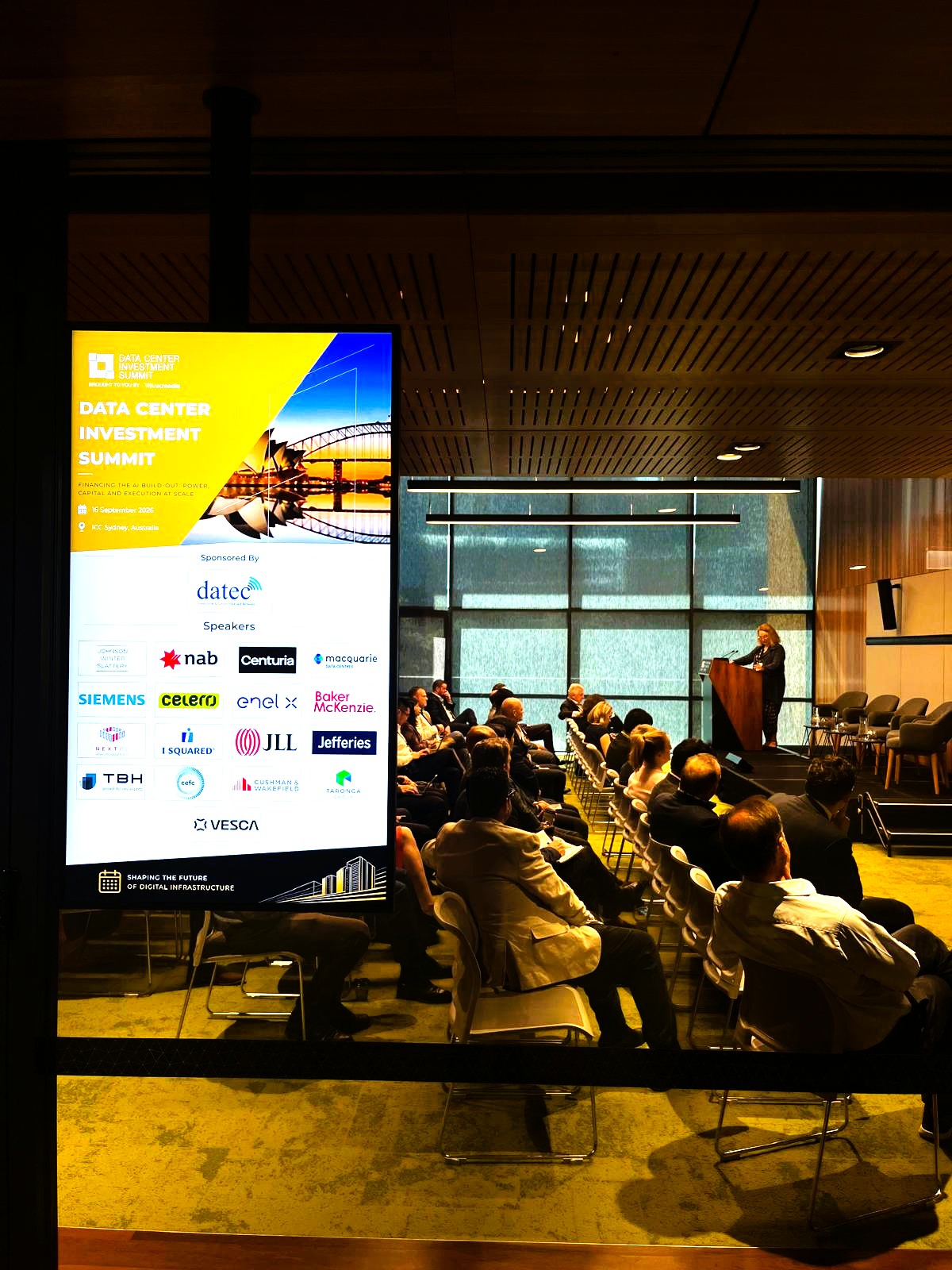
Earlier in September, w.media hosted the inaugural Data Center Investment Summit Australia at the ICC Sydney. Co-located with the Sydney Cloud the Data Center Convention, the event brought together investors across the capital spectrum, developers, operators and advisors for a focused discussion on the future of digital infrastructure investment.
1) Australia’s data centre growth is increasingly an energy and infrastructure challenge.
All panels discussed the growing difficulty of securing power for data centre developments, including connection costs, network infrastructure and the availability of suitable generation. The discussions highlighted that data centre developers are increasingly being drawn into issues traditionally associated with the energy sector.
2) The NSW requirement for renewable energy is creating additional complexity.
Participants examined the policy requirement for data centre developments to support new renewable generation, including the specific focus on new wind projects. Developers and operators questioned whether developers should be expected to take on this level of responsibility and risk before they have certainty around customers, workloads and project economics.
3) Timing is becoming a major investment risk.
A recurring theme was the mismatch between the time required to develop new data centre capacity and the time required to bring new renewable generation and infrastructure online. This creates uncertainty around how projects bridge the gap between immediate data centre demand and future energy supply.
4) Social licence is becoming a core development issue.
Almost unanimously, speakers and delegates noted that community engagement has historically received relatively little attention from parts of the data centre industry. That is changing, with developers increasingly facing organised community opposition around issues such as land use, noise and the impact of new infrastructure.
5) Developers need to demonstrate tangible benefits to local communities.
Rather than treating community engagement as a regulatory exercise, participants discussed the importance of demonstrating local benefits, including jobs, training and partnerships. One example mentioned was a partnership with Macquarie University to create training pathways and use a data centre facility for research and education.
6) Data centres are increasingly being viewed through a sustainability and risk-management lens.
The panel highlighted that investors and developers now need to consider a much broader range of issues – from energy and environmental requirements to community relations and regulatory compliance. This creates a more complex risk profile than the industry has historically faced.
7) The data centre industry is increasingly operating at the intersection of multiple sectors.
Participants emphasised the need to draw on expertise from energy, infrastructure, technology and other sectors. Digital-twin technology was cited as one example of how technological advances could help compress development timelines and improve project planning.
8) The changing customer mix is also affecting investment and financing assumptions.
One of the panel sessions discussed how traditional data centre customers have historically provided a degree of “stickiness” because of their connectivity requirements. AI deployments may have different characteristics, potentially making some customer relationships less sticky. At the same time, sovereign-data requirements could create a different form of long-term demand.
9) Bankability is evolving as the market changes.
Throughout the discussions we heard comparisons from earlier multi-customer data centre models with today’s hyperscale developments, where a facility may be built around a single major customer. This changes the credit assessment because the financial viability of a project can become much more closely tied to the credibility and contractual position of an individual customer
Australia’s data centre opportunity is substantial, but delivering the next generation of capacity will require developers, investors and policymakers to navigate an increasingly complex intersection of power, renewables, regulation, financing and community expectations.
The Australian summit was the last in w.media’s Data Center Investment Summit series for this year. The summits will return again in 2027 starting in Hong Kong.