
For Commend’s Martin Bruetsch, the intercom has evolved from a simple security device into an operational technology platform with a role across security, emergency response and day-to-day data centre operations.
Data centre operators have invested heavily in CCTV, sensors, access control and automated monitoring systems. But when something happens inside or around a facility, there is still a fundamental requirement that technology cannot entirely replace: people need to communicate.
“The button at the gate still exists, but it is now the smallest part of what the system does,” Martin Bruetsch told W.Media.
What has changed, he says, is that the intercom has stopped being a standalone appliance and become a communication platform sitting on the same network as access control, CCTV, alarms, building management and public address. “Once that happens, voice stops being a doorbell function and starts being an operational one,” he says.
The implications go well beyond allowing a visitor or delivery driver to speak to the security operations centre. The same terminal can allow a technician in a plant room to call the control room hands-free, carry an evacuation announcement, display instructions during an incident and self-monitor around the clock. “So the honest answer is that the intercom has quietly become operational technology,” Bruetsch says.
“Most operators haven’t reclassified it yet, as they still procure it as a security accessory, but that is what it is doing in the building,” he adds.
From detection to verification
One of the less obvious roles for voice communication comes when a data centre’s security systems detect a potential incident. Modern facilities can deploy sensors, analytics and CCTV across the perimeter and inside the building. But detection does not necessarily tell an operator what has actually happened.
“Verification is where audio earns its place,” Bruetsch says. “Detection technology is very good at telling you that something happened; it is much weaker at telling you what it means.”
A fence sensor fires, an analytics rule triggers or a door is held open. The operator now has an event and needs to determine whether it is a contractor, a kangaroo, a weather artefact or an actual intrusion. “Video gives you one input. Audio gives you two more: what you can hear at that location, and what the person there says when you speak to them.”
Bruetsch says the approach is recognised in the EDRS and ASBIS standards (EN 50726-1, IEC/EN 62820-2), where alarm, verification and response form a defined sequence. There is also a commercial benefit to resolving incidents before they escalate. “Acoustic verification is the cheapest way there is to kill a false alarm before it consumes a guard patrol, a callout or, worse, a police response,” he says.
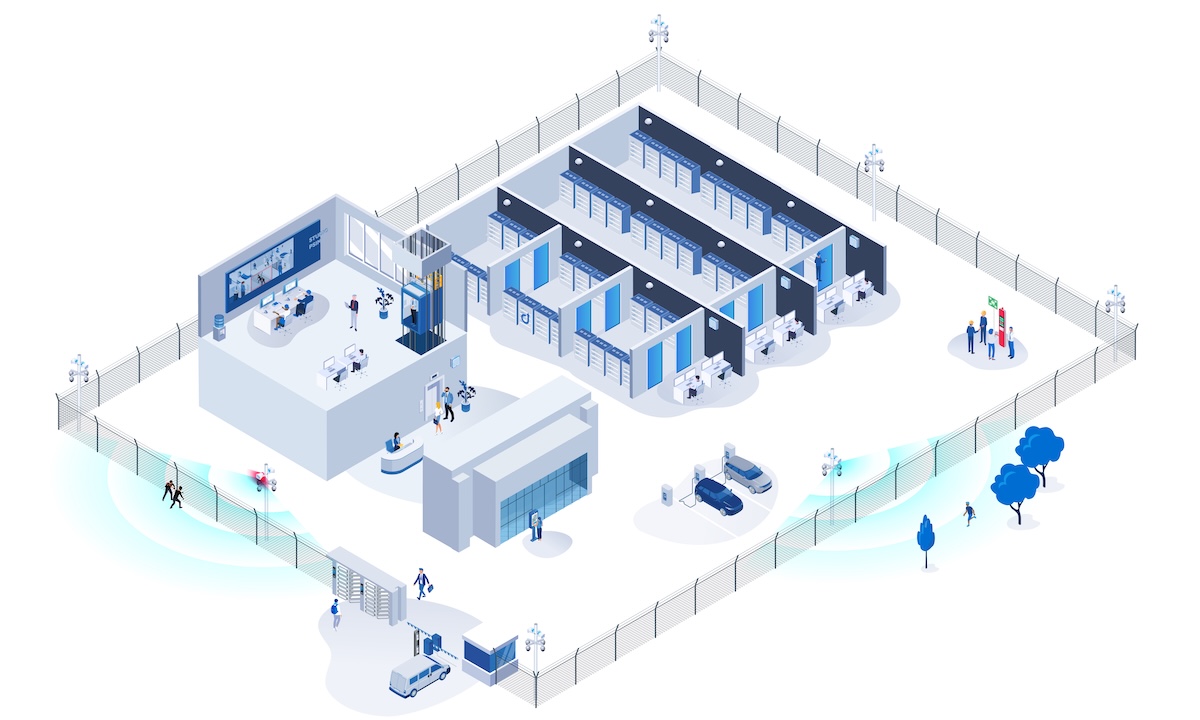
A typical perimeter sequence illustrates the point. Someone approaches the fence late at night. A sensor-driven IP loudspeaker issues a pre-recorded warning automatically while lights are activated, the control desk is called and the relevant camera is displayed.
A smart IP PA system can become part of that audio communication flow. Commend’s IP PA speakers can send pre-recorded messages when triggered by a motion detector or other sensor, before the control room is even activated. Their built-in microphones can also allow the operator to have a two-way conversation with an intruder, providing more effective deterrence, or with a service technician if there is no intercom nearby.
The operator can then listen and speak. “Nine times out of ten what comes back resolves it immediately: a contractor who has gone to the wrong gate, a driver who can’t find the loading dock, someone retrieving a drone. The operator redirects them and the event closes,” he says.
On the tenth occasion, the response, or the silence, tells the operator that the incident is real, allowing the response to escalate with a verified picture rather than a guess. “Either way, being addressed by name and by voice is a remarkably effective deterrent,” Bruetsch says. “People behave very differently once they know they are being watched by a person rather than a camera.”
Where CCTV cannot intervene
The distinction between observing an event and being able to intervene becomes particularly important around a data centre. “CCTV is passive. It observes and it records, and it is invaluable afterwards, but it offers no way to intervene in what is happening now. That is the gap audio fills: a bi-directional connection lets the control room observe and act in the same moment,” he observes.
The perimeter is an obvious example: large, usually unstaffed and protecting assets of disproportionate value. But Bruetsch also points to areas where cameras cannot necessarily provide the same situational awareness, including plant rooms, switch rooms, lift shafts and pits and loading docks at night. “In those areas hearing is often better situational awareness than seeing, and being heard is what actually changes the outcome,” he says.
That leads into another part of the story that Bruetsch believes receives far less attention: the role of communications in everyday data centre operations. “This is the part of the story that never gets told, and it is where most of the value sits,” he adds.
According to Bruetsch, Commend systems are used by some of the world’s largest hyperscale operators, where intercoms can handle contractor and visitor induction at the gate, delivery and loading dock coordination, escorted access into data halls, shift handovers, remote-hands requests and lift communications.
Then there is maintenance. “A technician in a plant room needs to confirm with the control room before switching a chiller or isolating a circuit. Someone working alone in a battery room or on a roof needs a fixed point they can reach without carrying anything. A generator test needs coordination between three people who cannot see each other,” he says.
He adds: “None of that is a security function. It is operations. But it runs on the same terminals, the same server and the same network as the security and emergency functions, which is precisely why the investment stacks up.”
When a mobile phone isn’t an option
The need for dedicated communications becomes more apparent when considering the conditions in which data centre personnel work. “Radios and mobiles assume three things that data centres frequently don’t provide: a free hand, a usable signal, and permission to carry the device in the first place,” Bruetsch said.
Gloves can defeat touchscreens, hearing protection can make handsets difficult to use and coverage can be unreliable inside shielded halls or lift shafts. In higher-security zones, personal mobile phones may simply not be allowed. “The practical consequence is that people stop communicating at the exact moments when communication matters most; or they take off protective equipment to make a call, which is its own risk,” he explains.
A fixed, hands-free intercom can remove those constraints because it is located where the work is being carried out, does not depend on mobile coverage and can be operated without a personal device.
That makes audio quality equally important. “Intelligibility is the whole ballgame,” Bruetsch said. “A communication system that is present but not understood is worse than none at all, because people rely on it and then mishear a critical instruction.”
Data centres can be particularly difficult acoustic environments, with continuous broadband noise and reverberation from hard surfaces. Plant rooms and cooling equipment create one challenge, while wind and traffic can affect communications around the perimeter. He believes the answer is bandwidth, not volume.
Everyday operations and emergencies
Bruetsch also argues that communications infrastructure should not sit idle until an emergency occurs. “There is, and it’s a costly mistake in two ways. Financially, a system used only in emergencies is dead capital…you are paying for infrastructure that runs at nearly zero utilisation. Operationally, it’s worse: nobody is familiar with equipment they never touch.”
The alternative is to use a common platform for everyday operations and emergencies.
“In normal mode the terminals are working assets: door stations, help and info points, operational call points, PA,” he says. “When an incident is declared, the same system switches to emergency mode at the push of a button in the control room – different screens, different priorities, different call routing, escape route guidance, assembly point communication.”
“Same hardware, same muscle memory, different behaviour,” he adds. Integration with other systems is an important part of that architecture. Rather than forcing an operator to assemble information from separate applications, audio, video, maps, access control and event information can be brought together.
“What integration buys you is time and context,” Bruetsch says. The approach also becomes relevant as operators manage multiple facilities. Networked communications can allow calls to follow the people rather than the buildings, routing calls between control desks, escalating unanswered calls and prioritising emergencies.
Another network endpoint to secure
There is a final complication. If communications systems have become operational technology and are connected to the network, they also become part of the cybersecurity discussion. “If it’s on the network, it’s an endpoint, and every connected device is a potential way in,” he says.
Bruetsch argues that communications infrastructure should therefore face the same scrutiny as other OT assets, including questions around security certification, vulnerability management, firmware support and penetration testing.
There is a resilience issue as well. “A communication system is most needed precisely when other things are failing,” he says. For Bruetsch, AI and automation will increasingly change what these systems can do, but the more fundamental shift is recognising what they already are. “Both, but the recognition matters more it’s the change that unlocks the rest,” he says.
As Australian data centres become larger and more automated, routine interactions can increasingly be automated, alerts verified and triaged, and systems made capable of monitoring themselves and escalating only those events that require human intervention.
But Bruetsch emphasises that the underlying message is straightforward. “Operators who treat voice communication as an operational technology – specified early, designed into the architecture, secured like OT, budgeted for its everyday use as well as its emergency use – get a system that works when it counts,” he says. “Operators who keep treating it as a fancy doorbell get exactly what they paid for, usually at the worst possible moment.”