
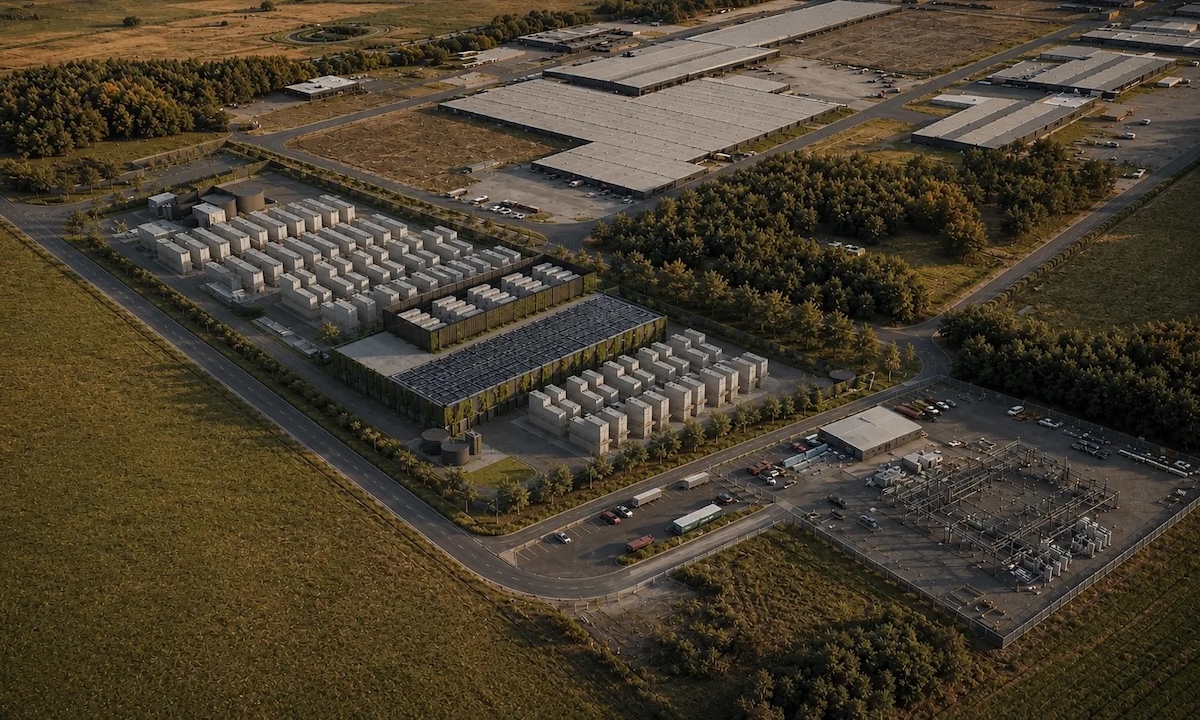
Australian AI infrastructure company Firmus Technologies has lodged plans for an AI-focused data centre at Wesley Vale in Tasmania, with the proposed facility to include a 2,689 sqm data hall, extensive cooling infrastructure and 40 diesel backup generators.
The application, lodged with Latrobe Council, covers 174 and 226 Mill Road, Wesley Vale, would be located within the established Mill Park industrial precinct on the site of the former Wesley Vale pulp mill. Firmus describes it as an AI Factory designed for large-scale AI and data processing.
The planning report says the project would make use of existing industrial land and infrastructure. The architectural drawings show a principal building with 3,502 sqm of gross floor area, comprising 2,689 sqm of technical accommodation, 793 sqm of administration space and a 20 sqm guardhouse. The building footprint is approximately 78m by 45m, with a principal roof height of about 8.5m. Rooftop mechanical equipment and screening bring the maximum height to approximately 15.1m.
Continuous operation
The facility is designed to operate continuously. An emergency management strategy prepared for the development says up to 10 people would work on site during the day, with around four staff during evening and night shifts. Firmus’s planning material says the project would support more than 20 permanent full-time employees once operational, across operations, maintenance, security, energy management, engineering and administration.
Cooling and water
The drawings provide a relatively detailed picture of the cooling system. The facility is planned to use 20 adiabatic cooling units and 20 chillers, with process-water pipework supplying both the rooftop chillers and external adiabatic coolers. According to the water assessment, the adiabatic units will provide the primary cooling function, with water-based evaporative cooling used during periods of high ambient temperature.
The chillers can also be supplemented by evaporation when required. The assessment says around 90 percent of the water applied to the evaporative pads is evaporated. The site plan includes four 250kL make-up water tanks, providing 1,000kL of storage, while the roof drainage system is designed to collect rainwater. The drawings specify 12 downpipes, each serving an effective catchment of about 300 sqm.
The project will not be supplied with water from TasWater under the current arrangements. TasWater has advised that it cannot supply a water connection to the site, although a connection could be explored if Firmus provides a design meeting its servicing standards. The planning documentation says wastewater volumes are expected to be small enough to be managed through the site’s stormwater retention system.
Backup power and bushfire protection
The development will include a substantial standby power system. The bushfire assessment identifies 40 containerised UPS diesel generators, with each generator capable of holding up to 10,000 litres of diesel, and identifies engine oil and LiFePO4 battery systems associated with the generators. The generators are visible around the building in the architectural elevations, alongside rooftop chiller equipment. The EPA has recommended that generator use be limited to that described in the application and that stored fuel be appropriately contained and bunded, given the scale of the standby generation system.
The site’s industrial location also places it close to electricity infrastructure. The planning report identifies the Electricity Transmission Infrastructure Protection Code among the planning controls applying to the site.
Environmental considerations
The EPA has provided preliminary advice on the application, including recommendations concerning noise and air-quality monitoring, suggesting post-approval modelling or monitoring given the scale of the development. The EPA also raised potential water-quality issues associated with evaporative cooling, recommending controls around any discharge to stormwater and monitoring for accumulated dissolved solids.
Interestingly, the application does not currently disclose the proposed IT load or total electrical demand of the facility. W.Media has asked Firmus to provide the project’s MW requirement. The development is now subject to Latrobe Council’s assessment process, with the council’s public notice allowing representations on the application.