
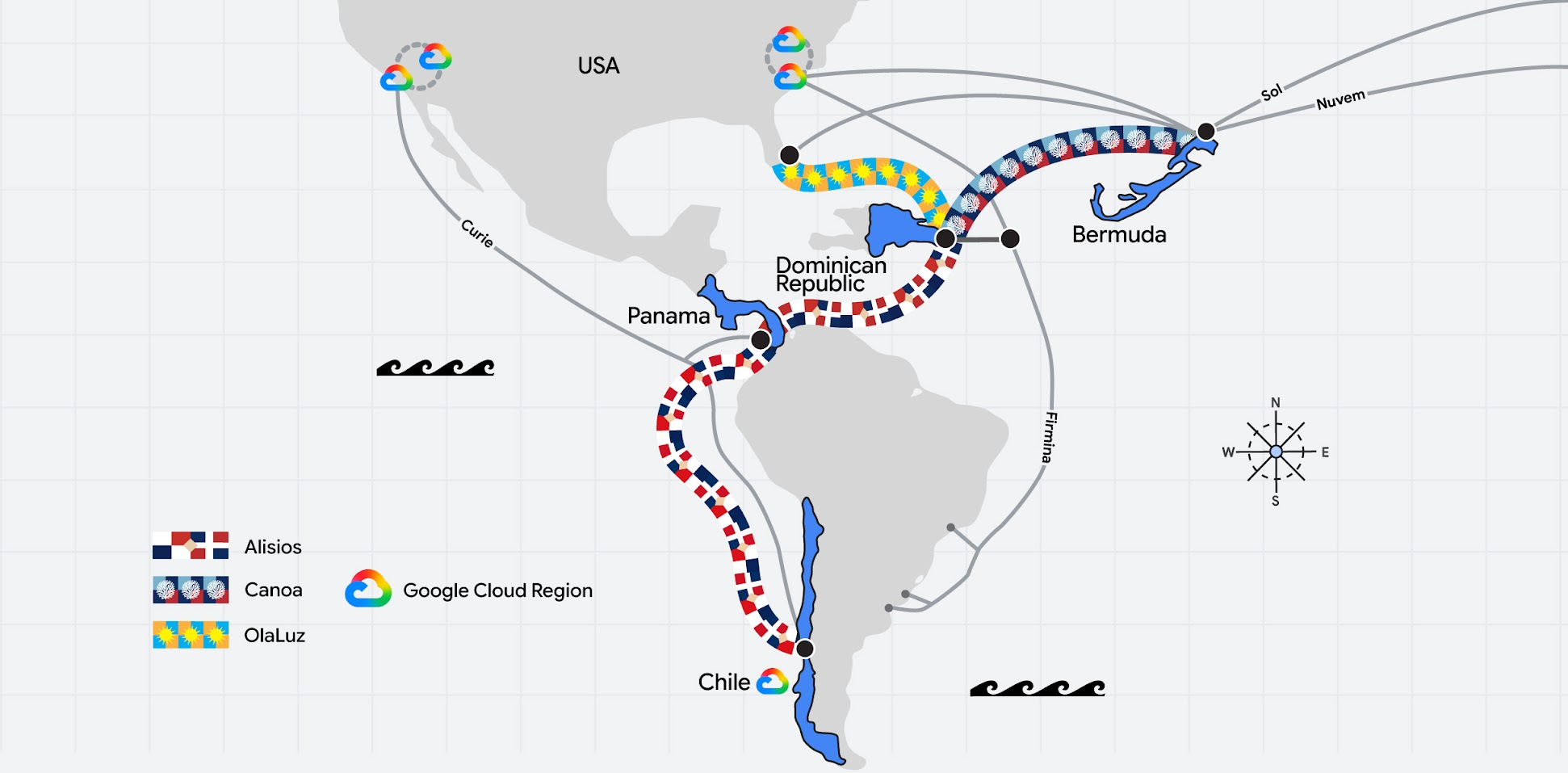
Google has announced three new subsea cable systems that will connect four regions across South America and the Caribbean to Europe and North America. The company says the new systems will improve resilience through redundancy while boosting capacity across South America and the Caribbean.
The three new cable systems will add to the Curie, Nuvem, and Sol cables that currently fall under the Americas Connect network. The new cables coming to the network are named Alisios, Canoa, and OlaLuz according to a press release.

The Alisios subsea cable system will connect the Dominican Republic, Panama, and Chile. Canoa will connect the Dominican Republic to Bermuda, with OlaLuz connecting the Dominican Republic to Florida.
“To further strengthen network diversity, Google is also introducing a new branch of the Firmina subsea cable that will land directly in the Dominican Republic. Originally built to connect North and South America, this new branch extends Firmina’s high-capacity reach and brings additional network connectivity to the Caribbean,” writes Brian Quigley, Google Cloud Vice President of Global Network Infrastructure.
This sort of resilience has been lacking in South America, which has historically depended on terrestrial connectivity that is congested and prone to failure or limited subsea connectivity. By investing in the Alisios, Canoa, and OlaLuz subsea cable systems, Google aims to make connectivity much more robust than in the past.
According to Quigley, the Americas Connect project will create redundant paths connecting Chile to Panama, with a third link connecting Panama to the US West Coast, providing connectivity to Google Cloud regions in Chile, Los Angeles, and Las Vegas.
“As we welcome the announcement of the Alisios, OlaLuz, and Canoa subsea cable systems, the Dominican Republic is pleased to continue partnering with Google to bolster digital connectivity and innovation as part of Americas Connect. Our participation in the Caribbean and Latin America telecommunications network allows us to join our partners in strengthening connectivity across the Americas, serving as an integral node in this expanding digital ecosystem,” said Luis Rodolfo Abinader Corona, President of the Dominican Republic.
Furthermore, the Canoa cable extends to Bermuda, where it will interconnect with the Nuvem and Sol cables that connect to Europe.
“This connection creates new digital pathways and partnerships between Bermuda and the Caribbean Community, while strengthening resilience for Bermudian households and businesses. We are encouraged that global infrastructure leaders such as Google continue to choose Bermuda. This investment reflects growing confidence in our island as a trusted digital gateway and strategic landing point in the Atlantic,” said Alexa Lightbourne, Minister of Home Affairs for the Government of Bermuda.
Google hasn’t shared information about the capacity that the Alisios, Canoa, and OlaLuz subsea cable systems will provide or when they will be operational. The company also hasn’t disclosed how much it plans to invest in these cable systems.

Google has invested in more than 30 subsea cable systems over the years. Earlier this year, w.media reported that the Sol and Nuvem cables had landed in Bermuda less than a year after Google announced the project. That cable is composed of 16 fiber pairs with a total capacity of 384Tbps and not only improves reliability for the island nation but also improves latency for Google and Google Cloud users around the world.