
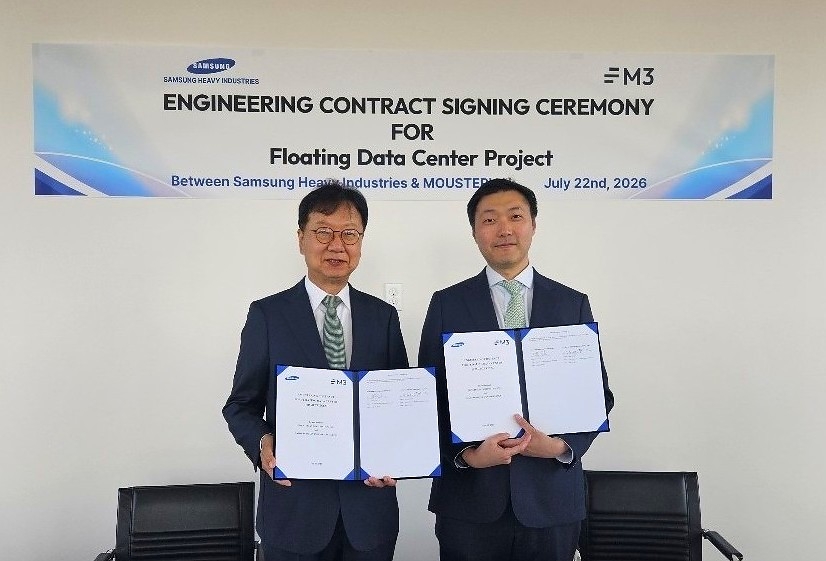
Shipbuilder and maritime engineering firm Samsung Heavy Industries (SHI) has signed an engineering contract with Mousterian Corporation (M3), an infrastructure developer, for the first moored floating data center (FDC) deployment in the United States, the first project agreement under a strategic framework SHI and M3 announced in April 2026.
Together, SHI and M3 will perform the basic design, detailed engineering, and production design for purpose-built moored FDC units delivering 50 MW of IT capacity. The FDC units are expected to be deployed in Texas and other key markets in the US, according to a press release.

“Signing this engineering contract transitions our partnership with Samsung Heavy Industries from intent to execution and gives us a clear path to scaling factory-built critical IT capacity for AI-class facilities,” said Min Suh, Chief Executive Officer of Mousterian Corporation. “We are jointly engineering the first mission-critical data center of its class to be fabricated off-site to shipyard standards.”
The M3 CEO went on to say that because the facility is built in a shipyard, fabrication advances alongside sitework rather than after it, giving these solutions an edge over conventional data center delivery methods.
“Floating data centers are a natural extension of the engineering, fabrication, and project delivery capabilities we have built over five decades in offshore and maritime construction,” said Sung-an Choi, Vice Chairman and Chief Executive Officer of Samsung Heavy Industries. “Together with Mousterian, we intend to deliver floating data centers with the same rigor, quality, and schedule certainty that define our maritime track record.”
According to M3, the FDC design makes use of bulk non-evaporative cooling that consumes no potable water and returns no process discharge to the surrounding waterway. The design of the data centers is said to have a very low power usage effectiveness and a low noise profile as it eliminates the need for air-cooled chillers and fans.
The FDCs are expected to be deployed alongside existing power generation infrastructure in a bid to demonstrate that delivery timelines can be reduced drastically, unlocking capacity for hyperscalers quicker than land-based data centers can.
Earlier this year, SHI signed a memorandum of understanding with several international partners to develop an FDC concept that uses shipbuilding methods to create scalable offshore digital infrastructure.

The fact that SHI and M3 plan to deploy FDCs in the US is good news for hyperscalers and even neoclouds in the region. Limited land availability is increasingly constraining buildouts in the US and putting a data center on water may erase that problem. FDCs also represent a growing market with QY Research reporting that the market could be worth as much as US$ 593 million by 2031.