
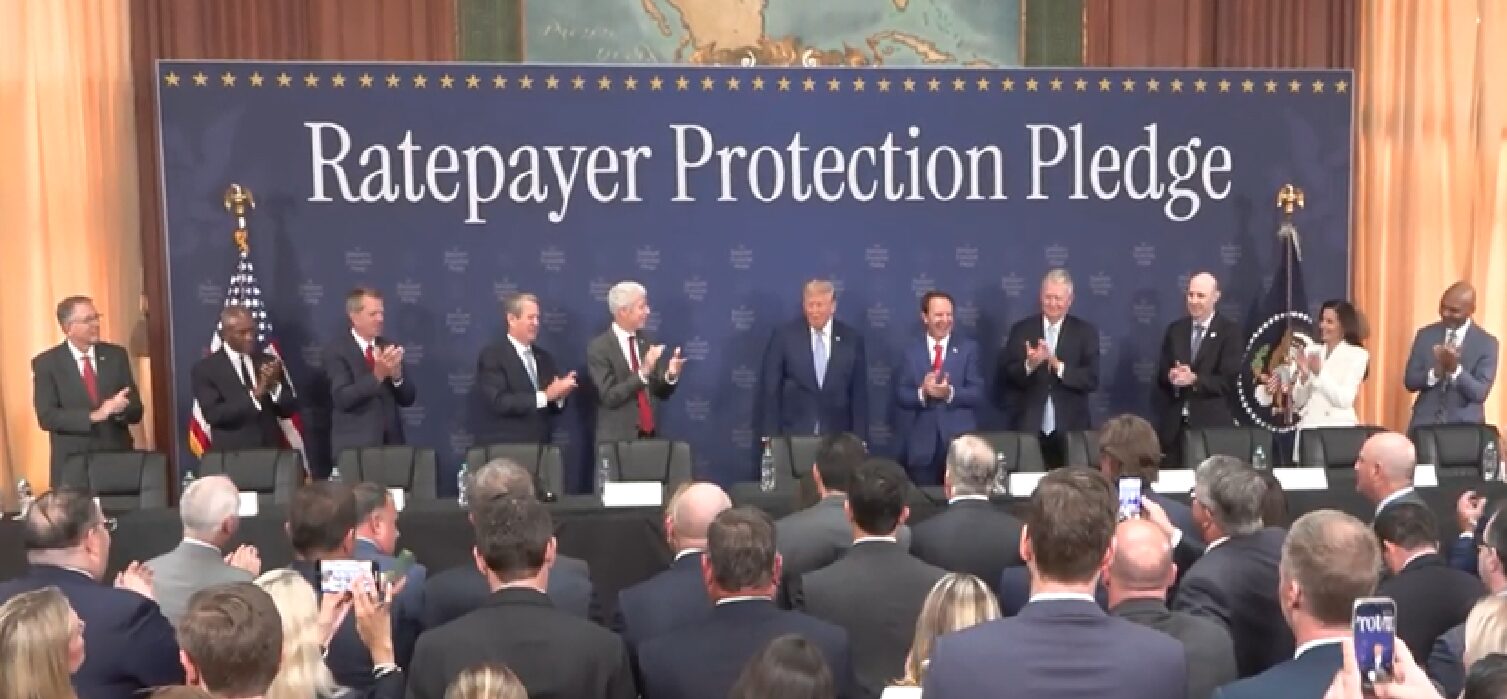
U.S President Donald Trump has extended the Ratepayer Protection Pledge to include over 200 new entities including governors, state legislators, developers, and power providers. The announcement was made last week at the U.S. Environmental Protection Agency (EPA) Headquarters in Washington, D.C.
President Trump first announced the Ratepayer Protection Pledge in his State of the Union address on February 24, 2026. On March 4, 2026, seven leading AI companies and hyperscalers — Amazon, Google, Meta, Microsoft, OpenAI, Oracle, and xAI — signed the Ratepayer Protection Pledge at the White House as a voluntary agreement aimed at preventing electricity costs tied to data center expansion from being passed to households.

In a press release, the EPA reiterated that as part of the obligations under the Ratepayer Protection Pledge, signatories are committing to build, bring, or buy all of the energy needed to power their facilities and to pay the full cost of that energy and its supporting infrastructure, no matter what. “Ratepayer Protection Pledge extends those obligations across the full chain of parties whose decisions determine what a family pays each month: the electric utilities that set rates, the developers that build the facilities, and the States that regulate both,” it explained. In other words, the Ratepayer Protection Pledge aims to safeguard communities that choose to welcome data centers from utility price hikes.
“The United States never settles for a second, and we don’t under this administration… we live by the motto ‘America First,” said President Donald. J Trump. “Thanks in part to this incredible [AI] technology boom, investments are pouring into the United States from all over the world.”
“The global race for AI is underway, and America must win it — but not by asking working families to pay for it,” said EPA Administrator Lee Zeldin. “Communities that welcome these facilities deserve every fact in front of them and every protection behind them. That is what the Trump EPA has delivered, and that is what the Ratepayer Protection Pledge builds on. Our Team at EPA is honored to host President Trump, Secretary Wright, and many other distinguished guests, for today’s important announcement.”
The Pledge commits signatories to five obligations: building, bringing, or buying new power supply; paying for all new power delivery infrastructure upgrades; paying negotiated rates whether or not they use the electricity; investing in local hiring and workforce development; and coordinating with grid operators to strengthen grid resilience, including by making backup generation available during periods of scarcity.
This expansion of the Ratepayer Protection Pledge comes amidst growing concerns about energy use by data centers, and more importantly how it was impacting utility bills of communities living in their vicinity. On July 18, as many as 142 groups protesting unchecked data center development held protests and demonstrations across 42 U.S states as per a Reuters report.
We have also covered the subject of opposition to unchecked data center development in the latest issue of w.media’s Cloud & Datacenters magazine. Click the image below to download your complimentary copy and turn to page 46-47:

Meanwhile, the EPA has advanced this work by making the rules of the road public and accessible before a shovel goes in the ground. In December 2025, EPA’s Office of Air and Radiation launched the Clean Air Act Resources for Data Centers webpage, giving developers, local communities, and Tribes a single location for the regulatory information, permitting guidance, and air quality modeling tools relevant to these facilities.
In May 2026, EPA launched the Permitting Authority Map, a public interactive tool that allows anyone to select a location and identify which agency — EPA, State, territorial, Tribal, or local — issues each environmental permit. EPA also published reuse considerations and a Redevelopment Mapper to help communities and developers evaluate Brownfield and Superfund sites for industrial reuse.