
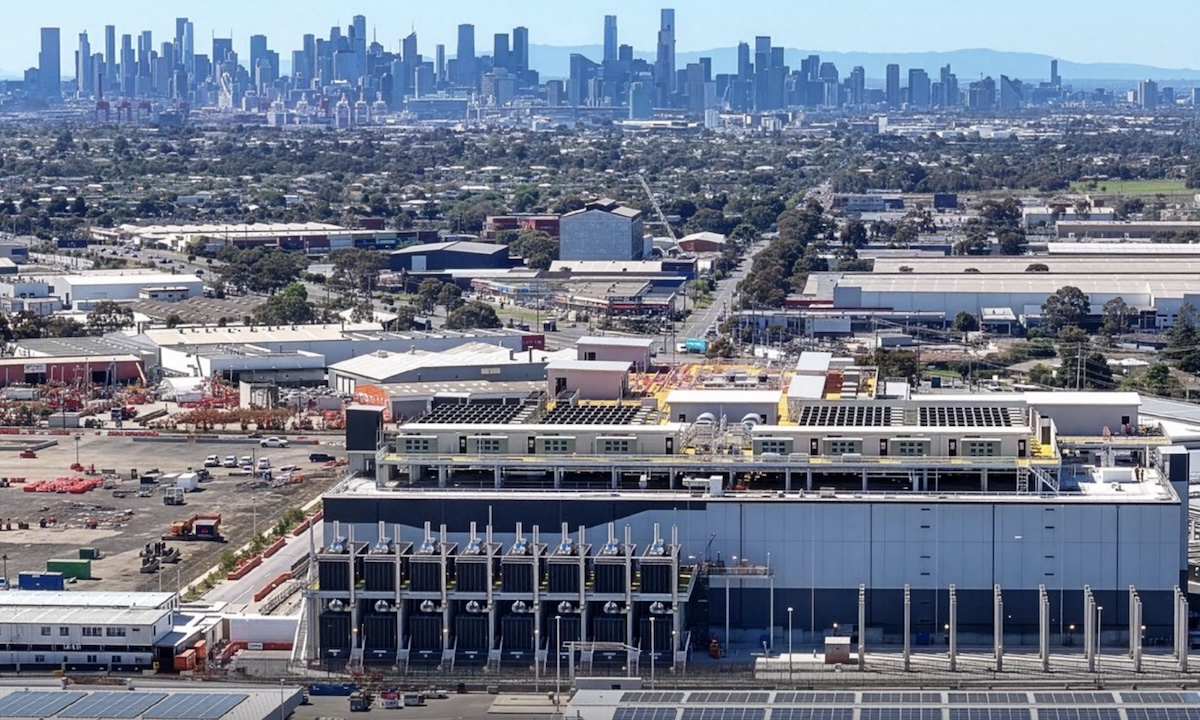
Australia’s electricity system planner has significantly elevated the role of data centres in its latest long-term network planning, forecasting the sector could account for almost 10 percent of National Electricity Market (NEM) demand by 2050 as AI infrastructure drives a new wave of electricity consumption.
In its 2026 Integrated System Plan (ISP), released today, the Australian Energy Market Operator (AEMO) identifies data centres as one of the key drivers behind a near doubling of electricity consumption across the National Electricity Market over the next 25 years.
For the first time, AEMO’s long-term planning positions data centres not simply as another source of electricity demand, but as one of the defining drivers of Australia’s future transmission, generation and system planning.
Under AEMO’s central “Step Change” scenario, underlying electricity consumption across the NEM is forecast to increase from 205TWh today to around 390TWh by 2050, driven by population growth, electrification, and the rapid expansion of electricity-intensive industries including AI data centres.
The report forecasts data centres will consume around 34TWh of grid electricity annually by 2050, accounting for almost 10 percent of total underlying electricity demand – five times the share they have today and the equivalent of 20 percent of current total grid consumption – becoming one of the largest new sources of electricity demand on the Australian grid.
AEMO said data centre development had already exceeded expectations set out in previous editions of the ISP. “Data centres have emerged as potentially significant consumers of electricity, with their development exceeding what had been forecast in previous ISPs,” the report states.
However, it notes there remains considerable uncertainty around future demand “as industry expectations on both connection rates and technical frameworks are revised.”
Higher demand
The operator has therefore incorporated data centre growth into all three of its long-term planning scenarios and created a dedicated “Higher Demand” sensitivity to test the resilience of Australia’s future electricity system should AI infrastructure deployment accelerate faster than expected.
That sensitivity assumes electricity demand would be approximately 39TWh higher than the Step Change scenario by 2050, largely driven by additional industrial demand in South Australia, Melbourne-Geelong, Sydney-Newcastle-Wollongong and Gladstone. South Australia would see the largest increase, with an additional 18TWh of electricity demand.
While higher demand would require significantly more renewable generation and storage, AEMO concluded its preferred development pathway remained robust even under that scenario.
Importantly for the transmission sector, the value of planned network investment increases substantially under higher AI and industrial demand. AEMO found the net market benefits of its transmission development pathway would rise from around AUD 30 billion under the Step Change scenario to AUD 61 billion under the Higher Demand sensitivity.
Rapid expansion
The ISP also highlights the rapid expansion already underway across Australia’s data centre sector.
According to AEMO, Australia currently has more than 160 operational data centres, with almost half located in Sydney and most of the remainder concentrated in Melbourne, Brisbane and Perth. Together they account for around two percent of today’s grid-supplied electricity consumption. By the end of the March 2026 quarter, 11 large data centre projects representing more than 5GW of maximum demand were progressing through the electricity connection process.
AEMO said these projects typically require around two years to progress from connection application to energisation before gradually ramping up to full electricity demand over five to 10 years.
Recognising the increasing impact of AI infrastructure on power system planning, AEMO said it has been working formally with the Energy and Climate Change Ministerial Council and other energy market bodies since March 2025 on the implications of large-scale data centre growth.
That work includes investigating ways to minimise system impacts, maximise potential system benefits, and develop appropriate regulatory frameworks for large data centres. The operator is also developing new technical standards for large data centres, alongside additional rule changes covering the operational integration and visibility of large inverter-based loads, replacing the current reliance on bespoke connection arrangements.
The latest ISP also reinforces the broader role AI infrastructure is expected to play in Australia’s energy transition.
Business and industrial grid electricity demand is forecast to double from 140TWh today to 280TWh by 2050, driven primarily by electrification, hydrogen production and AI data centres, while household net grid consumption falls as rooftop solar, batteries and electric vehicles become more widespread.