
Reshaping the AI data centers (AIDCs) through a grid-interactive AIDC strategy including introducing new products, that’s the key message of Huawei Technologies Co., Ltd.
Why do tokens matter? Because, in the AI era, AIDCs are transitioning from the traditional data center to the token factory where the end product is tokens. These are used to measure both the cost and efficiency of AI applications, says Bob He, Vice President of Huawei Digital Power.
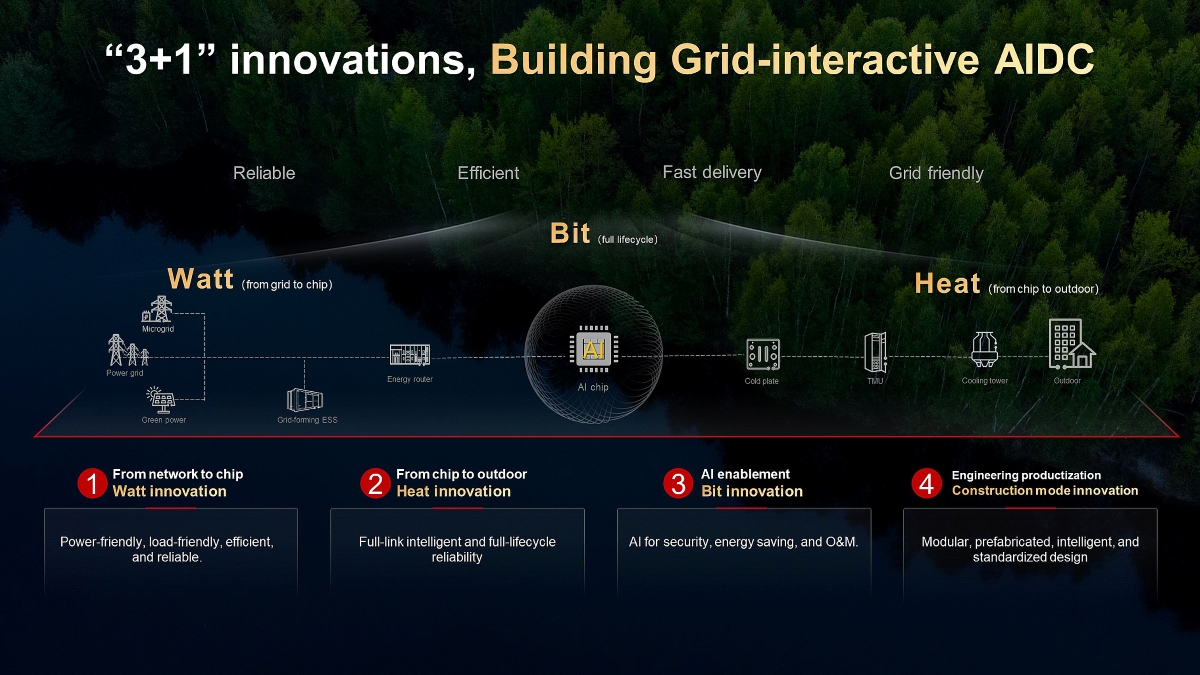
Huawei’s AIDC strategy is centered on the “3+1” innovations to maximize tokens per watt — Watt, Heat, Bit, and Construction.
Through its self-developed Taishan UPS, Hengshan DC UPS, SmartLi, PowerPoD, and megawatt level liquid cooling system, Huawei restructures the entire capability from grid to chip, from chip to cooling source and from operation to construction, accelerating the evolution towards grid-interactive AIDC.
“We need to make AIDCs more reliable, efficient, fast and futureproof, ” Bob emphasised. “Power defines compute, hence, we will build a grid forming energy router which can support the grid so an AIDC can be an active player and important node instead of being just a pure consumer of electricity.”
Heat Innovation (Cooling Link): Reshaping full-lifecycle thermal management reliability from chips to outdoors, with AI-powered MW-level liquid cooling system for efficient and reliable heat dissipation.
Construction Innovation: Shifting to prefabricated and modular construction so as to move the complexity of construction to the factory stage to speed up delivery.
Explaining further, Bob notes, “Most importantly, we will continually invest and innovate in technologies like power electronics, high voltage, AC/DC, SST, liquid cooling and digital technologies.”
Watt Innovation
Huawei believes the primary axis of innovation and restructuring is end-to-end power electronics integration.
“With silicon embodying power electronics technology, digital technologies will be increasingly embedded into the entire power supply chain,” says Bob.
Grid-forming technology is the key enabler of both grid-friendly and load-friendly operation. It is a critical capability that will become a must-have for AIDCs, functioning as a supportive grid-friendly node.
Another major trend is the move towards higher voltage and DC distribution.
“We view the shift to 800 V and 1500 V DC as a system-level revolution across the entire industry chain requiring practitioners to collaboratively address a full spectrum of end-to-end issues, from power supplies to power distribution to servers and beyond,” Bob elaborates.
That said, even as the industry advances towards DC deployment, the coexistence of AC and DC will remain a prolonged norm, Bob notes, and he explains:
“An 800 V or 1500 V DC architecture is not as simple as converting a certain UPS to DC output. It represents a full-link transformation from 10 kV all the way down to 1 V.
“Beyond high-density GPU servers, AIDC also includes CPUs, networking equipment, storage devices, and more. These devices have different power densities, different lifecycles, and different requirements for power supply methods.
“AC architecture is mature, reliable, and has a complete ecosystem. It will continue to serve a wide range of mainstream scenarios. DC architecture offers higher efficiency, shorter links, and is well-suited for high density. It will gradually expand in scenarios where conditions are ripe.”
For future AIDC power supply, Huawei has proposed a MIMO power architecture. MIMO stands for Multiple Input, Multiple Output encompassing multiple input sources, multiple output formats, and multi-level energy storage which together form the power architecture of future AIDC.
Under the MIMO architecture, Huawei will leverage SST technology to build a converged, grid forming energy router ultimately enabling the AIDC to become a true energy node that orchestrates source, grid, load, and storage.
New Power supply solutions
Consequently, Huawei has developed TaiShan UPS which can proactively adapt to the needs of a weak grid and achieve up to 98% efficiency. At the same time, Huawei has developed Hengshan DC UPS and the full-link 800 V products to accommodate new trends.
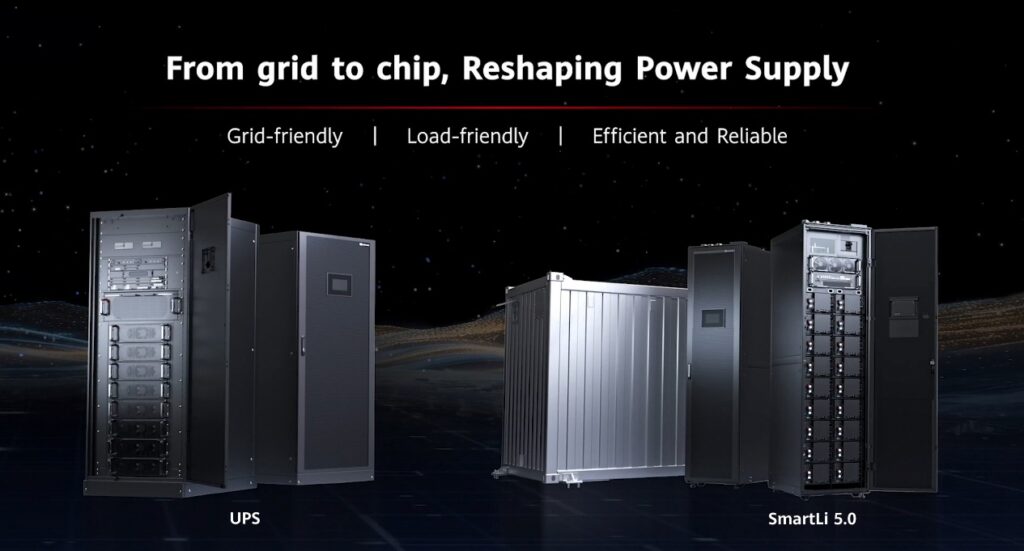
Huawei has developed what is believed to be the industry’s first SmartLi 5.0 that can be adaptable to 800 V DC architecture and withstand thermal runaway without catching fire.
Heat innovation
Liquid cooling is the future – it must be a system-level capability encompassing full-lifecycle and full-chain control with reliability of the entire chain from chip to cold source being prioritised.
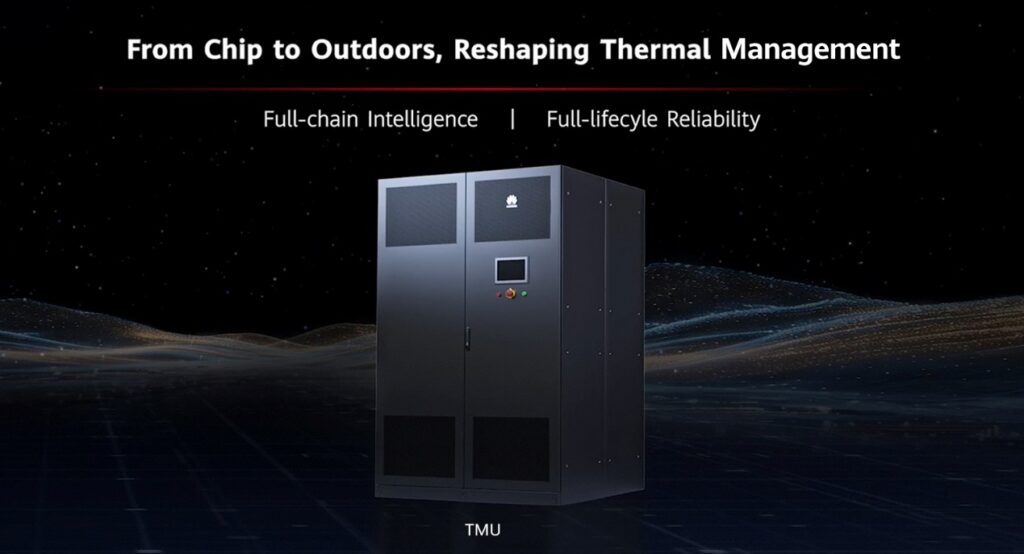
Huawei has proposed a new concept, the TMU, a thermal management unit which is the heart of the entire liquid cooling system. Supplementing that is an AI-powered liquid cooling management system which can proactively sense and predict system sub-health states, intervene in advance, identify micro-leaks early, predict coolant trends, and prevent the sudden outbreak of system risks such as fouling and clogging.
In short, moving from CDU to TMU is essentially a transition from a cooling capacity device to a system control device.
Construction Innovation
Huawei believes in speeding up delivery so that customer workloads can be deployed faster. And the one way to do this is to shift from on-site integration to productized, modular and intelligent delivery. It means, for example, front-loading integrating by standardizing interfaces in advance, front-loading validation so that much of the on-site testing is completed before leaving the factory, and pre-embedding many operations and management capabilities into its native systems. This could reduce the delivery timeline from 12 months to six or even three months.
The future of AIDCs
Currently, AIDC electricity consumption still relies predominantly on traditional power. However, in the long run, integrating more renewable energy will become the norm. But renewable energy is inherently variable, and AI workloads are not conventional stable loads either, Bob explains.
“Wind, solar, and other renewable sources bring challenges to grid predictability and adjustability. GPU clusters also experience rapid fluctuations during task initiation, scheduling, and switching. Yet, as AIDC scales up and the share of renewable energy increases, it could further intensify the pressure on grid balancing.”
As such, Huawei believes that AIDC must evolve from “adapting to the grid” to “supporting the grid,” and further to “actively forming the grid.” Huawei proposes a grid-interactive AIDC that integrates the source, grid, load, and storage, where “source” includes both traditional power and renewable energy, “grid” emphasizes stability and friendliness, “load” refers to the high-value, high-density, and highly fluctuating AIDC workloads, and “storage” is the key resource connecting the two ends and balancing the fluctuations. With a grid-forming energy router, a buffer can be created between the fluctuations on both ends, enabling AIDC to become a grid-friendly energy node.
Further, as AIDC enters the Token Factory era, traditional evaluation frameworks are no longer enough. “Looking only at PUE is not sufficient in the AIDC era, because what customers truly care about is not just “saving electricity,” but “how many tokens can be produced per watt”,” says Bob.
That explains why Huawei is proposing a new evaluation direction: the TokEnergy Index which Huawei hopes to jointly refine with its customers, partners, standards organizations, and industry experts.