
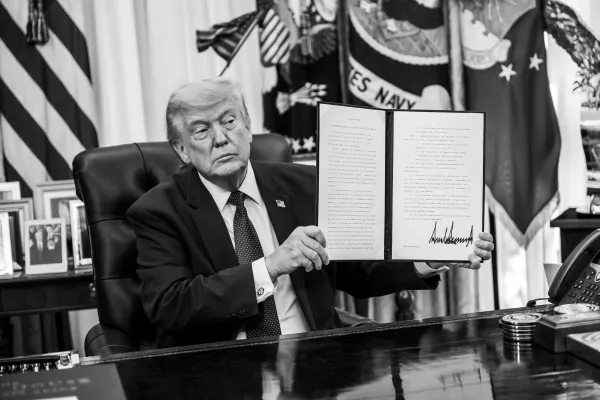
U.S President Donald Trump has issued a policy directive outlining how the federal government should approach Artificial Intelligence, emphasizing reduced regulation, closer work with industry, and expanded cybersecurity defences across federal systems.
The order titled ‘Promoting Advanced Artificial Intelligence Innovation and Security’ argues that the U.S. maintains leadership in AI due to private-sector innovation and a regulatory approach that avoids heavy federal restrictions. It directs agencies to prioritize cybersecurity upgrades across national security, defence, and civilian systems, with multiple deadlines of 30 to 60 days.

Provisions include those for accelerating vulnerability detection, expanding AI-enabled defensive tools, and improving hiring pipelines for cybersecurity roles. A proposed “AI cybersecurity clearinghouse” would coordinate vulnerability discovery and patch distribution between government and industry.
In the policy summary President Trump stated, “It is the policy of the United States to promote AI innovation and security by working collaboratively with the private sector to modernize government and private sector information systems and harden them against external threats; to protect American ingenuity and intellectual property from exploitation and theft by adversaries; and to cultivate America’s advanced AI-enabled capabilities.”
Trump continues, “The United States continues to lead the world in Artificial Intelligence because of the enormous talent and innovation of our AI industry, and because we refuse to stifle this innovation with overly burdensome regulation. As these capabilities evolve, my Administration will continue to work closely with industry to ensure that the best and most secure technology is deployed rapidly to confront any and all threats to our country.”
The directive also sets up a framework for assessing advanced AI systems used in cyber operations. Federal agencies would develop a classified benchmark to determine when a model qualifies as a “covered frontier model,” with voluntary pre-release government review offered to developers.
Additional provisions direct the Office of Personnel Management to expand cybersecurity hiring pathways and instruct the Attorney General, through the United States Department of Justice, to prioritize prosecution of cybercrimes involving AI-assisted unauthorized system access, fraud, and data breaches.
On security enforcement, it instructs the Justice Department to prioritize existing criminal statutes against the use of AI in hacking, fraud, and unauthorized system access. The order combines voluntary industry coordination, expanded federal cybersecurity infrastructure, and a non-regulatory stance toward AI model development.

The order emphasizes that implementation must remain within existing legal authority and available funding, and states that it does not create enforceable rights against the federal government and does not create a licensing or pre-approval regime for AI systems.