
Datasection, a Tokyo Stock Exchange-listed company that until recently was known primarily for data analytics and marketing services, recently posted revenues of JPY 33.6 billion (approximately USD 217 million) for the fiscal year ended March 2026 – a 933% increase on the prior year – almost entirely on the back of a pivot into AI infrastructure that the company is now calling its core business.
The company describes itself as a neocloud operator and claims it is currently the only Japanese company advancing large-scale AI cluster development while simultaneously securing GPU capacity, power resources, and customers on a global basis. Its FY03/27 guidance – JPY 162.2 billion in net sales, JPY 24.8 billion in operating profit – projects a further 383% revenue increase, built on data centre deployments spanning Japan, Australia, Thailand, and an expanding pipeline that stretches to the UAE.
From nought to 20,000 GPUs in eight months
Net sales recognition from the AI infrastructure business commenced in September 2025, with GPU clusters added sequentially from mid-September – generating approximately JPY 320 million in that month alone. By October, with full-scale operations underway, the business was generating approximately JPY 4.5 billion per month. As of 18 May, Datasection’s TAIZA cloud stack was operating 20,180 GPUs across Japan, Australia, and Thailand.
Central to the company’s competitive positioning is TAIZA itself – a proprietary cloud stack for operating large-scale AI clusters that Datasection says enables unified management of GPU infrastructure across multiple geographies. TAIZA is operated in partnership with CUDO Ventures, a London-based NVIDIA-certified cloud partner with which Datasection reached a capital alliance agreement in June 2025, with a joint venture subsidiary under discussion. Following testing by global customers, TAIZA has received strong evaluations, according to the company.
Datasection argues that while GPU demand has outpaced supply globally, most Japanese companies have been unable to close the procurement gap. Through supplier partnerships spanning GIGA COMPUTING of Taiwan, Inventec Corporation, and Compal Electronics – all major Taiwanese hardware manufacturers – the company claims its GPU procurement capability is disproportionately strong relative to other Japanese operators.
In May 2026, it signed a USD 325 million agreement with Compal for 635 servers equipped with 5,080 NVIDIA B300 GPUs, destined for its first Japanese data centre. Only a limited number of Japanese companies, Datasection claims, are currently capable of constructing large-scale AI clusters at all.
The customer and the intermediary
Almost all of Datasection’s AI infrastructure revenue flows through a single intermediary: NauNau Japan, a Tokyo-based business alliance partner named in the company’s formal financial results as the major customer accounting for JPY 30.5 billion – essentially the entirety of AI infrastructure revenue – in FY03/26. The underlying end customer is described as one of the world’s largest cloud service providers but has not been named by Datasection, citing confidentiality obligations.
Media outlets including the UK’s Financial Times have reported that Datasection’s biggest customer is Tencent, the Hong Kong-listed technology group, although Datasection has not confirmed or denied this.
The concentration of revenue through a single intermediary and a single undisclosed end customer is the most significant structural risk in the business. It is also, for now, the engine of its growth: the continuation of that customer relationship accounts for JPY 79.9 billion – the single largest line – in the FY03/27 forecast.
The Australia play
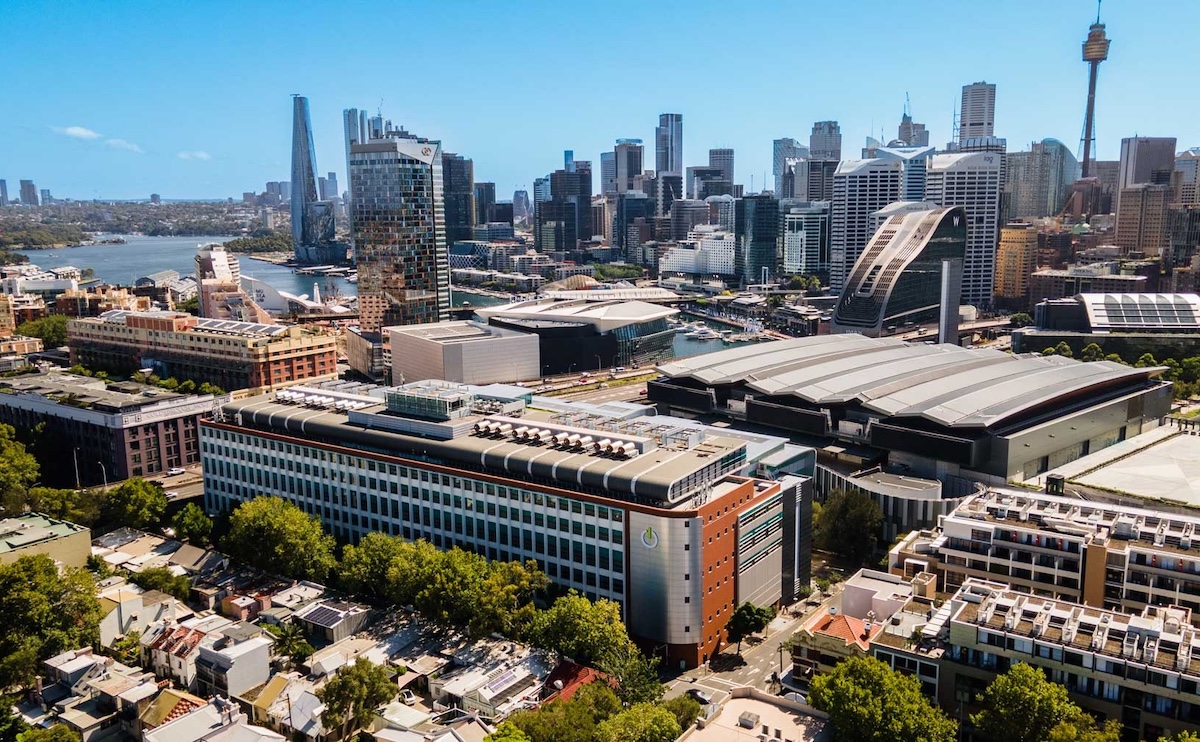
The most commercially significant new project is the company’s first Australian data centre, operating out of DigiCo Infrastructure REIT’s SYD1 facility at Ultimo (pictured, above) on the edge of Sydney’s central business district. According to the AFR, citing company sources, Datasection struck a deal with DigiCo in October 2025. Phased operations are scheduled to commence from July 2026, initially running approximately 10,000 NVIDIA B300 GPUs across 1,250 servers sourced from Inventec Corporation under a December 2025 purchase agreement, with approximately 20 megawatts of capacity.
The Australia project is planned to double to 40 MW by January 2027 and eventually scale to 30,000 GPU units, making it by far the company’s largest single deployment. Datasection’s FY03/27 forecast projects JPY 34.2 billion in revenue from the first Australian project and a further JPY 12.8 billion from the expansion phase, which it describes as highly probable. In April, the company had flagged delays at the Sydney centre due to late delivery of materials and equipment, a factor that also contributed to FY03/26 net sales coming in approximately 10% below the company’s own revised forecast.
The domestic and regional build-out
Japan’s first domestic project, in Inzai City, Chiba Prefecture, involves 5,000 NVIDIA B300 GPUs across 635 servers, with phased operations also scheduled from July 2026 and JPY 15.9 billion in projected FY03/27 revenue. In Thailand, a 5,000-GPU B200 cluster in Bangkok adds a further JPY 15.9 billion to the forecast, classified as a highly probable pipeline project. Hardware for the Thailand and initial Australian deployments was sourced under the December 2025 Inventec agreement covering 1,250 servers and 10,000 B300 GPUs.
Across all three initial deployments, the company is targeting approximately 20,000 GPUs and 40 megawatts of data centre capacity. To fund the GPU procurement underpinning this build-out, Datasection signed an exclusive arrangement agreement in May 2026 with an unnamed global investment firm managing approximately USD 100 billion in assets, targeting between USD 500 million and USD 1 billion in financing. Final arrangements are expected between May and August 2026, though the agreement does not guarantee funding and remains subject to due diligence and various conditions precedent.
The pipeline beyond
The contracted and near-term projects are only part of the picture. Datasection’s broader pipeline, if executed, would represent a step-change in scale that dwarfs what is currently reflected in earnings forecasts. Projects A and B – Japan and Australia – are contracted. Projects C through I are prospective, and none are included in the current FY03/27 guidance.
The pipeline includes Project D (70,000 GB200/300 units, approximately 1,000 racks), Project E (100,000 GB200/300 units, approximately 1,500 racks), Project F (30,000 B300 units, location under discussion), and Project I (70,000 B300 units in the UAE). The UAE ambitions are underscored by a memorandum of understanding signed in February 2026 with National Pulse Group, a Dubai-based national accelerator company, covering joint exploration of a data centre of approximately 150 to 180 megawatts alongside GPUaaS services, AI platforms for government and enterprise, and broader Digital Infrastructure as a Service deployment across the MENA region.
To strengthen its global commercial reach, Datasection appointed Scott Trowbridge, an early member of generative AI company Stability AI, as Chief Business Officer in March 2026. The same month it launched DSAI STAR Labo, an industry-academia collaboration with Keio University focused on AI governance, energy efficiency, and security architecture – a signal that the company is thinking beyond pure infrastructure provision toward the policy and sustainability dimensions that will define the next phase of the AI data centre industry globally.
Outlook
The FY03/27 forecast is explicitly contingent on the commencement of operations in Japan, Australia, and Thailand within the fiscal year and on the continuation of the existing customer relationship. It excludes any contribution from M&A or from the larger pipeline projects. The recent history of equipment delivery delays is a reminder that execution risk in this business is real, and the working capital dynamics of a rapidly scaling GPU operation – where revenue is recognised against receivables that take time to convert to cash – mean that the financing arrangement currently under negotiation is as important as the hardware itself.
What is less subject to global supply chain vagaries is the scale and speed of what has already been built. A company generating JPY 2.9 billion in revenue in FY03/25 is forecasting JPY 162 billion in FY03/27. Whether that trajectory holds will depend on whether Datasection can commission its facilities on time, whether its anchor customer continues to expand, and whether its broader pipeline converts from ambition into contracted revenue.