
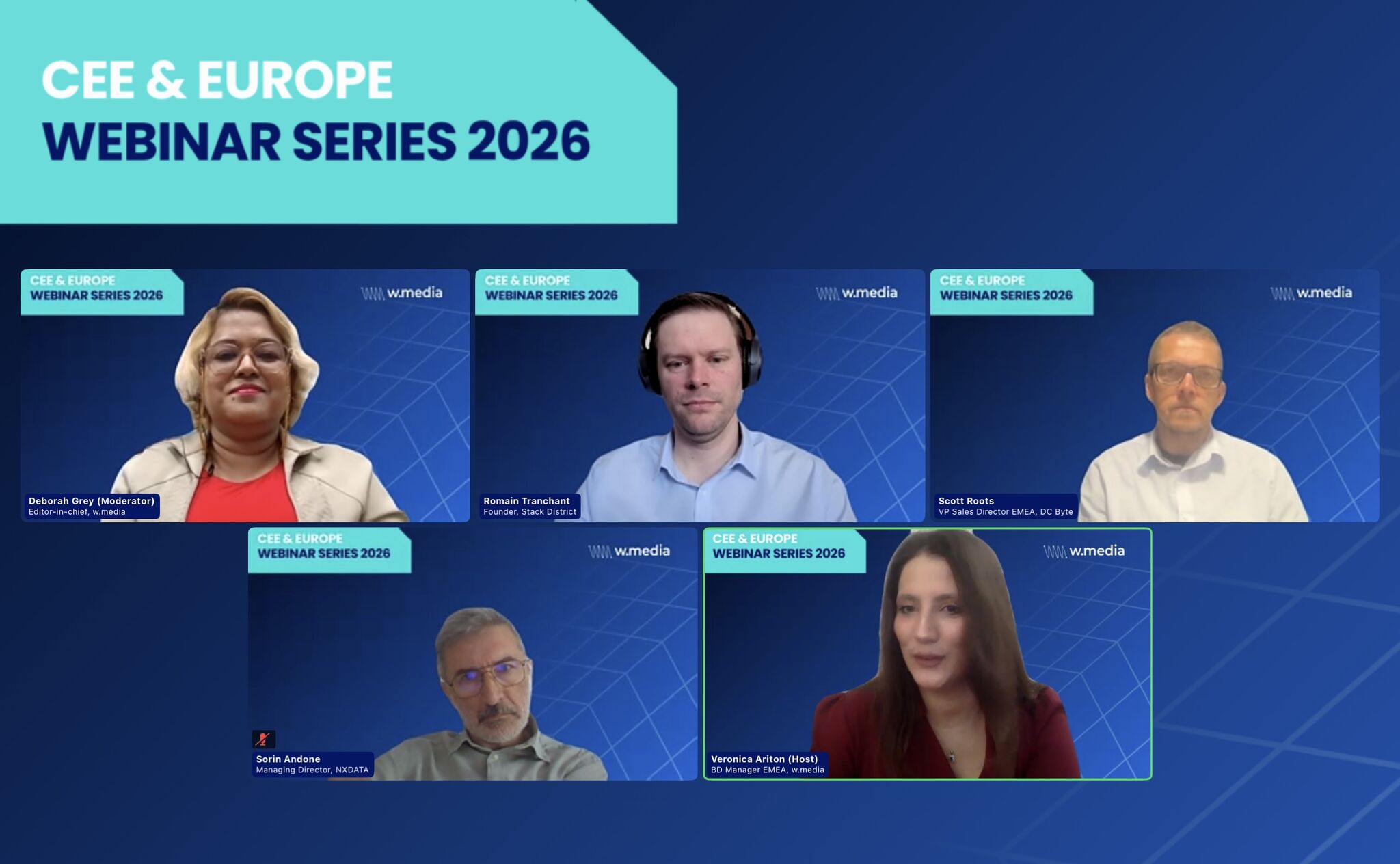
As part of our foray into Europe, we have kickstarted a special monthly webinar series showcasing the digital infrastructure industry across the continent. In the first episode of the webinar series, we took a deep dive into Central and Eastern Europe (CEE). Launched on April 29, 2026, this webinar focused on topics that are rapidly shaping the future of CEE’s data center market and the technological advancement such as new cloud infrastructure, emerging data center markets and AI hubs.
Hosted by Mihaela-Veronica Arinton, w.media’s business development manager for EMEA, and moderated by Deborah Grey, Editor-in-Chief, w.media, the webinar had a stellar line-up of expert speakers and industry veterans:
- Scott Roots, vice president and director of sales – EMEA, DC Byte.
- Sorin Andone, managing director, NXDATA.
- Romain Tranchant, founder and CEO, Stack District.

Here are some select excerpts from the webinar that began its first session with a keynote address by Scott Roots, followed by a panel discussion where Roots was also joined by Sorin Andone and Romain Tranchant.
Keynote session: Market Intelligence: CEE’s Datacenter Market Outlook 2026-2030
Deborah Grey: Scott, how you have seen the cloud and data center industry grow and evolve across CEE, and what makes it an exciting market today?
Scott Roots: The CEE market is a really interesting one. To some extent they’ve not quite come as fast as some people expected throughout the industry. However, we’ve seen a huge spike in activity in Central and Eastern Europe. So we’re now tracking at DC Byte just under about four GWs of total IT load across all stages of development.
That’s from a very early stage right through to live operational data centers. At the moment, probably 80 percent of that IT load is in a very early stage of concept design and land has been purchased. There’s been significant investment and significant intent from suppliers to take their IT loads to Central Eastern European, Baltics, Balkans, et cetera.
The market is kind of defined today as very heavily based on colocation. I think almost 90 to 95 percent of the CEE market is being driven by colocators. We have seen intent from global hyperscale companies in buying early pockets of land. A pocket of land or two in and around, Bucharest, was bought by Microsoft many years ago.
It’s not moved into any development stages yet, but there’s early signs of more intent coming from how we define self-built data centers owner-operators. So how long before we see an AWS, a Microsoft, a Google or somebody like that come and develop their own data center in the region? I don’t think it’s a million miles away.
For now we’re seeing a good driving of colocation, and that’s the key market right now. Poland, Romania are probably leading the way in terms of IT footprint in Croatia, and around Zagreb, with a very large AI development. So of that four GW I mentioned earlier, probably 40 percent of that is down to two single projects, one AI hub in Poland, one AI hub in Croatia, which are in very early stages of now, but we’re talking 700 GW-plus sites.
Frankfurt, Amsterdam, London or Paris are hideously expensive, power is restricted and land is expensive so CEE offers the counter of all of those, power is cheaper, land is cheaper. CEE offers a very highly skilled workforce and strong local market players. There’s not a huge amount of international or global data center operators coming in and dominating markets in Poland, Romania, Bulgaria, Hungary, et cetera are the local guys marching across CEE.
Deborah Grey: I’m curious, what exactly might be slowing development, and if rectified in time, what kind of growth potential does CEE have?
Scott Roots: I think at the moment, obviously Europe-wide, now this isn’t just CEE, power is the number one factor, regardless of where you’re building a data center, whether it is Frankfurt, London, Paris, Dublin. Dublin’s probably a great example with huge power restrictions. There is more power availability in CEE. There’s much less congestion on the power grids in Eastern Europe as there is compared to Western or Northern Europe.
However, some of the limiting factors which may be putting off Western investors might be the energy mix itself. Poland is still quite heavy on fossil fuels for their energy source. So organizations looking at sustainability that’s an absolutely critical factor. I think data sovereignty is a really interesting thing as well, and also proximity and safety of where your data center is.
We’re seeing across CEE an increase in government use of cloud. So the Romanian government over the last few years have invested very heavily in their own IT infrastructure, and we’re seeing that across the regions. Um, broadband penetration is improving across all regions. IT use is up, and in turn, that obviously increases the need, the requirement for data centers.

Panel Discussion: CEE as Europe’s Next Data Center Frontier: Technology Innovations and Capital Moving East
Deborah Grey: Sorin, as NXDATA has been an integral part of Romania’s connectivity ecosystem. What is your assessment of the CEE’s connectivity infrastructure?
Sorin Andone: The CEE connectivity infrastructure is becoming less problematic than what it was in the past. Speaking about Romania, I think it’s the same situation all over the CEE. So, the country has some of the fastest average internet speeds in Europe. This is a legacy of the unregulated competitive broadband build-out in the 2000.
Data center operation translates into care diversity and the whole infrastructure is built with established internet exchanges point, multiple Tier 1 carriers. The infrastructure itself is improving, not a bottleneck like it was a decade ago. So we have submarine cables, some of them coming to the Black Sea, terrestrial routes coming from Poland, Czech Republic, connecting directly to Frankfurt. This reduces the latency towards eastern EU and Western European IXPs.
I would say that low latency applications like real time AI inference, is probably milliseconds. Where milliseconds count, infrastructure would not be deployed so far away from Frankfurt. But for that segment and for some other segments, it’s a good option. I will say maybe the gap is here in ensuring the long haul fiber redundancy. Some of the terrestrial routes tend to be disconnected sometimes because of the lack of the redundancy, paths, or some of them are not so easily secured. So the routes exist, but the diversity is probably thinner than between Frankfurt, Amsterdam, London. From an operator building a multi-site disaster recovery architecture, this might be a problem but overall connectivity is pretty good.
Deborah Grey: Romain, why do you think there’s a shift away from centralized infrastructure?
Romain Tranchant: When we talk about traditional IT infrastructure, connectivity is at the top. This is all that matters. Everything they want is connected to the backbone, London, Frankfurt, Amsterdam, Paris, Dublin. That was literally at the top of the agenda even though cost was not actually one of the primary factors for as long as the connectivity was there. Resiliency was actually one of the top metrics. What we tend to see now is power and density. That’s literally all that matters, and we’ve got to look at unit economics of our clients to really understand what’s going on. There is a worldwide fight for cost per token. There is a real drive for reducing what the cost per token is gonna be.
We’ve got two mechanics for this. One is the cost of the hardware and the services, but most importantly, the cost of power. Eastern European countries are becoming a lot more interesting. The other thing is availability when we start looking at larger workloads to 10, 20, 30, 40 MWs of GPUs being deployed in, in those countries, people want it yesterday. There is a real drive for having available data centers placing 10 MW, 20 MW in Europe today is real hard, countries that are closer to being able to do this are Central and Eastern European countries so the rest is a supply chain issue.
Where can I build a data center as quickly, as economically viable as possible? And again, that points again to Central and Eastern European countries. Where the client wants to go and what their unit economics is one of the major drivers for the shift that we’re seeing at the moment.
Deborah Grey: Scott, where is the capital flowing? And is there a difference between the investment strategies across key CEE markets?
Scott Roots: Assuming clients will come, or do you buy some land and sit and wait for Microsoft to come and take 20 MW, but then it’s gonna take you two and a half years to build it? There’s a large portion of people coming to market wanting 10 MW yesterday, looking at the availability rates at the moment, probably Poland is the only place you could get 10 MW plus tomorrow, across the EU. So in terms of the investment strategies, it comes down to risk aversion really, I suppose, is to a slight gamble on if I build it, will I attract some customers? I’m pretty sure, yes, you will, as we’ve seen over the last 18 months. We see these AI companies coming in wanting 10 MW immediately as these guys are after super high density.
So we’re seeing them turning up in more interesting locations as well because the densities of racks now are in the triple figures of 100 KW, 120 KW so suddenly a GW footprint is probably a fifth, a 10th of what it used to be. So as long as that physical building site can get the power in, we’re gonna start to see some really big numbers.
Deborah Grey: Coming back to both Sorin and Romain. Gentlemen, in your opinion, why are hyperscalers and operators and investors increasingly looking to CEE as a growth market? What makes this so exciting?
Romain Tranchant: One of the things that we’ve seen on the world stage is that there is a clear drive for the EU in general to become a lot more sovereign about their technology stack in a global way. When we look at the EU’s capacity to actually house their own clouds, their own data centers, their own infrastructure. Where are those data centers gonna be built? How are the unique economics going to be, and how quickly can we get to it? And it turns out that the Central and Eastern European countries are actually great places for day-to-day talking about data center infrastructure in other capacities, uh, talking about innovation in infrastructure,
We see a lot of needs from government bodies, municipalities,regional more government-led actors that are now saying, “I do not want my data to leave the country. I want to be able to pinpoint exactly where it’s gonna go.” And so when we look at the maturity of the market in the Western countries in Europe, then the data center infrastructure is there and there is capacity for them to continue growing. The capacity in the Eastern European countries needs to grow to be able to get to a point where the government needs and the enterprise needs are
actually met which is why it pushes the investment to actually build that infrastructure actually in those countries.
Sorin Andone: I fully agree with Romain about this. So there is this demand coming from the necessity of storing the data inside the country. Obviously this is driving the demand in Europe but still there is a gap between this policy of having all the infrastructure hosted inside the country and also the fact that the cloud itself is still not sovereign. So the IT, software, cloud operators from inside Europe are developing the software platforms that will ensure sovereignty in terms of the full stack coming from the hardware.
Deborah Grey: Current technological innovations such as AI-ready design, liquid cooling, modular build, et cetera, have played a role in accelerating deployment in established markets like the FLAP-D markets. Are you also seeing the same in CEE?
Sorin Andone: There is a demand coming from AI, but it’s a very small scale. So mostly AI labs which are seeking to deploy something in between one hundred and twenty KW footprints, small GPU, inference-focused early stage compute by upstanding, up capacity close to their use base probably. Clients have not arrived with the wishlist. They like more structural deployment, scale up, and compliance framework are driving specification. They are looking to build physical security requests, which are changed by the operator’s request. Compliance frameworks are more structured compliance requests from the local operators like it was many years ago.
Romain Tranchant: The problem that we see with all the technologies like, uh, direct to chip route or exchangers and so on, is that operators cannot build past a certain point because only the technology that goes inside the rack densifies and what they need to put.
Cooling elements that go inside the rack will be, will be actually driven by the equipment that goes inside it. They’re not getting deployed at scale because on the other side of the equation, the likes of NVIDIA, AMD, and, and other suppliers will not release the equipment until they know that the data center is ready. So they’re trying to control the market to avoid black markets being created. So suddenly we end up in a situation where we see a lot of demands for a lot of data centers that GPU manufacturers are saying if it’s gonna take you a year, command or your order is gonna be delayed a year.
Deborah Grey: Let’s take a deep dive into power, because we know that data centers and particularly AI data centers are power guzzlers. Given this, Romain, would you say power availability and cost are the primary decision drivers for deployment of infrastructure in this region?
Romain Tranchant: They are definitely somewhere at the top of the list, but there is so much that goes into building a data center in a given region. I said earlier that effective power is now ranking towards the top for being able to build data centers anywhere because of the amount of power those, uh, GPU farms are actually taking. But in reality, between the location of the land, the safety of the land, the, uh, the, the regulatory framework, the country stability, risk that people are taking, the investment models, uh, who’s already in the country, how is it gonna be operated, there is a number of thing that goes into being able to build a, a data center. When we’ve got clients that come to us for greenfield opportunities, brownfield opportunities on a many megawatt level, the first thing they look at, and literally this is what we put at the top of our list, is how much power and when.
Deborah Grey: I’m glad you brought up renewables, because, Scott. In your opinion, how does CEE fare in offering renewable energy to data centers? Scott?
Scott Roots: I think everybody is trying to improve and better themselves. I mentioned at the opening of the talk very big AI projects. Now, one of those is going to be powered entirely by renewable power, which is gonna be on site, and there will be behind the meter that power feeding back into the grid. There will be battery storage solutions for when the solar and wind is not available, for example. It’s becoming an increasingly critical point for the fundamental IT user as we see requirements of reporting with Scope 3 emissions if you’re in colo or Scope 2 if you’re operating. You need to know and you do need to care about where your power comes from.
In a CEE there’s some really interesting, fantastic innovations happening across all of the countries. I think Romania is doing some really good stuff right now on a kind of national level. There’s some really interesting alternatives as well though in terms of gas. I think in the data center industry from the utility companies, the guys who are making the power, whether it’s solar farms, whether it’s wind, tidal, nuclear, biomass, slightly more sustainable power. I think once we can abolish burning coal to make electricity eventually across Europe will be a great day, and we’ll get there eventually. At the moment it’s the choice that certain places have. Fundamentally, power is absolutely critical and within the top three requirements.

Deborah Grey: Sorin, how are evolving infrastructure requirements shaping new builds and retrofits across the CEE region?
Sorin Andone: I agree with Scott. So one of the infrastructure requirements is coming from this power, requirements of being renewable, sourcing of the power, certificate of origin and so on.
So this is one of the main factors shaping the new builds. So a specific part of the CEE market has plenty of brownfield abandoned industrial sites, a kind of advantage which is not anymore present in the Western Europe because the technology evolved much more quickly there. So the industrial sites that were abandoned were regenerated and refitted but more quickly.
AI sites high capacity power sites were built in Poland, Bielsko-Biała, a former Fiat factory, which is having about 80, 90 MW of power and planned to have 200 MW. So that kind of deployment, it’s shaping the retrofitting of this brown brownfield, which is obviously an advantage.
********END*******
If you missed joining us live, you can watch the entire webinar here: