
For decades data centers have been built on Earth, bound to limits in electricity, cooling, land, and water. As artificial intelligence expands rapidly, those constraints are starting to become a major issue. A new idea is emerging to move the data centers into space, and the new space cowboys are saddling up.
These include Google, NVIDIA, SpaceX, Starcloud (formerly Lumen Orbit), Axiom Space, Madari Space, UAE Space Agency (UAESA), Orbital Chenguang, and NeevCloud, among others. Each company has their own plans and ambitions to make orbital data centers a reality.

But turning that vision into a reality requires overcoming major engineering and cost barriers from generating enough power in orbit, cooling high-performance chips in a vacuum, launching and maintaining large-scale infrastructure. Skeptics argue the timeline is ambitious yet the direction is increasingly clear, the next phase of AI infrastructure may not be on Earth, but above it.
The force is strong with Space data center market forecast
According to Fortune Business Insights, the global space-based data center market was valued at US$ 1.28 billion in 2025, and is projected to grow from US$ 1.44 billion in 2026, to US$ 3.81 billion by 2034, at a CAGR of 12.96 percent, with North America holding a 35.93 percent share in 2025.
Space-based data centers deploy computing infrastructure such as servers, GPUs, storage, and radiation-hardened systems in satellites or orbital platforms, using modular satellite clusters powered by solar energy with radiative cooling, inter-satellite optical links, and edge AI capabilities to process data in orbit.
These systems support applications including real-time Earth observation analytics, AI model training for remote sensing, in-orbit data centers for Low Earth Orbit (LEO) constellations, and cloud services for space stations, while reducing reliance on Earth-based data downlinks.
Growth is driven by scalable expansion beyond terrestrial land constraints and rising AI compute demand amid limitations of ground-based infrastructure, with key players such as Starcloud, Axiom Space, and SpaceX advancing GPU satellite testing, orbital data center concepts, and optical-link-enabled space computing systems.
The concept that satellites equipped with solar arrays to generate continuous power in orbit and run AI workloads above Earth is simple in theory but complex in practice. Instead of relying on terrestrial energy grids and water-based cooling systems, computation would be shifted into an environment with near-constant solar availability and no atmospheric constraints.
This idea is gaining attention as AI drives a surge in global electricity demand from data centers. Startup companies and major tech firms are beginning to test orbital computing systems, contemplating that space could offer a long-term solution to Earth’s energy limits.
Overview Energy and Meta have signed an agreement to develop space-based solar power intended to support large-scale computing infrastructure, including AI data centers. The plan involves an initial orbital demonstration targeted for 2028, with commercial energy delivery expected around 2030. Meta has secured early access rights to up to 1 GW of future capacity from the system, which is designed to supply additional electricity to existing terrestrial solar facilities rather than replace them.
The proposed system uses satellites in geosynchronous orbit to collect continuous solar energy and transmit it to ground-based solar plants as low-intensity near-infrared light. Those facilities convert the received energy into electricity and feed it into the grid, effectively extending their operating hours beyond daylight conditions. The aim is to increase output from existing solar infrastructure without requiring new land or major grid expansion, with the added electricity intended to help meet rising demand from data centers and other high-density computing workloads.
One small step for man, but one giant leap for data centers
Orbital data centers would function as distributed computing platforms assembled from satellites or modular structures in Earth’s orbit which would operate in sun-synchronous orbits that provide near-constant solar energy through large photovoltaic arrays. AI inference and data processing in space will transmit results back to Earth through high-bandwidth communication links. Early use cases would focus on processing data generated in orbit, reducing the need for downlinking massive raw datasets.
Thermal management is a major challenge as the space vacuum eliminates convection and heat must be rejected through thermal radiation. This requires extensive radiator surfaces and active thermal control systems, pumped liquids transferring heat from processors to external panels. Constant solar exposure also adds heat, maintaining electronics within safe operating temperatures at scale becomes a central design constraint.
Radiation tolerance is another defining factor since Earth’s atmospheric shielding exposes orbital hardware to cosmic rays and solar particles which can cause bit flips, degrade semiconductor materials, or permanently damage components. Space-based data centers would require system-level resilience such as error-correcting architectures, redundancy, shielding, and potentially hybrid approaches combining commercial chips with hardened subsystems. Maintenance of nontrivial failed components cannot be easily replaced thus designs must emphasize fault tolerance, modularity, and possible robotic servicing.
Operationally, these systems must coexist in an already congested orbital environment, large constellations or megastructures increase collision risk with other orbiting satellites and require continuous coordination for debris avoidance. Currently there are 15,000 satellites above Earth public and equipment safety is overseen by Nasa’s Orbital Debris Program Office that monitors satellite lifecycles, deorbiting strategies, replenishment schedules for system architecture and logistics. Frequent upgrades critical in fast-moving AI hardware would further increase launch cadence and orbital traffic.
The economic viability depends on launch cost and in-orbit assembly and scaling AI innovation in space. Fully realized orbital data centers would likely exceed the constraints of any single rocket, requiring autonomous assembly using robotics that are still under development. While declining launch costs and heavy-lift vehicles improve feasibility, the near-term trajectory points to incremental deployment: small, modular compute nodes in orbit that scale over time. These would act as a precursor layer handling niche, high-value workloads before any large-scale migration of terrestrial data center capacity becomes realistic.
The energy source for orbital data centers is one of their most compelling advantages. By leveraging near-constant solar illumination in carefully selected orbits such as sun-synchronous or LEO that both offer latency superior to fiber optics for long-distance terrestrial communication because light travels 47 percent faster in a vacuum than through glass fiber. These orbital data centers can theoretically achieve a near 100 percent renewable energy footprint, avoiding the carbon emissions associated with terrestrial fossil fuel-based power generation.
AI in the sky, and infrastructure in space
The manufacturing and launch of the massive solar arrays and battery systems necessary for operation represent a significant upfront energy and material investment. The overall sustainability profile depends heavily on minimizing the embodied energy of the launched components and maximizing their operational lifespan in orbit. Furthermore, minimizing the risk of space debris through responsible end-of-life deorbiting is paramount to the long-term sustainability of the orbital environment itself.
While high-bandwidth laser links offer superior data rates compared to traditional radio frequency (RF) communications, the latency and bandwidth limitations for communicating between orbit and Earth remain a critical constraint.
For latency-sensitive applications such as financial trading, real-time interactive services, the physical distance to geostationary (GEO) or even LEO introduces unavoidable round-trip delays that cannot compete with fiber-optic connections.
Initial workloads will be asynchronous or data-intensive, such as processing large sensor data caches from Earth observation satellites, rather than serving consumer web traffic or time-critical computations. The successful integration of orbital data centers into the global cloud infrastructure requires a seamless, high-throughput, and redundant terrestrial network of ground stations and laser communication terminals.
Do we have lift off?
Governments and corporations have begun work on “space data centers,” positioning it as a core system for the AI era. The objective is to test power, semiconductor, and communication technologies in orbit and secure a foundation for next-generation data processing beyond Earth.
Starcloud, has raised US$ 170 million Series A at a US$ 1.1 billion valuation for developing data centers in space. The company reached unicorn status 17 months after its Y Combinator demo day. The round is more than twice the size of the next-largest YC Series A and brings total funding to US$ 200 million.
Demand for compute tied to AI is rising faster than physical infrastructure on Earth can support. New data centers and energy projects often take years to permit and build. Starcloud’s approach is to place data centers in LEO, where solar energy is abundant and does not face the same constraints.
“The AI revolution is colliding with the physical limits of our terrestrial energy grid,” Philip Johnston, Co-Founder and CEO, Starcloud, had said at the time of the announcement. “We are quickly running out of places to build new energy projects for data centers on Earth. By moving AI compute to space, we unlock access to unlimited solar power and completely remove the energy bottleneck. This funding allows us to rapidly scale our orbital infrastructure and meet the massive commercial demand for sustainable AI compute.”
The company has moved quickly relative to typical aerospace timelines. With US$ 3 million in pre-seed funding, it designed, built, and launched its first satellite, Starcloud-1, in 21 months. The satellite launched in November 2025 and marked several technical milestones, including running an NVIDIA H100 GPU in orbit, training an AI model in space, executing inference on a version of Gemini, and demonstrating fine-tuning capabilities.
SpaceX announced in an update that the company has acquired xAI to combine AI, launch systems, satellite internet, direct to device (D2D) communication, and a global information platform into one stack. The goal is tighter integration across these systems to support both AI growth and space infrastructure. Current AI systems depend on large data centers on Earth which require high power and cooling, as demand increases, scaling them puts pressure on energy supply and infrastructure. Satellites can use continuous solar power and avoid many cooling limits. This could reduce reliance on ground-based data centers.
“My estimate is that within 2 to 3 years, the lowest cost way to generate AI compute will be in space. This cost-efficiency alone will enable innovative companies to forge ahead in training their AI models and processing data at unprecedented speeds and scales, accelerating breakthroughs in our understanding of physics and invention of technologies to benefit humanity,” Elon Musk, CEO, SpaceX had said at the time of the announcement.
And it isn’t just American or European companies that have joined the space race. At the United Nations Climate Change Conference (COP27), held in Egypt in November 2022, the UAE Space Agency unveiled the Space Data Center, a national digital platform designed to broaden access to space-derived data and unlock its potential across scientific, commercial, and public sectors.
The announcement reflected a broader strategic vision. His Excellency Salem Butti Salem Al Qubaisi, Director-General of the UAE Space Agency, emphasized this direction, stating, “Our priority is to support start-ups, entrepreneurs, and scholars, which is perfectly aligned with our vision to develop space solutions and applications to promote the UAE as a regional hub for space innovation.”
This momentum towards digital transformation into space is also evident in the private sector. In Abu Dhabi, Madari Space, has been pushing the boundaries of what data infrastructure could look like, announcing plans to build data centers in LEO. The initiative is a direct response to the surging global demand for data storage and processing capabilities.
Shareef Al Romaithi, CEO, Madari Space, explained the rationale behind this vision, noting that the company was exploring the concept to “address the exponential growth of data that is being generated both, on earth, as well as in space.” He highlighted a critical challenge in today’s data pipeline: vast amounts of information collected by Earth observation satellites remain raw and must be transmitted back to Earth for processing. “This data is all raw, unprocessed and needs to be downstreamed to terrestrial data centers,” he said, adding, “By placing data centers in space, we have the ability to store and process this data in space, enabling the data owners to make informed decisions in real time.”
With this approach, Madari Space is positioning itself to attract satellite operators, space technology firms, governments, and large corporations, any organization managing massive datasets and seeking secure, sustainable storage solutions. Together, initiatives like the Space Data Center and orbital data infrastructure signal a shift in how data is managed and utilized, marking a new chapter in the convergence of space technology and digital transformation in the UAE.
In India, NeevCloud, an Indian cloud infrastructure developer has partnered with Space-tech firm Agnikul Cosmos to launch over 600 orbital edge data centers and an AI data center platform in orbit using the extendable upper stage of its rockets as the hosting platform. Agnikul, which builds 3D-printed rockets for small satellites, has signed its first commercial deal to deploy an orbital AI data center module developed by NeevCloud.
Srinath Ravichandran, CEO, Agnikul, said, “Our convertible upper-stage technology lets these stages stay active and functional, turning them into usable assets that can host hardware and software in space including compute or data capabilities. That’s the next step for a space transportation company you build, launch, recover, and then extend into orbit.”
Narendra Sen, CEO, NeevCloud, said, “We are not just building a data center in space, we are building an entirely new layer of orbital inferencing infrastructure.”
A pilot launch is planned before the end of the year, with NeevCloud aiming to scale to 600+ orbital edge data centers within three years if testing succeeds. The companies say orbital processing could handle sensitive AI workloads for defence and finance under sovereign control while reducing costs by reusing rocket upper stages.
The collaboration also enables Agnikul to offer launch and on-orbit services without requiring customers to build satellites. The system aims to shift heavy AI computing from Earth to space-based infrastructure as part of a broader AI Supercloud expansion strategy.
Not to be left behind, NVIDIA is accelerating computing platforms by enabling AI-powered orbital data centers, geospatial intelligence, and autonomous space operations. By delivering data-center-level performance within size, weight, and power-constrained environments, AI applications can function seamlessly across ground and space, supporting increasingly sophisticated mission demands.
Central to this advancement is the NVIDIA Space-1 Vera Rubin Module, which significantly outperforms the NVIDIA H100 GPU with up to 25x more AI compute for space-based inference. Complementing this are the NVIDIA IGX Thor and NVIDIA Jetson Orin platforms, which provide energy-efficient, high-performance AI inference and edge computing capabilities in compact form factors. On the ground, systems such as the NVIDIA RTX PRO 6000 Blackwell Server Edition GPU enable up to 100x faster processing for geospatial intelligence workloads compared to traditional CPU-based systems.
Jensen Huang, founder and CEO, NVIDIA, “Space computing, the final frontier, has arrived. As we deploy satellite constellations and explore deeper into space, intelligence must live wherever data is generated. AI processing across space and ground systems enables real-time sensing, decision-making and autonomy, transforming orbital data centers into instruments of discovery and spacecraft into self-navigating systems. With our partners, we’re extending NVIDIA beyond our planet, boldly taking intelligence where it’s never gone before.”
These technologies collectively address the growing demand for real-time, on-orbit data processing. The Vera Rubin Module enables large language models and foundation models to run directly in space, while IGX Thor and Jetson Orin support real-time sensor processing, autonomous operations, and efficient bandwidth use. Meanwhile, NVIDIA’s CUDA-enabled ecosystem allows geospatial intelligence workflows to scale across orbit, edge, and cloud, accelerating applications such as disaster response, climate monitoring, and infrastructure analysis through faster, AI-driven insight generation.
Beijing Orbital Twilight Technology Co. Ltd. (Orbital Chenguang) closed a Pre-A1 round backed by venture and industrial investors including Haisong Capital, CITIC Construction Investment Capital, and Cathay Capital, though the amount was not disclosed.
More notably, the company secured 57.7 billion yuan (US$ 8.4 billion) in strategic credit lines from major lenders such as Bank of China, Agricultural Bank of China, and CITIC Bank indicative of strong institutional backing despite being non-committed financing. The company operates within a state-linked ecosystem led by the Beijing Astro-future Institute of Space Technology, aligning it with China’s broader push into space-based data centers.
Obstacles, technology challenges and plausibility: Houston, do we have a problem?
Orbital data centers would require higher launch rates and consistent delivery of large payloads that would allow deployment of many compute satellites over time. At scale, launching large amounts of compute hardware each year could add significant capacity without ongoing Earth-based energy use. This is still a long-term concept but outlines a possible path for scaling AI and supporting space-based infrastructure.
Launch capacity limits how much infrastructure can be built in space, even in high-activity years total payload mass to orbit is small compared to what large systems would need. Falcon and Starlink increased launch frequency and reduced cost for Starship which is designed to carry larger payloads per launch. This supports more capable satellites and expanded communication networks, including D2D coverage.
Elon Musk has ambition to launch 1 million data-center satellites into space, but many argue that this plan is not plausible or even possible even though forecast strong long-term benefits in space exploration and infrastructure with SpaceX often at the center of that optimism. Elon Musk’s track record has drawn scrutiny, particularly given past unmet projections such as his 2019 claim that a million autonomous Tesla robotaxis would be operational by 2020, a target still unrealized as of 2026. These delayed or unrealized projects have shaped how investors interpret his latest ambitions.
Musk’s push towards space-based data centers also coincides with growing concern among financial analysts about a potential AI bubble driven more by hype than fundamentals. The scale and speculative nature of the proposed orbital data centers have done little to ease those concerns. Concurrently public sentiment around AI has been shifting for separate reasons, including fears of job displacement, hiring disruptions, and evidence suggesting negative impacts on student learning.
SpaceX has cautioned investors that its plans to develop space-based artificial intelligence data centers remain highly uncertain, as the concept depends on unproven technologies and may never achieve commercial viability. According to its pre-IPO filing, these orbital computing systems are still in early development and face significant technical complexity.
The company emphasized that any future AI data centers deployed in space would need to operate in harsh and unpredictable conditions, exposing them to unique risks that could lead to malfunctions or system failures. Additionally, the viability of these space-based data centers is closely tied to the successful development and scaling of Starship, as delays or limitations in launch capability could hinder deployment and overall execution of this strategy.
Based on Google’s project Suncatcher there are five main challenges that orbital data centers must address:
First, an orbital data center system must achieve extremely high-bandwidth inter-satellite communication order of tens of terabits per second which is difficult because it requires far higher signal power than typical space links, forcing satellites to operate in very close proximity.
Second, maintaining such tightly clustered formations is itself a challenge, as satellites must be precisely controlled despite gravitational irregularities and other orbital perturbations.
Third, onboard machine learning hardware must be robust to the radiation environment in LEO, where sensitive components like memory are particularly at risk.
Fourth, the system’s economic viability depends on significantly reducing launch costs, which have historically been prohibitive.
Finally, additional engineering challenges remain unresolved, including how to manage heat in space, ensure reliable high-bandwidth communication with ground stations, and maintain long-term system stability and performance.
ETA on ongoing space data center projects: T-minus who, what, when?
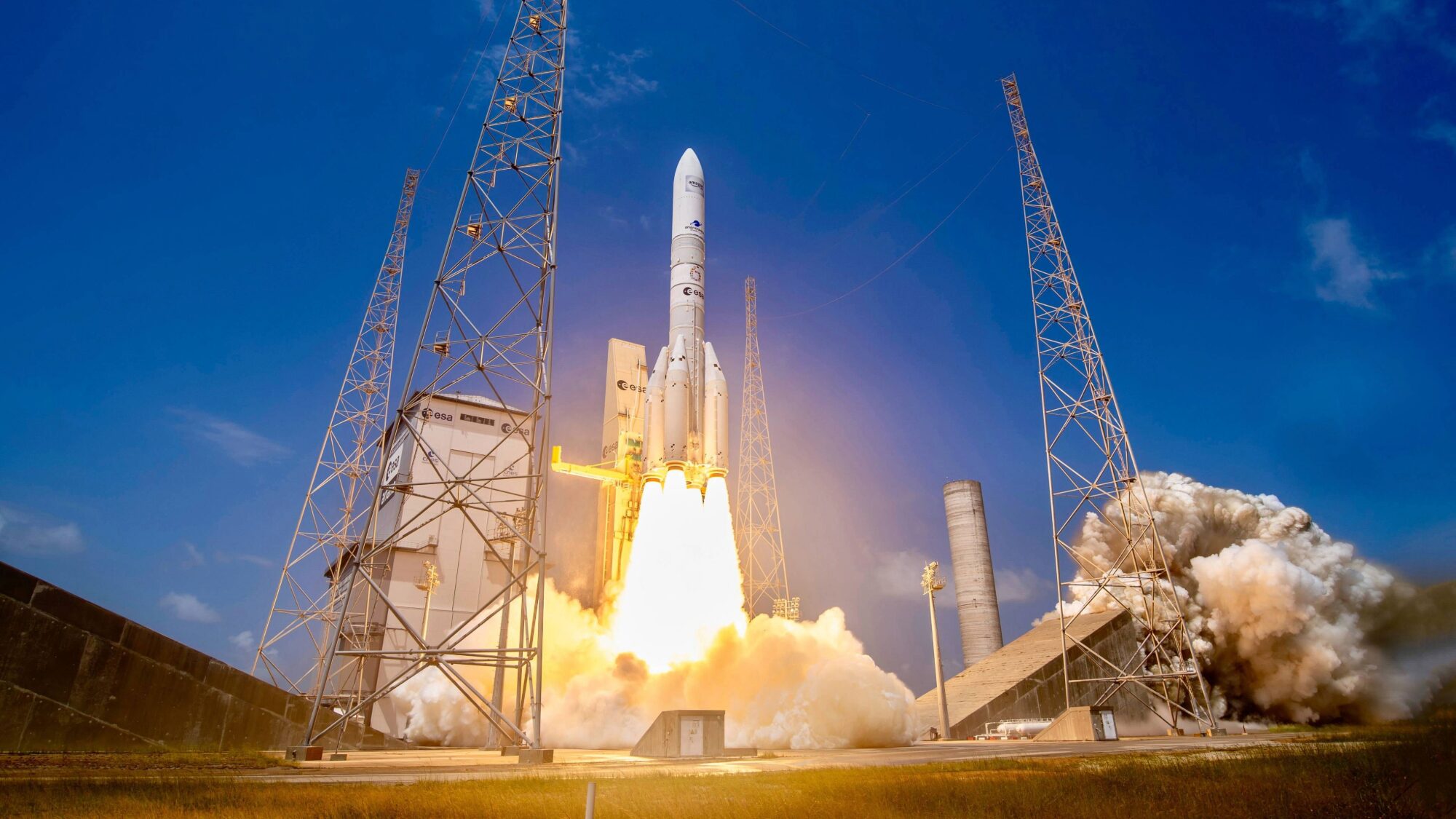
Amazon and Globalstar
When it comes to the Amazon Leo system, Amazon plans to roll out its D2D system starting in 2028, offering voice, data, and messaging with higher efficiency than existing direct-to-cell systems, and integrating it into a broader network of LEO satellites serving consumer, enterprise, and government users. Amazon’s most recent space activity occurred on April 27 2026 after the successful launch of the Atlas V mission which deployed 29 LEO satellites and marked Amazon’s sixth launch with the assistance of the United Launch Alliance (ULA) that increased the total number of satellites in orbit to 270.
Starcloud
Starcloud plans to launch Starcloud-2 later in 2026 and this second satellite will generate 100 times more power than its predecessor and carry the largest commercial deployable radiator ever sent into space. The satellite is expected to run commercial workloads for customers including Crusoe, with support from partners including Amazon Web Services, Google Cloud and NVIDIA.
Google’s Suncatcher
Project Suncatcher is Google’s research moonshot exploring how to scale machine learning compute in space. The project envisions a future network of interconnected, solar-powered satellites equipped with TPU AI chips that harness continuous solar energy to run large-scale AI workloads beyond Earth. Building on early research into satellite constellation design, communication, control, and radiation testing of TPUs, Google has published initial findings in a preprint paper outlining the technical approach. The next milestone is a planned learning mission with Planet to launch two prototype satellites by early 2027, aimed at validating hardware performance in orbit and laying the foundation for space-based, massively scaled computation.
Axiom Space
Axiom Space has signed agreements with Kepler Communications US Inc. and Skyloom Global Corp. to integrate and demonstrate high data-rate Optical Intersatellite Links (OISLs) on the first module of its planned commercial space station, Axiom Station. In parallel, the company is developing a cloud-enabled orbital data center (ODC T1) intended to process data in LEO without dependence on terrestrial cloud systems, described as “Earth independence.”
Before ODC T1 was deployed, Axiom launched a smaller prototype data system to the International Space Station in 2024. The prototype will test artificial intelligence, machine learning, data fusion, and cybersecurity applications. The company is also running early demonstrations using AWS Snowcone hardware already on the ISS. The full system is targeted for integration on Axiom Station’s first habitat module after it connects to the ISS, with launch planned by 2027. It is designed to support up to 10 Gbps optical relay connectivity and meet Space Development Agency interoperability standards.
SpaceX
The Federal Communications Commission’s Space Bureau accepted an application from Space Exploration Holdings, LLC (SpaceX) to deploy a vast new non-geostationary orbit satellite system of up to one million satellites an initiative the company describes as an early step toward achieving a Kardashev Type II civilization capable of harnessing the Sun’s full energy.
Filed on January 30, 2026, the proposal outlines the “SpaceX Orbital Data Center system,” which would operate at altitudes between 500 and 2,000 KMs across multiple orbital shells and inclinations, including sun-synchronous orbits. The system would rely heavily on high-bandwidth optical inter-satellite links, integrate with existing Starlink constellations, support telemetry, tracking, and command operations, and use designated radiofrequency bands for space-to-Earth communications, subject to regulatory approval and requested waivers.
Beijing Orbital Twilight Technology
Between 2025 and 2027, Beijing Orbital Twilight Technology Co. Ltd. will launch computing satellites to address key technical challenges. From 2028 to 2030, these space-based systems are scheduled for integration with Earth-based data centers to form a connected computing network. Its core investment thesis is a constellation of space-based data centers in 700–800 km orbit, targeting over 1 GW of power capacity for computer infrastructure by 2035. The model aims to bypass terrestrial constraints like land, energy, and cooling, positioning orbital compute as a next-generation infrastructure layer.
Madari Space
In the UAE, Madari Space is working with the Mohammed Bin Rashid Space Center to launch its first LEO data center launch planned for Q3 2026. Data is currently raw and unprocessed, requiring transmission to terrestrial data centers for handling.
NeevCloud
India’s first homegrown AI data center in space will be built by NeevCloud and space technology startup Agnikul Cosmos. The companies are aiming to launch a pilot mission in late 2026 to place AI SuperCloud infrastructure into space, positioning it at the edge of orbital computing.
Conclusion
Since the dawn of civilization, humanity has looked to the stars with fascination and curiosity, seeking to understand the vastness of the universe. Today, advances in technology are transforming that curiosity into ambition as the data center industry explores placing AI systems and digital infrastructure in space. What once seemed like science fiction is increasingly becoming a realistic possibility through continued investment and technological innovation.
As land, energy and environmental constraints intensify on Earth, orbital data centers could revolutionize the industry while opening new pathways for humanity’s expansion beyond our planet. In doing so, these developments may redefine the future of digital infrastructure and inspire future generations to push beyond the boundaries of Earth and continue humanity’s journey into space.