
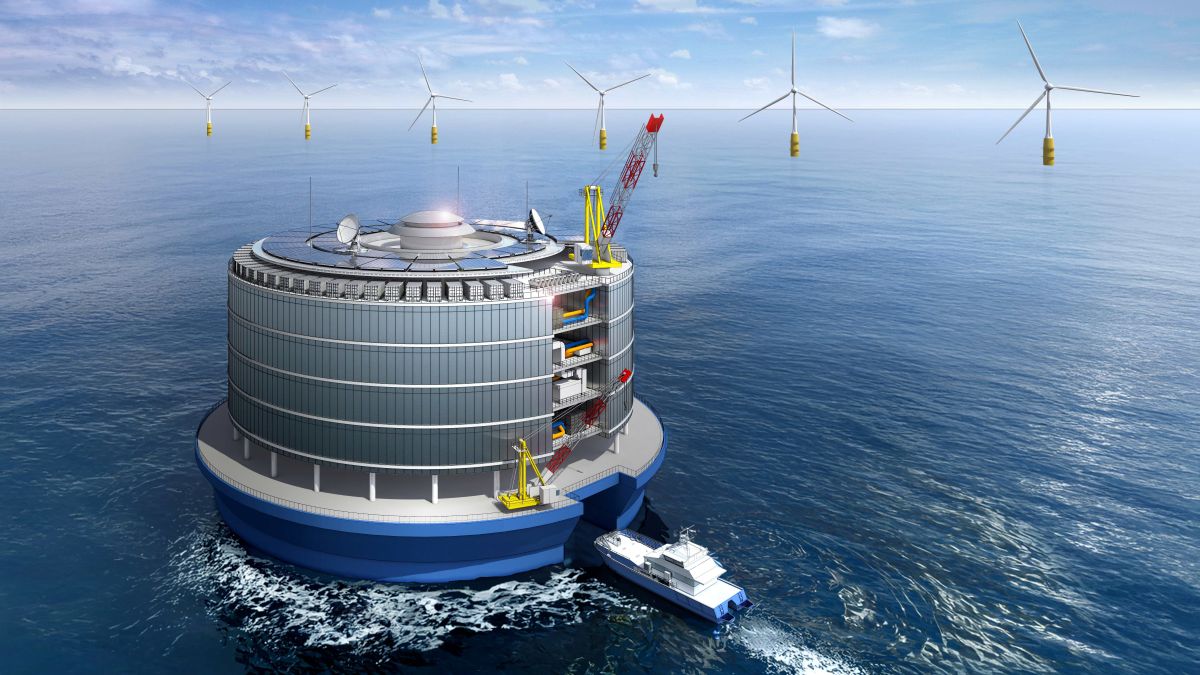
The idea of floating data centers has been bobbing around for some time now. The latest announcement of a floating data center about to be built off Yokohama in autumn 2025 has people excited again. Although only a Memorandum of Understanding (MOU) has been signed by a consortium of Japanese companies, the prospect of an offshore floating data center utilizing 100% renewable energy is looking very bright indeed.
The parties to the MOU, Nippon Yusen Kabushiki Kaisha, NTT Facilities, Eurus Energy Holdings Corporation, MUFG Bank, and the city of Yokohama, are looking to build an experimental green data center that they have described as the world’s first offshore floating green data center.
More than cooling
To be built on a mini float or “floating berthing facility”, the demonstration project would be initially powered by both solar and battery energy, to be supplemented later with wind power. If successful, further developments in the waterfront and sea areas of Yokohama port would be explored. According to Eurus’ press release, this project would set new standards for future data centers which are envisioned to operate entirely on renewable energy and emit no greenhouse gases during operation.
The future data centers would ideally utilise offshore wind power by being situated near offshore wind farms to maximise off-grid use of electricity. It would also eliminate the challenges of onshore data center construction, such as shortages of land and construction contractors, as well as extended construction lead times.
Globally, data centers face four structural bottlenecks: land scarcity – especially in urban and coastal regions – power grid limitations, water shortages and climate risk such as earthquakes, floodings and temperature fluctuation. The floating data centers offer a potential solution to all these challenges.
In addition, its modular construction allows for flexible deployment. The container-like modular design is optimised for salt-resistance, modularity and rapid deployment. The floating data center would be monitored real time on temperature, humidity, vibration, energy stability, and uptime. Energy storage and cooling redundancy are retained to maintain autonomous operations.
Singapore’s floating data center
Meanwhile, Singapore’s own experimental floating data center project, a first on the island nation, is still in the preparatory stage. The Keppel Data Centres’ Floating Data Centre Park (FDCP) project aims to alleviate land, water and energy constraints of traditional data centres.
Similar to the Yokohama debut model, the FDCP also features a modular design and aims to harness seawater for cooling, thereby increasing cooling efficiency by up to 80%, by their estimate. Indeed, the proposed seawater district cooling system will be 10 times larger than the largest built in the world.
The planned floating data center also avoids the use of potable or industrial water in cooling towers and is envisioned to optimize energy usage by integrating LNG and possibly hydrogen infrastructure for onsite power generation.
In conclusion, a floating data center may be preferable if cooling efficiency,access to renewable energy, or coastal proximity are critical. They also help when land is costly or scarce, and maritime risks are manageable. These factors apply to Yokohama and Singapore, and could benefit other coastal regions too. Whether this becomes the standard model for future data centers is still uncertain. Key challenges remain, especially in maintenance and reliable renewable power.

Comparison between floating and land-based data centers
| Floating DC | Land-based DC | |
| Cooling Efficiency | Utilise the surrounding sea as a heat sink for cooling and hence reducing treated water consumption. | Higher energy expenditure for cooling, especially in warm climates, unless using geothermal, etc. |
| Renewable Energy Integration | Potential synergy with offshore wind, tidal, or wave energy sources. | Depending on location, wind and solar can be harnessed. |
| Land & Building costs | Avoids high land costs in urban/coastal areas while modular designs may offer scalable & cost-effective expansion. | Space constraints & high land costs in urban areas while environmental impact from land-use changes (e.g., habitat disruption). But established construction practices and infrastructure reduce upfront investment. |
| Connectivity | Placement near coastal cities can reduce latency issue and improve connectivity. | Reliable grid connections and terrestrial fiber networks ensure consistent operation. |
| Disaster Resilience | Less vulnerable to land-based risks e.g., earthquakes, floods but must withstand maritime hazards e.g. storms, tsunamis & saltwater corrosion. | Susceptible to earthquakes, floods, or wildfires, depending on location. |
| Security | Physical isolation may deter unauthorized access but vulnerable to maritime threats e.g. piracy, collisions.
|
Tight 24-hour security is possible with state-of-the-art equipment. |
| Environmental Concerns | Discharging warm water could harm marine ecosystems. | Emissions not an issue so far. |
| Engineering and Maintenance | Higher initial costs for marine-grade infrastructure (corrosion-resistant materials, stabilization systems) while maintenance requires specialized marine access. | Accessible for repairs, maintenance, and physical security measures without marine logistics. |
| Legal Issues | Jurisdictional ambiguities in international waters and compliance with maritime/environmental regulations add complexity. | Clear compliance with local laws, data sovereignty requirements, and environmental standards. |
Note: This article was originally published in Issue 8, cloud & datacenters magazine.