
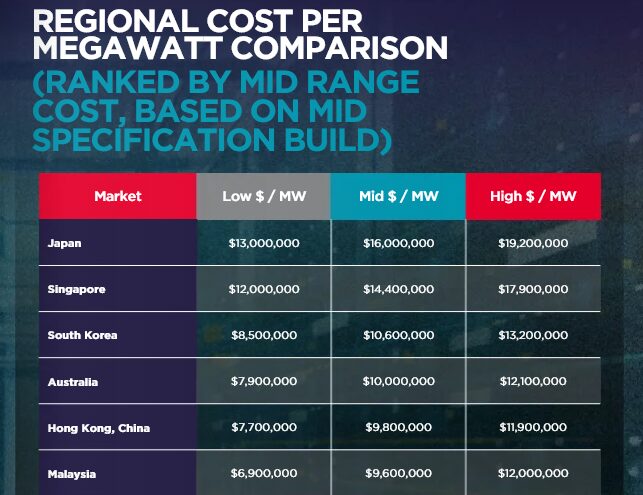
The Asia Pacific region’s data center sector is undergoing a significant structural shift in development costs in wake of the AI boom, finds a recent report by global commercial real estate services firm Cushman & Wakefield. According to its recently released Asia Pacific Data Center Construction Cost Guide 2026, sourcing strategies, labour costs, and supply chain constraints are key factors contributing to widening cost differences between markets, recording a 2.4-times variation in build costs within the region.
The report finds that data center construction costs across APAC now range from US$ 7.9 million to US$ 19.2 million per MW. Japan remains the region’s most expensive market at US$ 19.2 million per MW, followed by Singapore at US$ 17.9 million per MW, while Taiwan is the lowest at US$ 7.9 million per MW. “These differences reinforce that development economics are no longer moving uniformly across the region, increasing the importance of precise market-level modelling, especially for large AI-optimised campuses,” says the report.

“Across Asia Pacific, construction cost inflation diverges sharply, with some markets seeing increases above 15% while others remain below 5 percent,” says Andrew Green, Head of Data center Group, Asia Pacific. “A key reason for this split is that AI is reshaping the physical and technical requirements of data centers, particularly at the shell and core level. Higher power density, more complex cooling systems and stronger structural requirements are becoming standard in AI‑ready facilities, with very different cost implications depending on local power availability, labour capacity and delivery conditions.”
As AI adoption accelerates, its influence on core design standards is becoming more pronounced. Facilities are increasingly planned around higher density compute and advanced cooling approaches, setting a new baseline for next‑generation development. Pritesh Swamy, Head of Research and Advisory for the Data center Group in Asia Pacific, says, “AI is transforming data center design far faster than traditional development cycles anticipated. Each new generation of high‑performance hardware demands more power, more cooling and greater structural resilience. These requirements are redefining what it means to build a future‑ready facility, and markets that can meet them effectively are pulling ahead while others face rising delivery and cost pressures.”
The report finds that in established hubs such as Tokyo, Singapore, Sydney, Taipei and Johor, competition for power‑accessible sites, grid capacity constraints and longer connection timelines are increasing development complexity and delivery risk. In addition, evolving structural, electrical and cooling systems are increasing complexities for future-ready builds.
“Procurement conditions are also contributing to uneven cost outcomes. Price differences between Chinese and non‑Chinese suppliers are widening, while longer equipment lead times and the growing adoption of prefabricated and modular construction are adding variability to project budgets,” says the report, adding, “At the same time, many legacy facilities are proving difficult to retrofit for high‑density AI workloads, steering owners toward alternative uses such as edge computing, warm storage and interconnection hubs.”

“Developers across the region are navigating a more complex delivery environment. Power readiness, procurement decisions and site conditions have become central to project feasibility, particularly for AI-focused builds that require higher density infrastructure and faster deployment timelines,” said Sam Asher, Head of Development and Commercial Advisory, Project and Development Services, Asia Pacific.
According to the report, together, these forces are reshaping development strategies across APAC. “Feasibility is increasingly defined by access to power, supply‑chain resilience and the ability to deliver AI‑ready infrastructure at scale,” it finds. “As operators accelerate their AI strategies, markets that can combine reliable power, advanced technical capability and predictable delivery pathways are emerging as the region’s strongest contenders for the next wave of digital infrastructure investment.”