
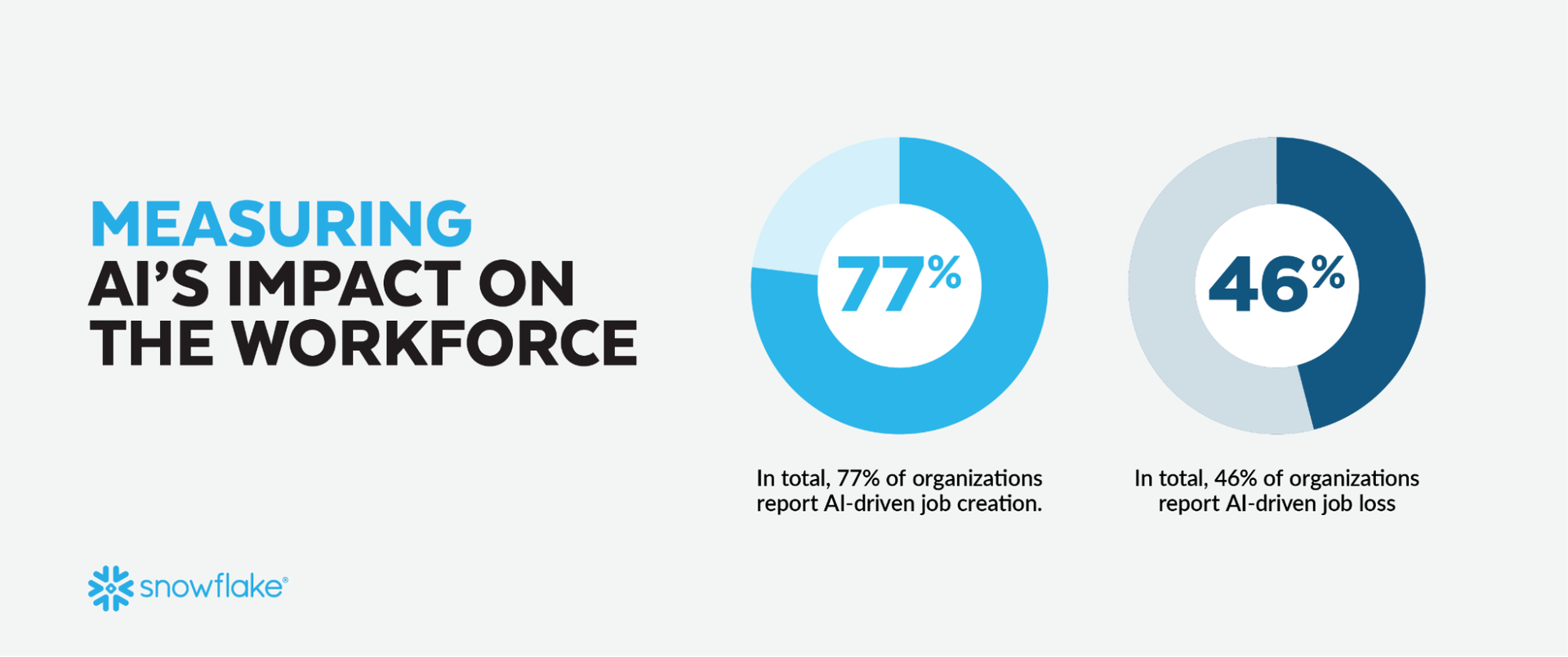
With the advent of AI, there have been growing concerns surrounding loss of jobs hitherto performed by actual human beings. Increased deployment of Agentic AI, AI enabled automation and resource optimization, have often added to burgeoning apprehensions, even as technology industry leaders usually dismiss these fears.
But now, according to a new study, AI adoption might be creating more jobs than those it is rendering redundant. Snowflake, an American cloud-based data platform company in collaboration with Omdia, a research division of Informa TechTarget, surveyed 2,050 business and technology leaders across 10 countries about AI adoption.

Impact of AI on jobs performed by humans
As per their report titled The ROI of Gen AI and Agents, overall, 77 percent of organizations reported increased hiring related to AI initiatives, while 46 percent reported role reductions, suggesting AI is restructuring roles rather than simply replacing workers. It further found that 42 percent of the respondents claimed that AI created jobs, with 11 percent saying it eliminated roles, and 35 percent experienced both hiring and reductions across surveyed organizations. Companies using multiple AI applications reported stronger workforce gains, 75 percent saw a net positive employment impact, compared with 56 percent among early adopters.
“AI’s impact won’t be uniform; some roles will dramatically amplify their influence and productivity, while others risk being left behind. The difference comes down to how effectively it’s used: breaking down problems with first-principles thinking and guiding AI agents like high-performing teams,” said Anahita Tafvizi, Chief Data Analytics Officer, Snowflake. “The strongest ROI isn’t coming from experimentation alone, it’s coming from embedding AI into core operations while strengthening data readiness and governance policies. The future of work will be shaped by companies that pair AI ambition with trusted infrastructure, and the right skills to turn it into lasting impact.”
Job gains: Sectoral trends
Job gains are most visible in technical areas. IT operations reported the largest increase, with 56 percent stating AI created new roles, followed by cybersecurity 46 percent and software development 38 percent.
However, these areas are also seeing reductions as tasks are automated: IT operations reported job losses in 40 percent of organizations, while customer service/support and data analytics each reported 37 percent. The report suggests these changes reflect workforce restructuring as companies automate certain tasks while building new capabilities.
Barriers to scaling AI
Beyond workforce shifts, data readiness remains the main barrier to scaling AI. Organizations reported earning about US$ 1.49 for every dollar invested in AI, yet 96 percent still face significant challenges expanding initiatives.
Nearly 80 percent of respondents cited technical or data-related barriers with 65 percent breaking down data silos is difficult, and 62 percent struggle to measure data quality. Only 7 percent of organizations have half of their unstructured data ready for AI use. Among surveyed countries, India reported the highest readiness at 14 percent, followed by Australia and New Zealand 12 percent, Canada 10 percent, and the United States 8 percent.
Governance concerns are also growing. The report found 57 percent of employees including 66 percent of C-suite executives use AI tools not formally approved by their organizations. Meanwhile, 60 percent of respondents said companies need greater investment in data infrastructure and monitoring. Enforcing data governance was described as “very challenging” by 22 percent of middle managers and individual contributors and 19 percent of senior executives.
“The data shows that AI is delivering tangible returns, but scaling it successfully requires a strong data foundation and governance framework,” said Adam DeMattia, Senior Director of Research at Omdia by Informa TechTarget. “Organizations that can unify their data, improve quality, and operationalize AI responsibly will be best positioned to sustain ROI and workforce gains. With its focus on secure, governed data and AI integration at scale, Snowflake is well positioned to help enterprises move from experimentation to enterprise-wide impact.”
Most early adopters report strong financial results with 92 percent of AI investments already delivering positive ROI, and companies expect to allocate about 22 percent of their technology budgets to AI next year.
AI adoption: Sectoral trends
AI adoption is currently highest in technical teams with IT operations 62 percent, data analytics 59 percent, cybersecurity 53 percent, and software development 50 percent. Other departments such as procurement, sales, and marketing lag behind, with around 30 percent reporting active use.
By industry, advertising and media lead adoption with 42 percent reporting AI systems in production, followed by healthcare and life sciences 34 percent, and manufacturing and technology 32 percent.
The study also shows AI becoming deeply embedded in software development. Respondents reported about 48 percent of code is now generated by AI tools, 82 percent use AI to improve testing and bug detection, and 80 percent report better overall code quality.

Conclusion
Overall, the survey indicates AI is moving from experimentation into core operations, delivering measurable financial returns while reshaping workforces. However, the biggest barriers to scaling AI are data readiness, quality, and governance, rather than the technology itself. Organizations that improve these areas are more likely to expand AI successfully and sustain productivity and employment gains.