
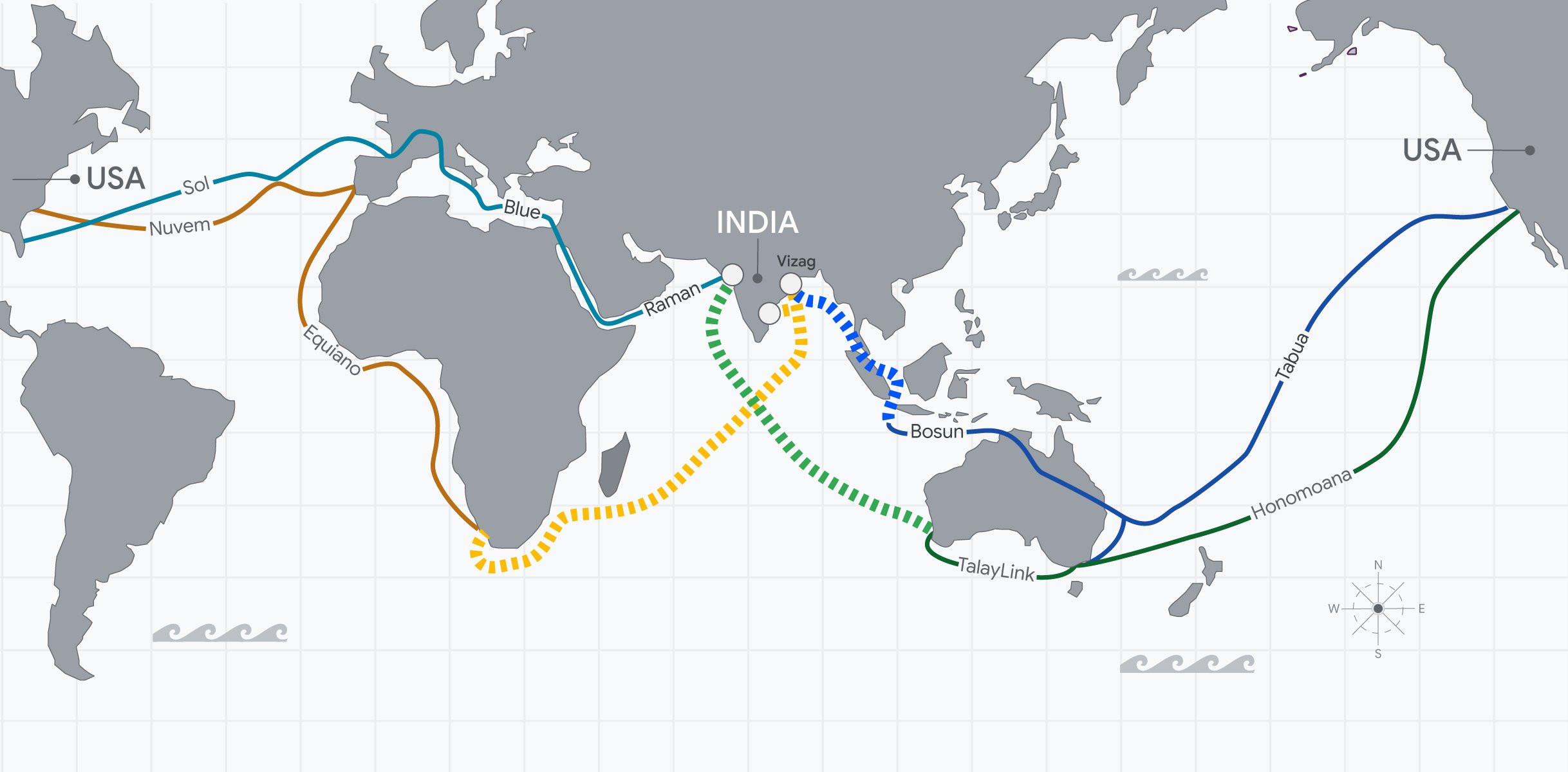
Google has announced America-India Connect, a collaborative infrastructure initiative anchored by its five-year US$ 15 billion AI infrastructure investment in India to increase the reach, reliability, and resilience of digital connectivity across four continents.
In an official blog, Google revealed that America-India Connect, in collaboration with local partners, will establish a new international subsea gateway in Visakhapatnam (Vizag); three new subsea paths connecting India to Singapore, South Africa, and Australia; and four strategic fiber-optic routes that bolster network resilience and capacity between the United States, India, and multiple locations across the Southern Hemisphere.
“We are developing a direct fiber-optic path between Vizag and Chennai on India’s east coast to South Africa. When combined with the Equiano and Nuvem subsea cable systems, this will create a redundant high-capacity route that connects the American east coast around Africa to Vizag,” said Brian Quigley, VP, Global Network Infrastructure, Google Cloud, who authored the blog. “Additionally, we are delivering a direct path between Vizag and Singapore. When combined with the Bosun and Tabua subsea cable systems, this will create a South Pacific route that connects the American west coast through Australia to Vizag.”
These investments aim to establish Vizag as a major international subsea gateway, offering diversity from existing landings in Mumbai and Chennai. Meanwhile, Google also has plans for India’s west coast.
“We are constructing a direct fiber-optic path between Mumbai and Western Australia. In combination with the TalayLink and Honomoana subsea cable systems, this will create a South Pacific route connecting the American west coast around Australia to Mumbai,” said Quigley, “This new path complements the Blue, Raman, and Sol subsea cables, which together form a data corridor from the American east coast through the Red Sea to Mumbai.”

At present, India has 17 subsea cables landing in 14 distinct cable landing stations in five cities: Mumbai, Chennai, Cochin, Tuticorin and Trivandrum. The connectivity ecosystem needs to be augmented significantly if it is to keep up with the slew of digital infrastructure projects announced by global players recently, including Google’s own upcoming data center in Vizag.