
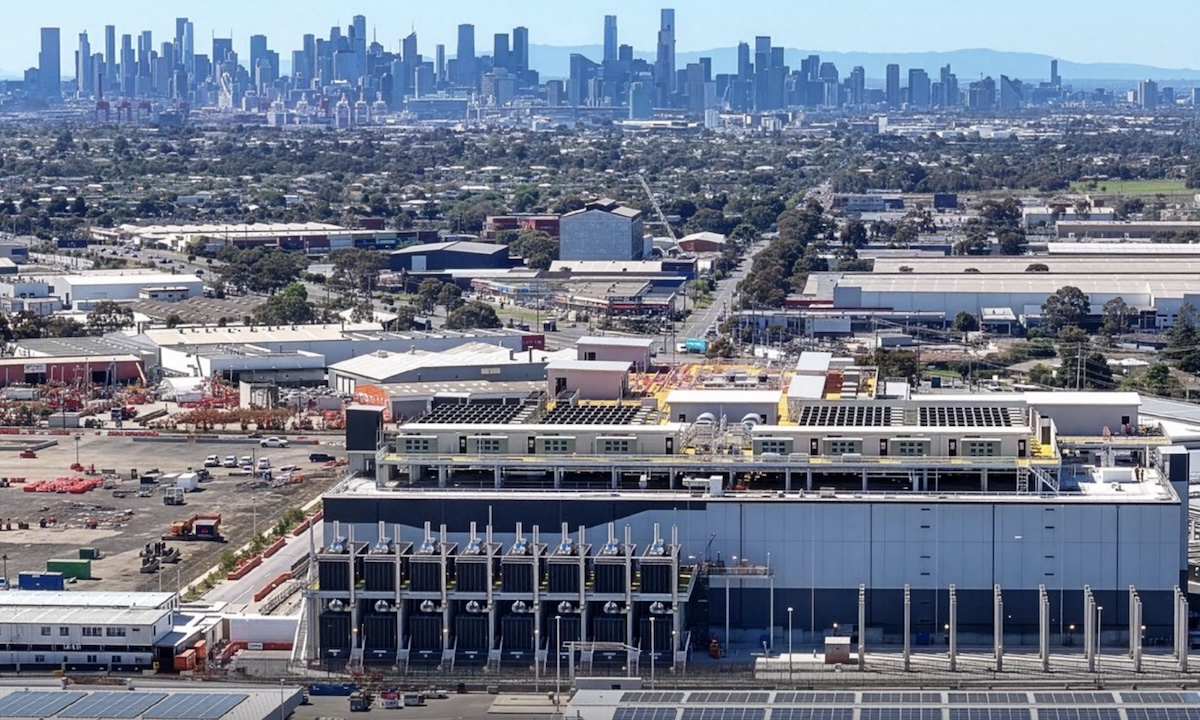
A new academic paper by UTS Transdisciplinary School academic Dr Bronwyn Cumbo argues that participatory design could provide a structured way for local governments and communities to engage with Australia’s rapidly expanding data centre sector, as state governments accelerate support for new developments.
The paper, Opportunities for Participatory Design in Shaping Australia’s Data Centre Futures, examines how decision-making around data centre development has become increasingly concentrated at state and national levels, while the impacts of new facilities are experienced locally. Cumbo describes this as a form of “vertical inequity”, where benefits and strategic direction sit higher up the system, while costs and disruptions are borne by host communities.
Australia’s data centre industry is entering a new phase of growth, driven by cloud and AI demand and reinforced by government strategies positioning the sector as critical infrastructure. New South Wales and Victoria have both moved to streamline planning and investment processes, while parliamentary scrutiny in NSW has highlighted growing concern around energy, water, and land use.
Against this backdrop, Cumbo’s research explores how participatory design (PD) – a methodology traditionally used in urban planning, technology design, and public services – could be adapted to data centre development. Rather than opposing growth, the paper positions PD as a way to broaden how data centre futures are imagined, so they incorporate local priorities alongside government and industry objectives.
While participatory design is sometimes conflated with co-design, Cumbo’s paper distinguishes PD as a broader and more sustained approach to engagement. Co-design processes are already used in large Australian infrastructure projects such as Sydney Metro and WestConnex, typically to inform specific design elements once strategic decisions have largely been made.
Participatory design, by contrast, focuses on earlier and ongoing involvement, creating space for communities and local governments to engage with underlying assumptions, trade-offs, and long-term futures. Rather than seeking consensus on predefined outcomes, PD emphasises mutual learning, transparency, and the inclusion of lived experience in shaping how infrastructure is imagined, governed, and delivered over time.
Four visions
The study identifies four dominant visions shaping Australia’s data centre expansion: the ambition to become a sustainable regional hub, the pursuit of resilient and sovereign digital infrastructure, economic expansion, and a perceived race to capitalise on time-limited investment opportunities.
Cumbo argues that while these visions appear “clean” and straightforward at a strategic level, they often fail to reflect the more complex realities experienced by communities living near data centre clusters.
Drawing on interviews conducted in Sydney, the paper notes that local councils and residents frequently encounter developments late in the planning process, with limited scope to influence outcomes. Issues such as water use, noise, light pollution, land competition, and unclear local economic benefits feature prominently, while consultation processes are often perceived as informational rather than collaborative.
Participatory design, Cumbo suggests, could help address these gaps by creating structured forums for mutual learning between industry, government, and communities. The paper outlines three potential areas where PD could be applied: building “critical data centre literacy” so communities can better understand and assess sustainability claims; improving transparency around environmental and resource governance; and expanding future-planning processes to include community aspirations such as housing affordability, local amenity, and environmental protection.
Not a substitute for development
Importantly, the research does not frame PD as a substitute for existing planning systems, nor as a mechanism to veto development. Instead, it is presented as a way to support better alignment between national digital infrastructure strategies and local lived experience, reducing the risk of mistrust, project delays, or community opposition as the sector scales.
Cumbo describes the work as contributing to government strategy by exploring how communities living alongside data centre clusters can be included and benefit from growth, an area she says is currently unclear. She points out that the project is intended to support public policy by taking a deeper look at how communities living alongside data centre clusters can be included and benefit from growth, particularly where current pathways remain unclear.
The paper forms the basis for further applied research through an Australian Public Policy Institute-funded project focused on co-designing a roadmap to establish NSW as a sustainable data centre hub. While centred on NSW, Cumbo says the findings are likely to be relevant for other Australian regions experiencing rapid data centre expansion.
As data centres become increasingly embedded in urban and regional landscapes, the paper suggests that approaches such as participatory design may play a growing role in bridging the gap between strategic ambition and local impact.