

Following the much-publicised protest last Saturday by a group of 50 residents demanding an end to dust pollution allegedly caused by the construction of a data center near their homes in Johor, the incident had brought up more questions than answers.
The 50-strong delegation claim to represent 1,000 residents from across four housing estates in the Gelang Patah district. Health issues were among some of the complaints that the residents attributed to the construction.

Question: One thousand residents from four housing estates – that’s a lot of dust chalked up to affect that many people. Breathing issues would surface. Properties being caked in dust would be normal. Did the residents complain to the developer and/or local authorities prior to the protest? Perhaps, and because nothing came out of it, the residents very likely decided to band together and launch a protest hoping to pressure the powers that be.
Question: Why was there inertia by the local authorities? Deafening silence from the developer/contractor is expected but from the local authority?
Question: Is there a law that prescribes a minimum distance between a data center construction site and a housing area (or the nearest house)? Apparently, there is, or rather, there are such laws; just that they are not codified into a single piece of legislation. You just need to piece them together to get the answer.
According to the news report, the construction site was located less than a kilometre from the nearest home. In contrast, other data centers in Johor are located in dedicated industrial parks or former plantation lands which are far from residential areas.
Piecing together the possible regulations that might cover the issues involved in the protest:
- Environmental Quality Act 1974 (Act 127):
Data center construction is currently not a prescribed activity requiring an Environmental Impact Assessment (EIA) under the current environment laws but can still be made mandatory if the situation requires it, for example, risky surroundings such as landslide-prone areas, or large amounts of waste.
On the other hand, based on MIDA’s statement on its website quoting an article in The Star newspaper, Malaysia does require EIA for large-scale data centres.
Major construction projects such as townships, or other large-scale developments which include hyperscale data centers must submit an EIA report to the Department of Environment (DOE).
The DOE will determine the acceptable distance between the data center and the housing area based on the risk, such as dust, noise, and vibration impacts (‘site suitability evaluations’).
2. Town and Country Planning Act 1976 (Act 172), Planning Permission under Section 19: No construction can commence without planning permission from the Local Authority. When considering approval of planning permission, the local authority can set specific conditions regarding the layout, which include mandatory buffer zones between the data center and existing houses.
3. Local Authority bylaw and conditions: Local councils usually impose strict rules on working hours and noise, forcing contractors to maintain a working distance or provide noise barriers (e.g. zinc perimeter fencing). Local authorities can also require a road buffer zone ranging from a few metres up to 30 metres or more, depending on the scale of the project.
Other laws that could be applied include requiring the data center developer to describe its proposed monitoring program for ambient air quality, as well as stipulating the acceptable dustfall, a tool to assess air quality or evaluate the effectiveness of dust control measures.
The latest Johor State Data Centre Development Planning Guidelines which was published in April 2024 (yes, time for an update) stipulates a buffer zone of 50 meters between the data center building line and the housing lot boundary for both commercial and industrial zones (see diagram).
“A minimum 50-meter buffer zone shall be maintained from the building line of the data center, including all related support structures such as chillers, generators, to ensure a safe and compliant distance from the residential lot boundary. The specific buffer zone requirements may vary depending on the local regulations, zoning ordinances, and surrounding development conditions. The design of a buffer zone can incorporate various factors, including the width of the road, the displacement of adjacent buildings, perimeter planting, parking spaces, and other relevant features, as deemed necessary by the local authorities.”
Illustration of Data Centre Development Buffer Zone in a Commercial Zone
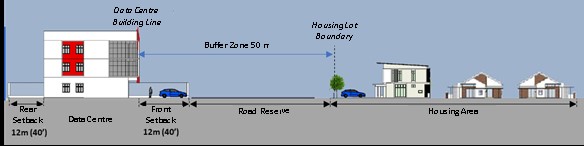
Source: Johor State Data Centre Development Planning Guidelines Study
The guidelines further stipulate the following:
“3.5 Permitted Planning Zones
Data center development is typically restricted to industrial or commercial planning zones as designated by the local plan, to ensure the development aligns with the local character, zoning regulations, and community needs, thereby mitigating potential negative impacts and fostering a harmonious relationship between the data center and its surrounding. As such, technical conditions such as buffer zones may be mandated beyond the requirements outlined in specific guidelines.”

Verdict
Based on the above, it appears that the Johor local authorities have full discretion to stipulate conditions before approving a data center application. Presumably, this discretion extends to all stages of the construction and operation of a data center post-approval. Hence, if there are issues, then we have to turn to the local authorities’ wisdom in solving it.
In other words, if any party could resolve this matter decisively, it would be the local authorities which are vested with full powers to deal with whatever challenges posed by data centers.