
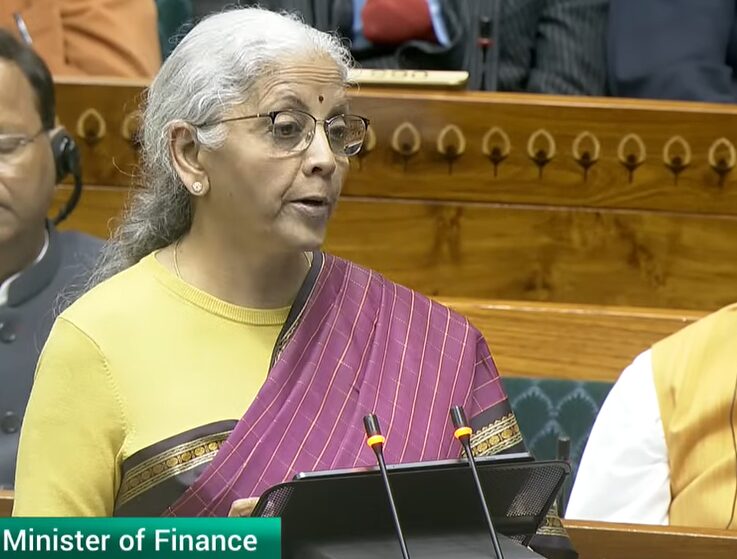
India’s Finance Minister Nirmala Sitharaman made a surprising announcement while delivering the nation’s budget on Sunday, offering foreign cloud service providers a tax holiday till 2047 if they use data centers in India to offer services globally. This is subject to these foreign companies also providing services to Indian customers through an Indian reseller. The move aims to attract foreign investment, as well as enable growth of Indian data centers.
“Recognizing the need to enable critical infrastructure, and boost investment in data centers, I propose to provide tax holiday till 2047 to any foreign company that provides cloud services to customers globally by using data center services from India,” said Minister Sitharaman. “It will, however, need to provide services to Indian customers through an Indian reseller entity.” Further sweetening the deal, the Minister said, “I also propose to provide a safe harbor of 15 percent on cost in case the company providing data center services from India is a related entity.”
This announcement has been received enthusiastically by industry players from both global digital infrastructure giants and homegrown heavyweights.

Manoj Paul, Managing Director, Equinix, India, views the initiative as a positive move that will “enhance long-term predictability and investment certainty for capital-intensive digital infrastructure.” Paul told w.media, “The Union Budget 2026 is being viewed as a significant move towards making India a strong player in the international digital and AI-based economy, as countries are actively competing to attract large-scale technology investments.”
He further said, “Such measures will further reinforce the increasing recognition of data centers as a critical enabler of cloud adoption, AI workloads, and global interconnectivity, and will also help to support India’s vision to become a preferred destination for serving international markets.”
Sunil Gupta, Co-founder, CEO & Managing Director, Yotta Data Services, concurred, saying, “The Union Budget 2026 marks a decisive and well-thought-out shift in how India approaches cloud and data centers, recognizing them as long-term strategic infrastructure that underpins AI adoption, digital public services, and economic growth. The announcement of a tax holiday till 2047 for global cloud operators setting up data-center infrastructure in India is a strong signal aimed at accelerating capital inflow, early capacity creation, and faster enterprise cloud adoption at scale.”
Gupta also hailed the decision to include homegrown data centers more meaningfully in this digital transformation journey. “The introduction of a clear safe harbor provision including a defined 15 percent tax on cost for cloud and data-center services delivered through Indian operating entities addresses a different but equally important objective: long-term certainty and scalability,” he said. “In practice, while the tax holiday helps global players enter India quickly, large-scale and mission-critical operations naturally gravitate towards Indian entities because predictability in taxation, compliance, and regulatory alignment matters far more than headline tax rates as businesses scale.”
He explained, “As cloud and AI workloads move from experimentation to regulated and business-critical deployment, global cloud providers are therefore unlikely to own and operate all physical infrastructure themselves. Instead, they will increasingly adopt asset-light models outsourcing both colocation and high-performance GPU infrastructure to trusted Indian partners while focusing on platforms, software, and customer engagement. This allows them to scale rapidly, manage capital and technology risk, and operate within a stable and transparent tax framework under the safe harbor regime.”
Paul also sees the provisions for Indian data center companies as a positive step. “The emphasis on routing domestic services through local businesses is expected to increase value creation and ecosystem participation within India.” But he cautions that advancements in important enablers like more affordable and dependable power, faster fiber deployment, and stronger alignment with sustainability objectives will also be necessary for the long-term development of AI-ready digital infrastructure.
“To fully realize the potential of these Budget announcements, continued policy support for renewable energy integration, grid stability, and network expansion will be required. India’s digital infrastructure ecosystem is well positioned to support long-term value creation, global interconnectivity, and a stable AI-powered future through supportive policies and an encouraging investment climate,” said Paul.

A recent report by PwC estimates that the total data center capacity across India could go up to 14 GW by 2035, based on investment commitments made by big-ticket global and domestic players, as well as a favorable regulatory environment. It also estimates investments worth US$ 70 billion dollars into the industry during this period.
Crisil Ratings expects the revenue of India’s data center operators to reach around Rs 20,000 crore annually by fiscal 2028. This translates to an annual growth of 20-22 percent. However, when it comes to IT load capacity, its projections are more modest. Crisil finds that to cater to the buoyant demand, capacity in the industry is expected to double to 2.3-2.5 GW by March 2028.
Readers would recall that in October 2025, Google announced its largest investment in India to date, totaling approximately US$ 15 billion over the next five years (2026-2030). This capital will establish Google’s first Artificial Intelligence (AI) hub in the country, located in Visakhapatnam (Vizag), Andhra Pradesh.
Meanwhile, in December 2025, Amazon announced plans to invest more than US$ 35 billion across all its businesses in India through 2030, building on nearly US$ 40 billion invested in the country so far. This investment will focus on business expansion as well as three strategic pillars: AI-driven digitization, export growth, and job creation.